Text-to-speech pronunciation
Hear any word in the target language read aloud. Supports a wide range of languages. Plays automatically when a card is flipped — no extra steps.
Learn 50 words. Forget 40. Feel frustrated. That cycle isn't a personal failure — it's what happens when you study without a system designed for how memory actually works.

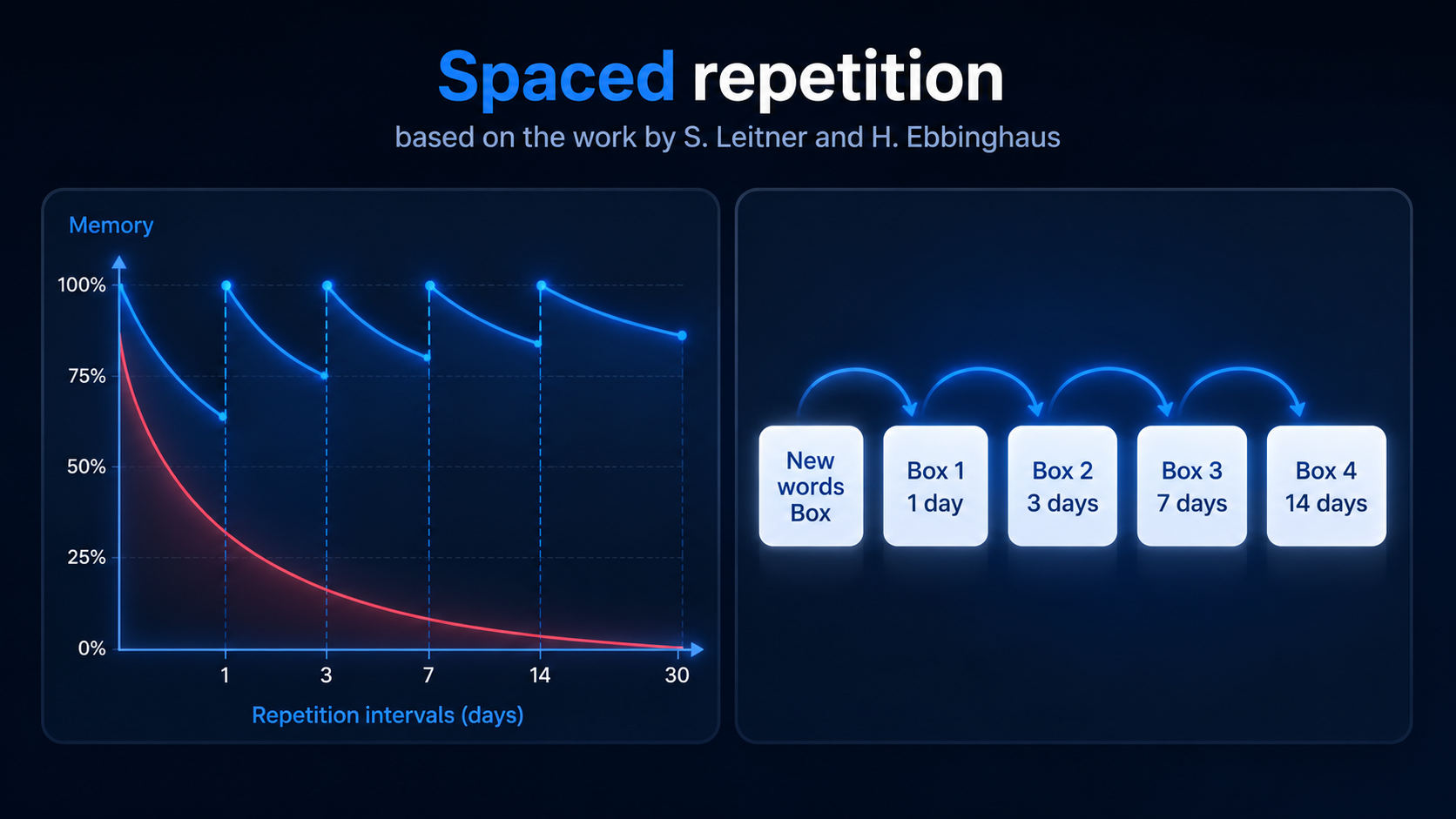
Within 24 hours of learning something new, most people forget up to 70% of it. Within a week, even more is gone — unless there's been active review in between.
The solution isn't reviewing everything every day — that's unsustainable. The solution is reviewing each word exactly when it's about to be forgotten. That's what spaced repetition does. Each successful recall at the right moment pushes the forgetting curve back further, requiring less and less frequent review over time.
A word you've reviewed 4 times with spaced repetition will stay in memory far longer than a word you read 20 times in a single session.
Reading a word in context helps you understand it. But seeing it once or twice doesn't build reliable recall. You need repeated, active retrieval across spaced intervals.
A vocabulary notebook or phone note is great for adding words. It's terrible for reviewing them. You end up reviewing the same page of early words and ignoring everything added later.
Seeing a word is different from knowing how it sounds. Many learners internalize a wrong pronunciation and only discover the mistake months later — when it's already been hardwired.
Travel vocabulary, business vocabulary, and grammar exceptions are completely different. Mixing them in one list creates noise and slows down focused review.
Front: the target language word + audio. Back: translation + example sentence + usage note. All of this fits in one Repetit card.
A new word starts at day 1. Recall it correctly and it comes back in 3 days, then 7, then 14, then 30. Forget it — and it resets. Words you know well stop appearing every day. Words you're struggling with come back sooner.
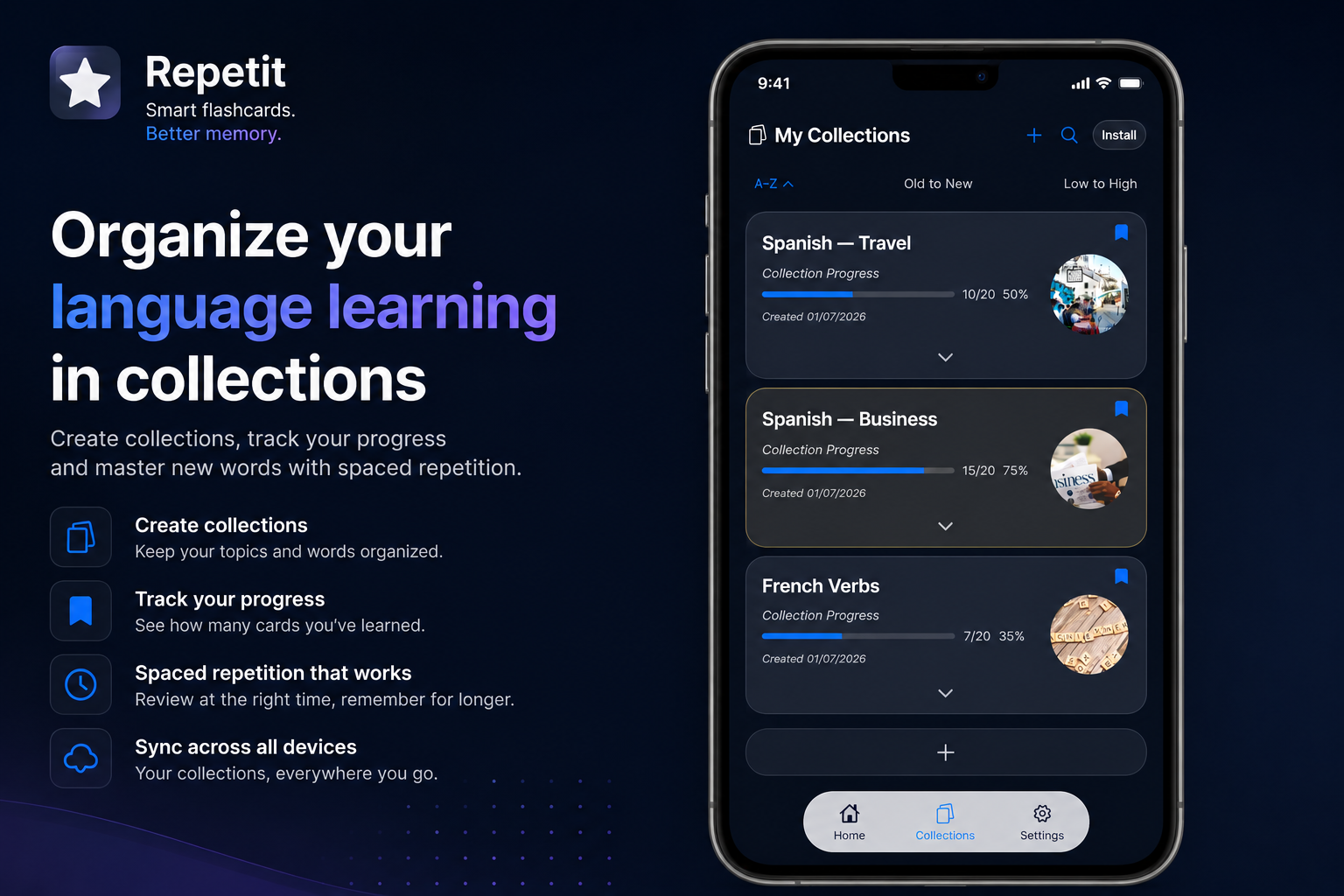
Instead of one giant "Spanish" deck, create separate collections: Travel, Business, Verbs B2, Idioms. Focused review is faster and more satisfying.
Have a spreadsheet or vocabulary export from a textbook? Use CSV or XLSX import to load hundreds of words instantly. Format: first column = front, second column = back.
Hear every word pronounced correctly from the moment you add it. This is especially important for tonal languages (Mandarin, Vietnamese) and languages with non-phonetic spelling (French, English).
A photo of an apple is faster to process than the word "manzana → apple." Visual associations bypass translation and build more direct word-concept links.
Consistency beats intensity. 10 minutes every day produces far better results than an hour twice a week. The SRS system only works if you show up regularly.
Adding 50 new words at once floods your review queue. Add 5–10 per day — this keeps daily sessions manageable while building vocabulary steadily over weeks.
Hear any word in the target language read aloud. Supports a wide range of languages. Plays automatically when a card is flipped — no extra steps.
Record yourself pronouncing a word and play it back. Compare with the TTS version. Useful for shadowing practice and fixing pronunciation habits early.
Add a photo to any card to build a direct visual memory link. For vocabulary, this often beats translation as a recall cue — especially for concrete nouns.
Tag cards by grammar category, difficulty, or topic. Filter your review session to only verbs, or only cards tagged "B2" — focus where you need it most.
Import vocabulary exports from textbooks, Anki, or any spreadsheet. Thousands of words can be added in seconds — with front and back text already mapped.
Review on a plane, during a commute, or anywhere without Wi-Fi. All cards and audio are stored locally on your device — no connection required.
Adding 10 new words per day and reviewing consistently: ~300 words per month, ~3,600 per year.
For context: conversational fluency in most languages requires 2,000–3,000 high-frequency words. At this pace, you'd cover that in under a year — with 10–15 minutes of daily practice.
The key is not adding more words — it's reviewing consistently. Words added but not reviewed are wasted effort. Repetit's daily review queue handles this automatically: it shows only what you're about to forget, so nothing slips through.
Most learners comfortably retain 10–20 new words per day. The bottleneck isn't the system — it's adding cards and reviewing consistently. Add more if you have time, but don't sacrifice review quality for quantity.
Both work, but phrases tend to be more useful for speaking. Use isolated words to build base vocabulary, then add example sentences (on the back of the card) to show the word in context. Many learners find that learning a word in a memorable sentence makes it stick faster.
Yes. Repetit supports any language on both sides of a card. Text-to-speech covers a wide range of languages including Spanish, French, German, Japanese, Chinese, Korean, Arabic, and more.
Both directions are useful, and some learners create two cards per word. Native → target language tests production (harder). Target → native tests recognition (easier). Experienced learners often move to target → target (a definition or synonym in the target language), which builds deeper understanding.
Yes. Passive vocabulary (words you recognize) builds faster with flashcards. Active vocabulary (words you can produce) requires more repetition plus actual speaking practice. Flashcards primarily train recognition — to activate a word fully, also use it in sentences and conversation.
Mornings tend to work well for fresh encoding; evenings are good for review before sleep (sleep consolidates memory). Most importantly: pick a consistent time and treat it as non-negotiable. Consistency matters more than timing.