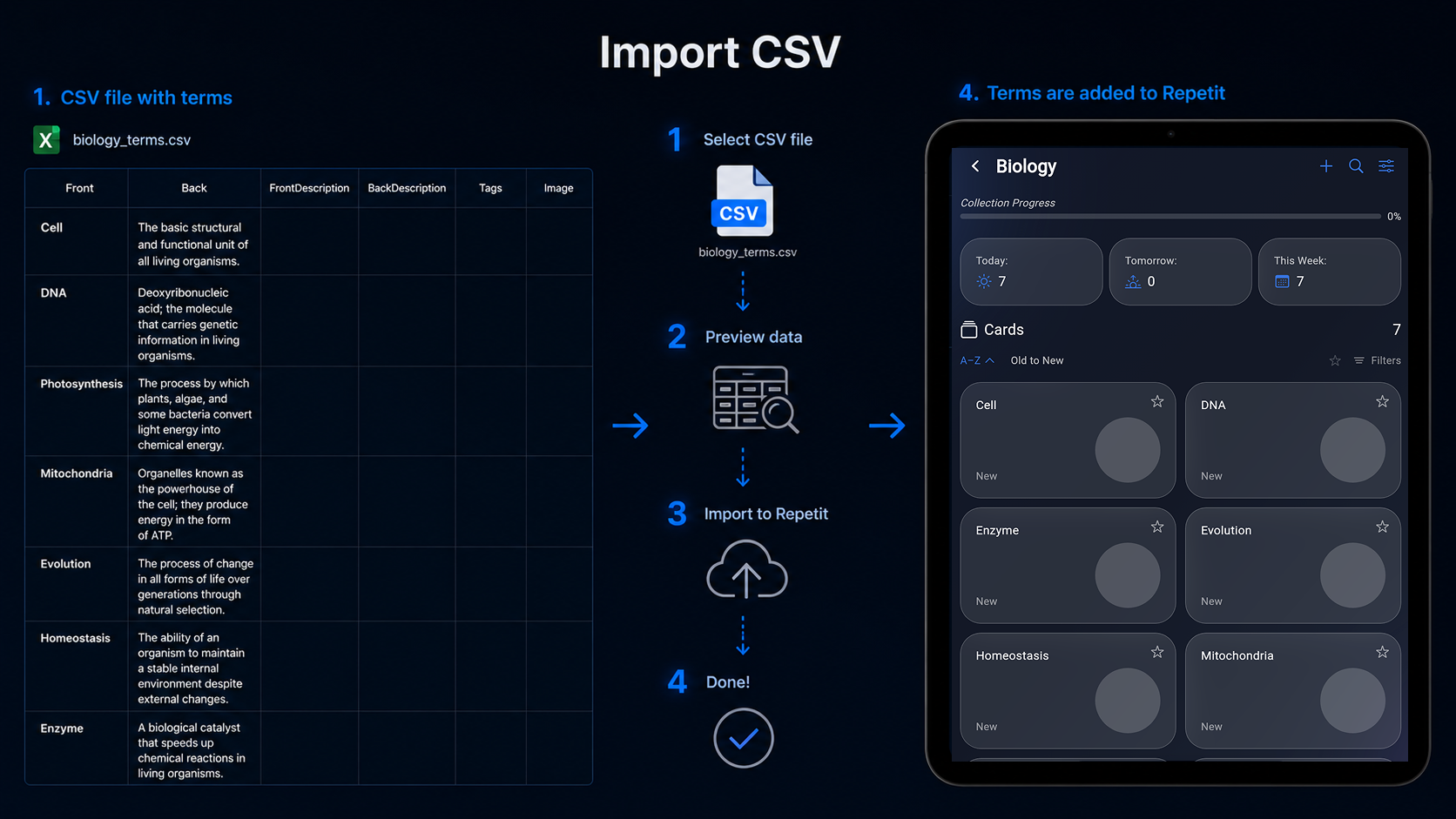
CSV & XLSX import
Already have notes in a spreadsheet? Import them directly. Turn 200 terms into a full review deck without typing a single card by hand.
You read the chapter three times, highlighted half the page, and still blanked on the exam. The problem isn't effort — it's method. Here's what actually works, and how to set it up in minutes.
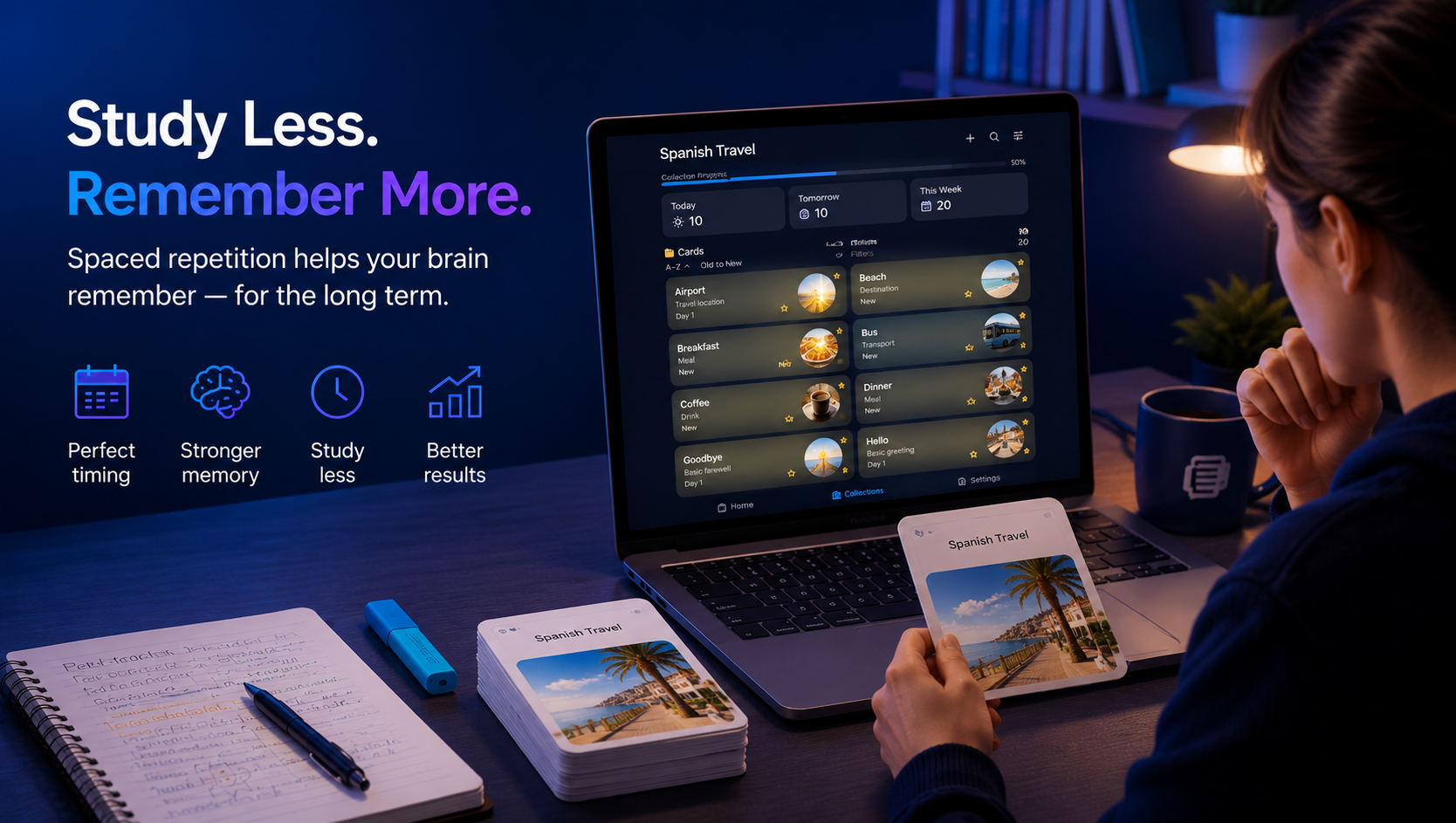
Information learned in one long session is mostly gone within 48 hours. You pass the test, but the knowledge doesn't stick.
Familiarity with text is not the same as recall. Reading something again gives you the illusion of knowing it.
Without a system, you study based on feeling — and feelings are wrong. You over-review easy material and under-review what you're actually weak on.
The closer the exam, the more overwhelming the pile. Most students don't have time to review everything — and they don't need to if they start earlier with the right system.
Every time you recall a piece of information, you strengthen the memory trace in your brain. The key word is recall — not re-reading, not highlighting. Active retrieval.
Spaced repetition builds on this by timing each review just before you'd naturally forget. That moment of effortful retrieval — slightly hard, but doable — is when the memory deepens most. Review too soon and there's nothing to strengthen. Wait too long and you've already forgotten.
The result: the same material takes far fewer total reviews to stick long-term. Research consistently shows that students using spaced repetition outperform those who cram — not just on exams, but weeks later.
Days between reviews: 1 → 3 → 7 → 14 → 30. Nail a card and the interval grows. Forget it and it resets. This keeps the review load minimal while building genuinely durable memory.
One collection for Anatomy, one for History, one for your upcoming certification. Each collection tracks its own progress independently.
Type cards manually, or use CSV/XLSX import to turn a spreadsheet of terms into a full deck instantly. If you already have notes, this takes under a minute.
Repetit tells you exactly what to review each day. Don't skip days before the exam — the earlier you start, the lighter the daily load.
For concepts that don't stick — add a diagram, a mnemonic image, or a voice note. Multiple formats reinforce the same memory from different angles.
The progress screen shows which cards are learned, which need attention, and what's due this week — so you always know exactly where you stand.
Already have notes in a spreadsheet? Import them directly. Turn 200 terms into a full review deck without typing a single card by hand.
Keep subjects separate. Each collection has its own progress, schedule, and card list — no cross-contamination between chemistry and history.
Add diagrams, charts, anatomical drawings, or handwritten formulas directly to cards. Visual memory is often stronger than text alone.
Hear pronunciations, listen to terms, or record your own mnemonics. Especially useful for medical vocabulary, foreign terms, and anything phonetically tricky.
Review on the bus, in a waiting room, between lectures — without needing Wi-Fi. All your cards and progress are stored locally.
See exactly how many cards are learned, how many are due, and how your retention rate changes over time. No more guessing how prepared you are.
Ideal: 3–4 weeks before the exam. At that point, each card only needs to be reviewed 3–4 times total before the exam date. The daily workload stays under 20 minutes.
Starting 1 week out: Still worth it. You won't complete the full cycle for every card, but even 2–3 reviews with active recall beats reading your notes once. Focus on high-priority material first.
After the exam: Keep the collection. You've already built the deck. Set it aside for a month and then review once — you'll be surprised how much held. This is how students build lasting knowledge, not just pass tests.
Yes. Dozens of peer-reviewed studies confirm that spaced repetition produces significantly better long-term retention than massed practice (cramming). Students who use it consistently recall more on exams and retain the information weeks after.
Most students spend 10–20 minutes on daily reviews. Because the system only shows what you're about to forget, you don't re-review things you already know — making every minute count.
Yes. Repetit supports CSV and XLSX import, so you can turn a spreadsheet of terms and definitions into a full deck in seconds. No need to create cards one by one.
Repetit has a free plan with up to 20 cards and the full spaced repetition cycle — good for trying it out. The Plus plan at $2.99/month unlocks unlimited cards, CSV/XLSX import, audio, and daily reminders.
Any subject with discrete facts works extremely well: vocabulary, medical terms, historical dates, legal definitions, formulas, anatomy, foreign languages, chemistry symbols, coding syntax. Subjects that require long-form reasoning (essays, case analysis) benefit less from flashcards alone, but you can use them to memorize the key concepts and frameworks.
Catch up as soon as you can. Repetit stacks the due reviews, so after a missed day you'll see a slightly larger review session. Don't try to create two sessions back-to-back — just do what the app shows for that day and continue normally.