
Just starting out
5 to 10 minutes a day. The entire point of week one and two is proving to yourself that the habit can happen daily — the amount of material covered matters far less than the streak of showing up.
Day one: pure motivation. Day three: it already feels like a chore. Day seven: you've quietly stopped. It's not a willpower problem — it's a habit built at the wrong size. Here's how to build one that survives past week one.
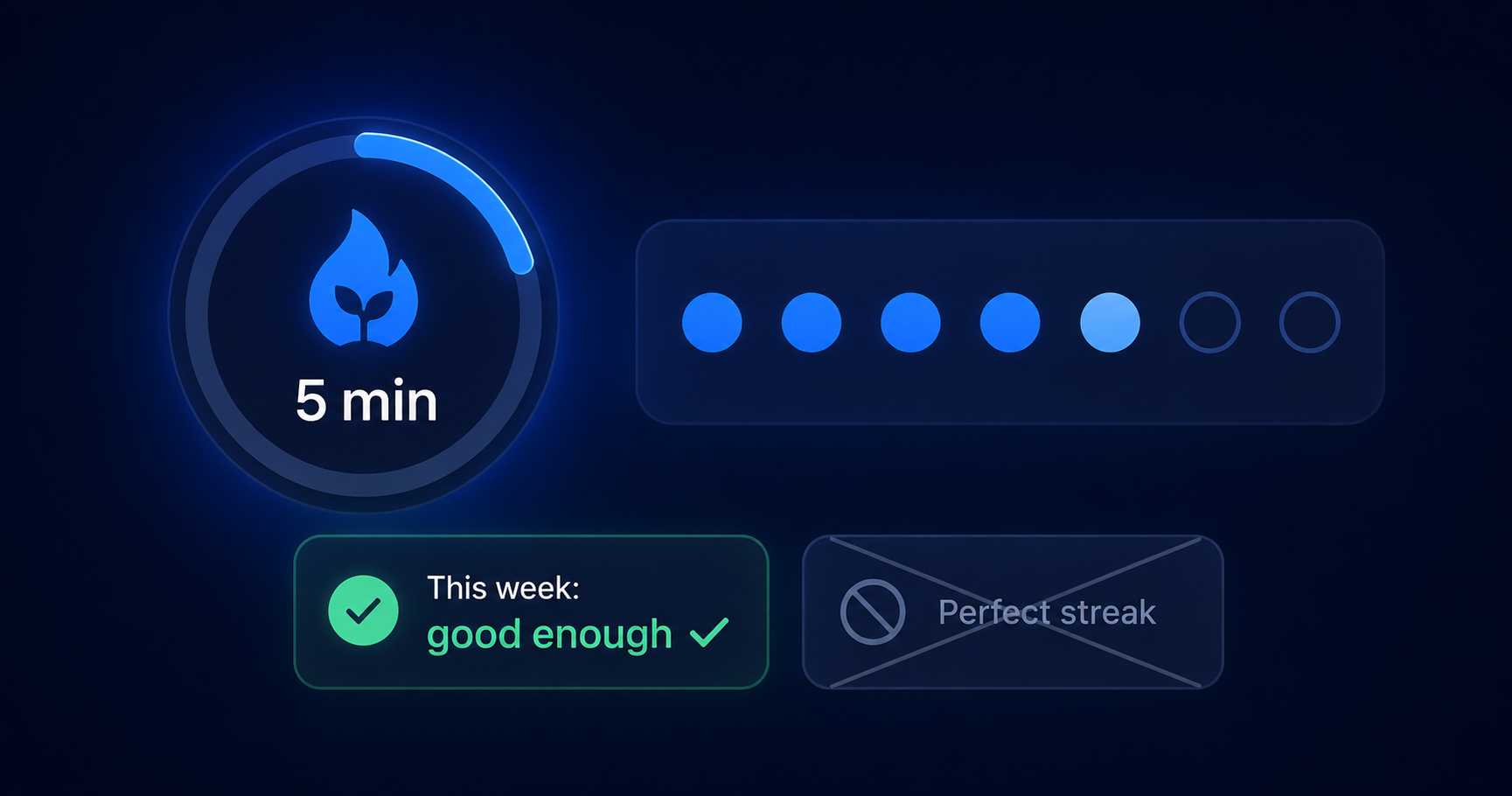
/assets/img/blog/ once generated.Most people who decide to learn something new are still going strong on day one. By day three, the initial spark has faded into effort. By day seven, a huge share have already quietly stopped — not because the goal stopped mattering, but because the routine they built could only run on motivation, and motivation is the least reliable fuel there is.
This isn't a discipline problem. It's a design problem. A habit that requires an hour, a perfect mood, and zero interruptions will collapse the first time real life shows up — and real life always shows up before week two.
The fix is to make the habit small enough to survive a bad day, soft enough to forgive a missed one, and visible enough that you can see it working before the payoff of "actually knowing the thing" arrives. That's what the rest of this guide walks through.
"An hour a day" sounds ambitious on day one and impossible on day five. A goal you can't hit consistently doesn't get adjusted — it gets abandoned, because missing it feels like proof the whole plan failed.
Motivation is what gets you to start. It was never built to carry a routine for months — it naturally fades within days, and a habit that depends on it has no backup plan for the days it doesn't show up.
Without a soft landing, skipping a single day feels like breaking something. The instinct is to wait for a "clean start" on Monday, and that wait quietly stretches into never coming back.
Real results — fluency, recall, a new skill — take weeks to show up. Without something smaller to see day to day, there's nothing to confirm the effort is paying off, so it's easy to conclude nothing is happening at all.
A behavior becomes automatic through the number of times it's repeated in a stable context, not through how hard or long any single session was. Five minutes every day builds a stronger habit loop than one heroic hour once a week.
Completing a small, clearly defined task triggers a real sense of progress and reward, almost regardless of its size. A tiny finished session counts, neurologically, as a genuine win — which is exactly why it's worth protecting on hard days instead of skipping.
People tend to assume motivation creates consistency, but it usually runs the other way: seeing evidence that a habit is working — a tracker, a streak, a chart — is what keeps motivation alive long enough for the habit to become automatic.
Put together, these three mechanisms point in the same direction: shrink the habit until it's repeatable every day, treat every completed session — however small — as a real win, and make that win visible immediately. None of this requires more willpower than you already have; it just stops asking willpower to do a job it was never suited for.
Notice the sticking column isn't "less ambitious." It usually covers more material over a full year, precisely because it never stops — a small daily habit compounds in a way a big habit that quits in week two simply can't.
Define the smallest version of the habit you'd still call a real win — 5 flashcards, 5 minutes, one short lesson. This isn't your target for a good day; it's your floor for a bad one, and it's the version that actually determines whether the habit survives.
Replace "30 minutes every day, no exceptions" with a range like "5 to 30 minutes." A soft goal is still met on your busiest day, which means you never face the all-or-nothing choice that causes most people to skip entirely.
Tie the session to an existing routine — right after coffee, right before you close your laptop, right after you sit down on the train. Borrowing an existing cue removes the need to remember or feel motivated to start.
Log whether you showed up, not how well the session went. A simple mark for "done" every day gives you visible proof the habit is real, long before the underlying skill has had time to show any results of its own.
If you miss a day, resume at the minimum version the next day — don't try to make it up. A missed day only becomes a dropped habit if you decide it has to; otherwise it's just one data point in a much longer routine.
Minutes in the floor: 1 → 3 → 1 → done. One minute to open the app and see what's due, three minutes of actual review, one minute to log the session as complete. Under 5 minutes, and the streak — soft goal and all — stays alive.
5 to 10 minutes a day. The entire point of week one and two is proving to yourself that the habit can happen daily — the amount of material covered matters far less than the streak of showing up.
10 to 25 minutes a day, once the habit feels automatic rather than effortful. This is usually a few weeks in, and it's fine to let good days run longer without ever raising the floor.
20 to 40 minutes a day, temporarily, in the weeks before an exam or deadline. Treat this as a short-term stretch of the range, then let it settle back down once the pressure passes.
Notice the floor never changes — only the ceiling does. That floor is what a soft goal actually protects, and it's worth reviewing your own numbers with the same logic used in our guide on how many flashcards to study per day.
A simple done/not-done mark matters more than any score. Showing up is the whole habit — everything else is a bonus on top of it.
A single streak count can be wiped out by one missed day. A 7-day rolling view — say 6 out of 7 — survives a miss without erasing the weeks of progress that came before it.
A short, specific list of what's due removes the guesswork that turns "I should study" into "I'll do it later." A tracker that tells you exactly what's owed today is one less decision standing between you and starting.
A tracker that celebrates hitting the floor — not just big numbers — reinforces the behavior you actually need on your worst days, instead of quietly implying that a small session doesn't really count.
Zooming out to a monthly view shows the habit is real even on weeks with a few gaps. It's the trend line, not any single day, that tells you whether the habit is actually sticking.
"An hour a day" is a great goal for month three, not day one. Starting too big means the habit fails the exact test — a busy day — that matters most for it to survive.
The first missed day rarely ends a habit on its own — the decision to wait for a "fresh start" afterward is what does. Resuming immediately, at the smallest version of the habit, is what actually protects it.
Motivation shows up more reliably after a session starts than before it. Waiting for the right mood before opening the app hands the decision to a feeling that isn't obligated to cooperate.
Other people's visible pace tells you nothing about their actual starting point or how many quiet restarts got them there. Your only real comparison is your own habit last week.
Cramming a week's worth of missed sessions into one long make-up marathon trades a manageable habit for an exhausting one, and it often triggers the exact burnout that causes the second, more permanent quit.
Without any visible record, there's no evidence the habit is real until the underlying skill shows results — which takes far longer than a week. By the time proof would have arrived, most people have already quit.
None of these mistakes look dangerous in the moment — that's exactly why they're so common. The fix for all six is the same: build the habit small enough, soft enough, and visible enough that it doesn't need a good week to survive a bad day.
The people who are still learning six months from now aren't the ones who felt the most motivated on day one — they're the ones whose habit was small enough to survive the days motivation didn't show up. A 5-minute floor, a soft weekly goal, and a simple tracker do more for your odds of sticking with it than any amount of initial enthusiasm.
If you've already missed a few days, that's not a verdict on whether this will work for you — it's just data. Restart at the minimum version tomorrow, and let the tracker show you the habit rebuilding itself, one small session at a time.
Start small: pick your 5-minute floor, your soft weekly range, and one cue to attach the habit to. Everything else in this guide is just protecting that one decision from the days it's hardest to keep.
The first week runs on the motivation of starting something new, and that motivation fades on a predictable schedule. Once it drops, whatever's left is the routine you actually built — and for most people that routine was too big, too vague, or too dependent on feeling inspired every single day.
A minimum viable habit is the smallest version of a routine you'd still call a genuine win — small enough to finish on your worst day, like reviewing 5 flashcards or studying for 5 minutes. It exists to protect the streak, not to represent your real effort; most days you'll do more, but the floor never disappears.
Soft goals work because they remove the all-or-nothing trap that kills most habits. A goal like "5 to 20 minutes" is still met on a busy day, so you never face the choice between a hard fail and skipping entirely. Consistency, not intensity, is what carries a habit past the first month.
A useful tracker shows that you showed up, not how much you did — daily completion, a rolling weekly view instead of a single fragile streak number, and what's actually due today. Tools that only reward big numbers push you toward the marathon sessions that cause burnout and quitting.
Missing days is normal and doesn't erase your progress — what matters is the next session, not a perfect record. Restart at the minimum viable version of the habit rather than trying to make up for lost time, since overcorrecting is what usually causes the second, more permanent quit.
Research on habit formation suggests it typically takes anywhere from a few weeks to a couple of months of repetition before a routine starts feeling automatic rather than effortful, and the range depends heavily on how small and consistent the habit is. Small daily habits reach that point faster than big, irregular ones.