
The Ebbinghaus Forgetting Curve: Why You Forget Everything — and How to Stop
In 1885, a German psychologist memorized thousands of nonsense syllables and tracked exactly how fast he forgot them. What he discovered explains why every study session you've ever had eventually failed — and points to the only method that actually works.
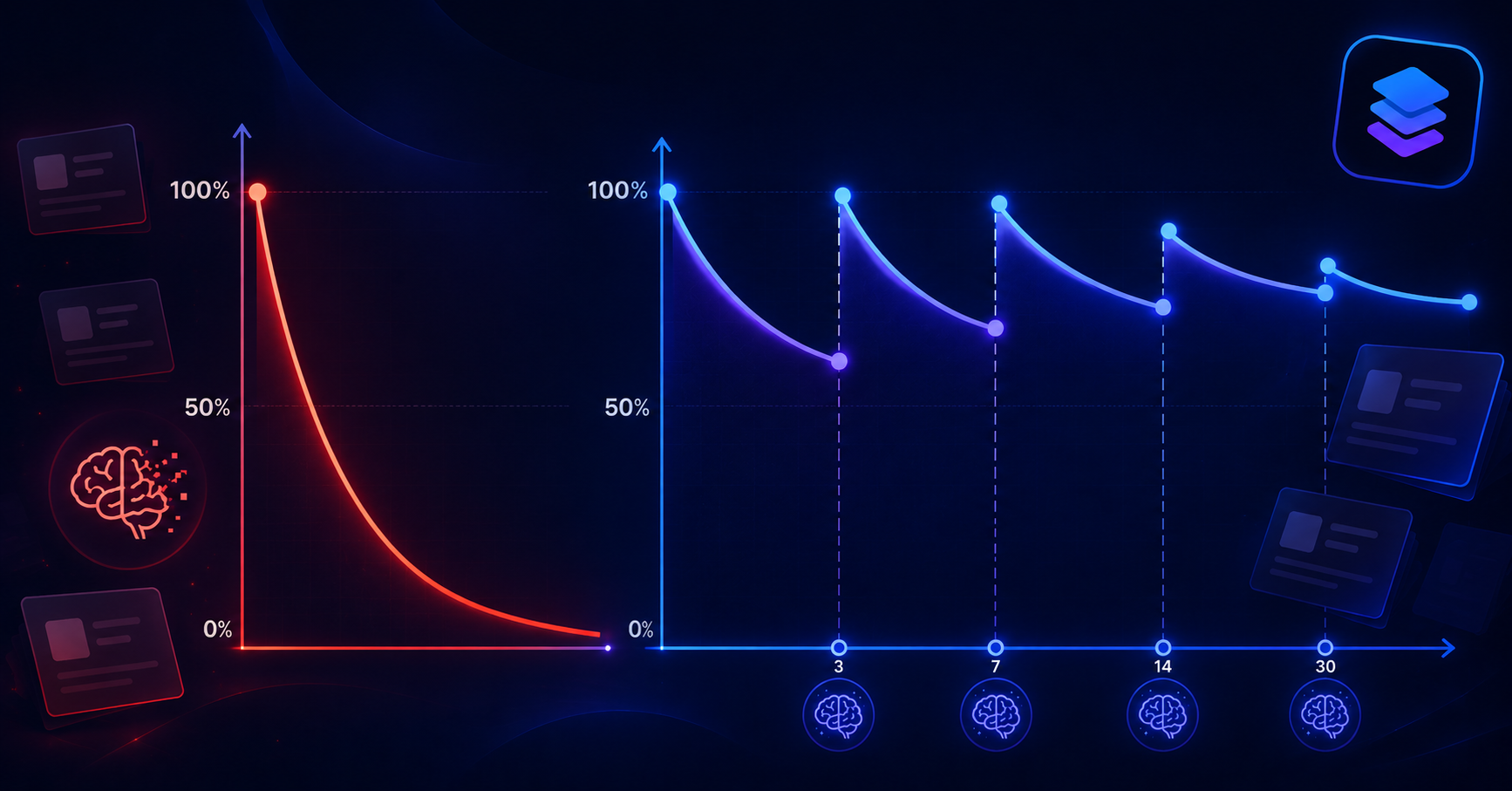
How fast you actually forget
forgotten within 20 minutes of learning
forgotten after 1 hour
forgotten after 24 hours
forgotten after 2 days
forgotten after 6 days
forgotten after 1 month
Without review — memory drops steeply in the first hour, then slowly plateaus near 10% after a month. With spaced repetition — timely reviews keep retention consistently above 80–90%, with each review extending the flat period further.
How Ebbinghaus discovered the forgetting curve
Hermann Ebbinghaus was working in Berlin in the 1880s with an unusual methodology: he used himself as the only test subject. He invented lists of nonsense syllables — meaningless combinations like DAX, BUP, ZOL — specifically designed to have no pre-existing associations in memory.
He would memorize a list until he could recite it perfectly, then wait a fixed amount of time and test recall. His key metric wasn't just how many syllables he remembered — it was the "savings score": how much less time it took to re-learn the list compared to the original learning session. If re-learning took 40% less time, he had retained 40% of the original memory.
He ran this process hundreds of times, across dozens of time intervals from 20 minutes to 31 days. The result was the first quantitative map of human forgetting — published in 1885 in his landmark monograph Über das Gedächtnis (On Memory).
The curve has been replicated with real-world materials — vocabulary, medical facts, historical events — and the shape holds. The exact retention percentages shift depending on meaningfulness and method, but the fundamental pattern is universal: memory decays rapidly at first, then slows to a gradual plateau.
Retention at each time point — original measurements
| Time since learning | Retention (no review) | Memory lost | What this means |
|---|---|---|---|
| Immediately | 100% | — | Just learned — fully in working memory |
| 20 minutes | 42% | −58% | More than half gone before you even leave the room |
| 1 hour | 33% | −67% | Two-thirds forgotten — and the drop is slowing |
| 9 hours | 26% | −74% | Sleep has begun to consolidate what remains |
| 1 day | 25% | −75% | Three-quarters gone — cramming yields this |
| 2 days | 21% | −79% | Decline continues but much more slowly |
| 6 days | 19% | −81% | Plateau beginning — curve flattening |
| 31 days | ~10% | −90% | Almost entirely gone without any review |
Why memory decays — what's actually happening in the brain
Synaptic decay
When you learn something, neurons form new synaptic connections. Without reinforcement, these connections weaken over time — proteins that maintain synapses are recycled by the cell if not reinforced through repeated activation.
Interference from new memories
New information competes with old. The more you learn after a session, the more those new memories overwrite the retrieval pathways to earlier ones. This is called retroactive interference — and it's why sleep right after learning helps.
Missing retrieval cues
Memory isn't lost like a deleted file — it's often still there, but unreachable. The cues that were present when you learned (context, emotion, surroundings) aren't available later, so the memory can't be triggered. Active recall practice strengthens retrieval pathways regardless of context.
Consolidation requires sleep
Short-term memories are transferred to long-term storage during slow-wave and REM sleep. Learning the night before a test and then sleeping is significantly better than the same learning followed by a wakeful night — the sleep itself is part of the memorisation process.
Factors that speed up — or slow down — forgetting
Meaningfulness — slows decay
Information connected to existing knowledge is forgotten much more slowly. A medical student who already knows anatomy retains new terms faster than someone starting from scratch.
Emotional salience — slows decay
Memories with emotional weight are encoded more strongly via the amygdala. Stories, vivid examples, and personal relevance all reduce the forgetting rate.
Sleep after learning — slows decay
A full night's sleep after a study session dramatically reduces the drop in the first 24 hours. Sleep is not passive rest — it's active memory consolidation.
Active recall — slows decay
Testing yourself immediately after learning slows the initial steep drop. Even one retrieval attempt right after the session extends the effective retention window significantly.
High stress — steepens decay
Cortisol impairs memory consolidation. Material learned under high stress (last-minute cramming before a test) is encoded weakly and forgotten faster.
Distractions after learning — steepens decay
Scrolling your phone or watching video immediately after a study session floods working memory with new stimuli — increasing retroactive interference and accelerating forgetting.
How a timely review resets the forgetting clock
When you successfully recall a piece of information, two things happen simultaneously: the memory trace is reactivated and strengthened, and the subsequent forgetting rate slows down. The curve after the first review drops less steeply than after the original learning. After the second review, less steeply still.
This is called the spacing effect — and Ebbinghaus was the first to document it systematically. He showed that distributing reviews across time was dramatically more efficient than massed re-study. Spending one hour reviewing spread across a week produced far better retention than spending an hour reviewing all at once.
The critical question is when to review. Too early and the memory hasn't started decaying — you waste time on something you would have remembered anyway. Too late and you've already forgotten — you have to re-learn from scratch. The optimal moment is just before the curve crosses your target retention threshold (usually around 80–90%).
This is exactly what the SM-2 algorithm automates. It tracks every card's history and calculates the optimal review date individually — so you never review too soon or too late.
100%
→ 90%+
→ 90%+
→ 90%+
→ 90%+
→ long-term
5 practical rules for beating the forgetting curve
Review within 24 hours of learning
The steepest part of the forgetting curve happens in the first hour. A single review session the next day — even 10 minutes — dramatically flattens the subsequent decay. Don't wait a week. Don't wait three days. Review the next day.
Space your reviews — never mass them
Reviewing the same material four times in one evening is less effective than reviewing it once over four evenings. The time gaps are not wasted time — they're where the forgetting (and the subsequent reinforcement) actually happens.
Use active recall, not re-reading
Reading your notes again does not reset the forgetting curve. It creates familiarity, not memory. Closing the book and trying to recall the information — even partially, even imperfectly — is what triggers the memory rebuilding process.
Sleep after learning — protect the consolidation window
The first night after learning new material is when consolidation from hippocampus to long-term cortical storage happens. Avoid heavy new learning right before sleep — you want the session you just had to consolidate undisturbed. Don't scroll social media for an hour post-study if you can help it.
Make material meaningful before you memorize it
Ebbinghaus used nonsense syllables — material with zero existing connections. Real knowledge isn't like that. Before trying to memorize a term, spend 60 seconds understanding what it means, how it connects to something you already know, and why it matters. Pre-connected memory decays far more slowly.
Why spaced repetition is the only method that beats the curve at scale
The five rules above are all correct — but applying them manually across hundreds or thousands of facts is impossible. When do you review card #347? Is it the same day as card #102? Did you review card #89 two weeks ago or three?
Spaced repetition software solves this entirely. Apps like Repetit track every card's history, calculate where each one sits on its personal forgetting curve, and surface only the cards that are about to fall below your retention threshold. Every card gets reviewed at exactly the right moment — not based on a fixed schedule, but based on your actual performance on that specific card.
The result: instead of managing the forgetting curve manually, you just show up for 10–15 minutes each day. The algorithm does the rest — fighting entropy on your behalf, one card at a time.
FAQ: the Ebbinghaus forgetting curve
What exactly is the Ebbinghaus forgetting curve?
It's a mathematical model of how memory decays over time without review. Discovered by Hermann Ebbinghaus in 1885, it shows that people forget roughly 58% of new information within 20 minutes, 67% within an hour, and up to 90% within a month — without any review. The curve is steepest at the beginning and gradually flattens.
Is the forgetting curve the same for everyone?
The general shape is universal — rapid early decay, then a plateau — but the exact rates vary by person, material, and conditions. Meaningful, emotionally engaging, or well-connected material decays more slowly. Sleep-deprived or highly stressed learners forget faster. Ebbinghaus used artificial, meaningless syllables; real-world retention is generally somewhat better.
Does the forgetting curve apply to skills as well as facts?
For procedural skills (playing piano, riding a bike), memory is more robust and decays much more slowly — especially for well-practiced skills. The forgetting curve primarily models declarative memory: facts, vocabulary, concepts. Procedural memory uses different storage pathways and follows different decay patterns.
How many reviews does it take to "beat" the forgetting curve?
For most facts, 4–6 well-timed reviews are enough to push the decay rate so low that the memory remains accessible for months or years. Spaced repetition systems automate this calculation — each successful recall earns a longer interval until the card is effectively in permanent long-term memory.
Why does cramming feel effective but fail long-term?
Cramming produces strong short-term recall — you genuinely know the material on exam day. But because it's massed study with no spacing, the forgetting curve is steep and the retention plateau is low. Within a week, the vast majority is gone. Spaced repetition sacrifices some short-term intensity for dramatically better long-term retention.