Frequency Dictionaries: Which Words to Learn First
Not all words pull their weight. A frequency dictionary ranks vocabulary by how often it's actually used — so you can learn the 500–1000 words that unlock most of a language, instead of the 500–1000 words a random textbook chapter happened to give you.
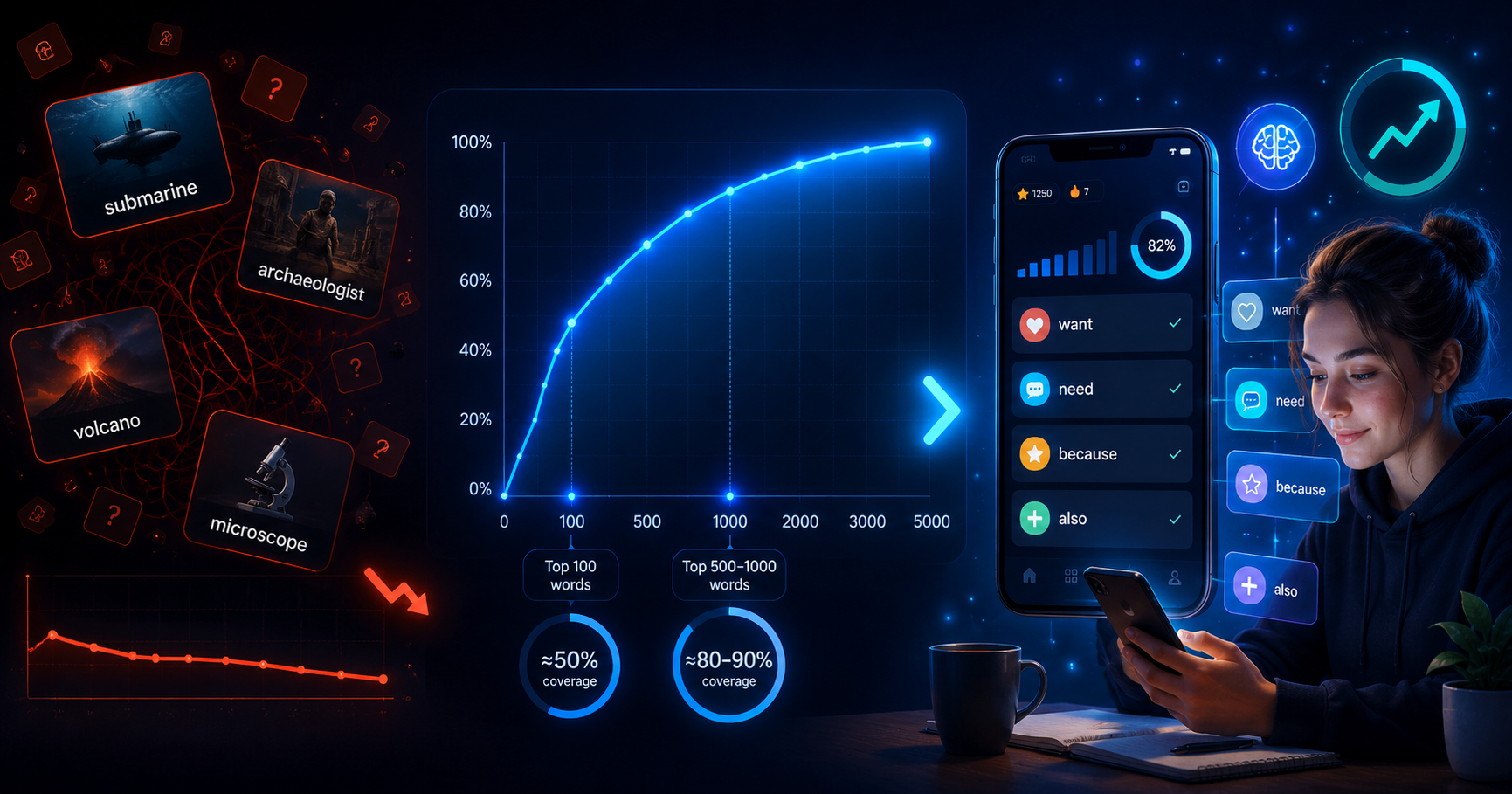
Open a random textbook chapter and it's easy to assume every new word in it matters equally. It doesn't. In every language, a small core of words does most of the work — showing up in nearly every sentence — while the vast majority of the vocabulary shows up rarely, if ever, in your actual reading and conversations. A frequency dictionary is simply a ranked list that tells you which is which.
This isn't a minor optimization. Two learners who each memorize 500 words can end up with wildly different levels of real comprehension, depending entirely on whether those 500 words were chosen by frequency or by chance. One of them can follow a basic conversation; the other has 500 flashcards and can't order coffee.
Below: the data behind why frequency matters so much, how to actually build your first 500–1000 word list, where to find a frequency dictionary for your language, and the pitfalls that catch people who use one for the first time.
None of this replaces grammar study, listening practice, or actually using the language — a frequency list only solves one problem: which words deserve your limited attention first. But solving that one problem well changes the return on every hour you spend afterward, which is why it's worth getting right before you make a single flashcard.
If you've ever felt like your vocabulary app "isn't working" despite steady daily use, it's worth checking this before anything else. A perfect review habit built on the wrong 500 words still produces a learner who can't order coffee.
A small number of words carry most of the load
In the early 20th century, linguist George Zipf noticed that if you rank a language's words by frequency, the most common word appears roughly twice as often as the second most common, three times as often as the third, and so on. The practical consequence: a relatively small set of words accounts for a disproportionate share of everything ever spoken or written.
In English, the single word "the" alone makes up roughly 5–7% of all words in a typical text — more than most people would guess for one word. Zoom out to the top 10 words (mostly articles, pronouns, and basic prepositions) and you're already looking at a meaningful double-digit share of everything written or spoken. The pattern isn't an English quirk; the same skewed, top-heavy shape shows up in the frequency data of essentially every language that's been studied this way.
of everyday text covered by just the 100 most frequent words in many languages
coverage from the top 500 words — the range most beginner goals target
coverage from the top 1,000 words — a common "solid basics" milestone
coverage once you reach roughly the top 3,000 words
These numbers vary somewhat by language and by whether you're measuring speech or writing, but the shape of the pattern is remarkably consistent: coverage rises fast at first, then flattens sharply. That flattening curve is the entire argument for using a frequency dictionary instead of a random list.
Why word 1,001 is worth far less than word 1
Look at the shape, not just the numbers: the curve is steep from 0 to 1,000 words and nearly flat from 3,000 onward. Doubling your vocabulary from 1,000 to 2,000 words buys a few more points of coverage. Doubling it again from 2,500 to 5,000 buys even less. Your first 1,000 words, chosen well, are the highest-leverage vocabulary you will ever learn in a language.
This is also why "I know 2,000 words but still can't follow a conversation" is such a common complaint. Text coverage measures whether you'd recognize a word if you saw it written down — it says nothing about whether you chose the right 2,000 words, whether you can recall them fast enough in real time, or whether you've actually practiced using them. Coverage is necessary but not sufficient; frequency-based selection just makes sure the necessary part isn't wasted on the wrong words.
Roughly how vocabulary size maps to proficiency level
| Approx. level | Approx. word count | What it typically allows |
|---|---|---|
| Beginner (A1) | 500–1,000 | Basic phrases, simple exchanges, survival-level conversation |
| Elementary (A2) | 1,000–2,000 | Everyday topics, simple past/future, short written texts |
| Intermediate (B1) | 2,000–3,500 | Most everyday conversation, travel, straightforward opinions |
| Upper-Intermediate (B2) | 4,000–6,000 | Detailed discussion, most news and media, workplace conversation |
| Advanced (C1+) | 8,000+ | Nuanced, idiomatic language across most topics and registers |
The useful takeaway isn't the exact numbers — sources disagree on the precise boundaries — it's the shape: your first 1,000 words already put you in reach of basic conversational ability, while each proficiency level after that requires progressively more vocabulary for progressively smaller gains in what you can express. That's the same diminishing-returns pattern from the coverage chart, just relabeled in terms of what you can actually do with the language.
Function words vs. content words — why the list mixes both
Function words — the grammatical glue
Articles, pronouns, prepositions, and conjunctions: "the," "of," "and," "to," "in." Short, abstract, and unglamorous, but they dominate the top of every frequency list because they're required in nearly every sentence, regardless of topic.
Content words — the actual meaning
Nouns, verbs, adjectives, and adverbs that carry the topic of a sentence: "want," "house," "good," "quickly." These are more concrete and easier to picture, which is usually why they feel more satisfying to learn — even though frequency-wise, function words often outrank them.
A frequency list naturally mixes both, and that's exactly what makes it more useful than a themed vocabulary list (all food words, all travel words). Themed lists give you content words without the function words that connect them into sentences — you end up able to name a lot of nouns but unable to actually say anything with them. The blend a frequency list gives you, in roughly the proportion real language actually uses it, is what turns memorized words into usable sentences.
Frequency-based selection vs. random word lists
Random selection
- Pulls vocabulary from whichever textbook chapter, TV episode, or article comes up next
- Ends up with niche words ("submarine," "archaeologist") before basic ones ("also," "because")
- Struggles to build full sentences even after 450 words — too many common connectors are missing
- Comprehension of real speech and text stays low despite steady flashcard progress
Frequency-based selection
- Pulls the next words directly from a ranked frequency list for the language
- Learns "also," "because," "want," and "need" in week one — the connective tissue of every sentence
- Can follow basic conversation and simple text well before 500 words
- Every new word noticeably increases what they can already understand
The random-selection learner isn't doing anything wrong in terms of effort or technique — the flashcards are well made, the reviews happen on schedule, the habit is solid. The entire gap between the two outcomes traces back to one decision made before either of them opened a flashcard app: what list of words to start from.
How to build your first 500–1000 word list
Find a frequency dictionary or word list for your language
Search "[language] frequency dictionary" or "[language] top 1000 words." For widely studied languages, published frequency dictionaries and free corpus-based lists both exist — either works as a starting source.
Test what you already know
Skim the list and mark words you already recognize solidly. Most learners aren't starting from zero — skip these rather than re-adding them, so your flashcard total reflects genuinely new vocabulary.
Work through the list in order, in daily batches
Add 10–15 unfamiliar words per day, starting from the top of the list and moving down. Don't skip ahead to "more interesting" words further down — the ranking exists precisely to protect you from that instinct.
Layer in 2–3 personally relevant words per day
Frequency lists are generic by design. Add a small daily quota of words tied to your job, hobbies, or daily routine so the vocabulary is immediately usable in your actual life, not just generically "common."
Turn each word into a card with context, not just a translation
A bare word-translation pair is harder to recall than a word paired with a short example sentence. This matters even more for frequency-list words, since many are abstract function words with little meaning in isolation.
Review on a spaced schedule, not all at once
Attach the list to a normal spaced repetition schedule rather than trying to memorize it in a weekend. See our guides on learning 1000 words in 3 months and building a review schedule for the pacing details.
Where frequency data actually comes from
Every frequency list is only as good as the text it was built from — linguists call that source text a corpus. A list built from 19th-century novels will rank words differently than one built from movie subtitles or social media posts, because the vocabulary of formal literature and casual speech genuinely differs. Knowing roughly where a list's numbers came from tells you how much to trust it for your specific goal, whether that's reading, conversation, or something more specialized.
Published frequency dictionaries
Academic and publisher-backed frequency dictionaries exist for most major languages, built from large text corpora (books, subtitles, news, web text). These are usually the most rigorously ranked option.
Subtitle-based corpora
Some of the most useful modern frequency lists are built from film and TV subtitles, since subtitles closely resemble natural spoken language — often more useful for conversation than word lists built from formal writing.
Free community word lists
Many language-learning communities maintain free, crowd-checked frequency lists. Quality varies, but for popular languages the well-known ones are generally reliable and a fine starting point.
Built-in app word lists
Some vocabulary and flashcard apps ship with pre-ranked frequency-based decks for popular languages. Convenient, but check whether the source corpus is disclosed — that tells you how much to trust the ranking.
Common pitfalls when using a frequency list
Function words feel boring and abstract
Many top-100 words are prepositions, articles, and conjunctions — "of," "the," "but." They're grammatically essential but hard to picture, so they get skipped in favor of "cooler" nouns further down the list. Resist this; they appear in nearly every sentence you'll ever read.
Frequency isn't the same as your context
A general frequency list reflects average usage across a whole language, not your specific needs. A doctor, a backpacker, and a business traveler each need a different top 500 words beyond the shared core — layer in personal vocabulary on top of the list.
Formal and informal registers get mixed
Some frequency lists are built from written corpora (news, books) and under-represent casual spoken vocabulary, or vice versa for subtitle-based lists. Check what the list was built from if your goal is specifically conversation or specifically reading.
Cognates create a false sense of progress
Words that closely resemble your native language ("information" / "información") get recognized easily and feel like fast wins, inflating your sense of progress. True frequency-based learning includes plenty of non-cognate words that take real, deliberate effort.
The list decides your ceiling before you've studied a single day
Spaced repetition, good card design, and daily consistency all matter — but none of them can fix a vocabulary list that was never worth learning in the first place. Word selection happens once, at the very start, and it quietly determines how much real comprehension every hour of review afterward will actually buy you.
A frequency dictionary is the cheapest, highest-leverage decision available to a language learner: five minutes spent finding the right list before you make a single flashcard changes the return on every study session that follows.
It's also a decision you only have to make once per language. Unlike daily habits, review pacing, or card design — all things you have to keep getting right day after day — choosing a good frequency list is a single upfront choice that keeps paying off for as long as you keep learning that language.
Find a frequency list for your language today, work through the first 500 words in order, and add your own relevant vocabulary alongside it. That combination is what actually gets you to real comprehension fastest.
FAQ: frequency dictionaries
What is a frequency dictionary?
A frequency dictionary (or frequency word list) ranks the words of a language by how often they actually appear in real speech and writing, based on analyzing a large body of text called a corpus. Instead of alphabetical order or a textbook's chapter order, words are ordered by real-world usefulness.
How many words do I need to know to understand most of a language?
Roughly speaking, the 100 most frequent words cover about half of everyday text in many languages, the top 1000 cover around 70–80%, and the top 3000 push past 90%. Exact numbers vary by language and by whether you're measuring speech or writing, but the pattern — a small core of words carrying most of the load — holds broadly.
Where can I find a frequency dictionary for the language I'm learning?
Published frequency dictionaries exist for most major languages (often built from large text corpora), and many are also available as free word lists online or built into vocabulary apps. Search for "[language] frequency dictionary" or "[language] top 1000 words" — for widely studied languages, several well-regarded options exist.
Should I skip words I don't personally need just because they're frequent?
No — frequency and personal relevance solve different problems and work best combined. Use a frequency list for your core 500–1000 words since it guarantees broad usefulness, then add words specific to your life, job, or hobbies on top. Skipping frequent words because they feel boring (many are function words like "of" or "but") usually backfires, since those words appear in nearly every sentence you'll read or hear.
Are the most frequent words the easiest to learn?
Not necessarily. Many high-frequency words are short function words (articles, pronouns, prepositions) that are grammatically essential but abstract and hard to picture, which can make them harder to card well than a concrete noun like "dog" or "coffee." Frequency tells you what to prioritize, not how easy a word will be to memorize.
Does a frequency dictionary replace a textbook or course?
No. A frequency list is a vocabulary priority tool, not a full curriculum — it doesn't teach grammar, pronunciation, or how words combine in real sentences. It works best alongside a textbook, course, or immersion content, feeding your flashcard deck with the highest-value words while the rest of your study covers grammar and usage.