
Flashcards are a form of retrieval practice: you try to produce an answer from a cue before checking it. Research consistently finds that retrieving studied material can improve later retention compared with additional study alone. The size of the benefit depends on the material, test, retrieval success, feedback, and timing; it is not a guarantee that every card will produce deep understanding.
A card can efficiently practice a fact, distinction, sequence, or short explanation. Complex problem solving and extended arguments usually need worked examples, practice problems, essays, or discussion too. Use flashcards for the parts that can genuinely be retrieved and checked.
Practical rule: write the question so you know what kind of answer is required before revealing the back. Write the answer so you can judge your response without interpreting a long paragraph.
What makes a flashcard question effective?
One identifiable task
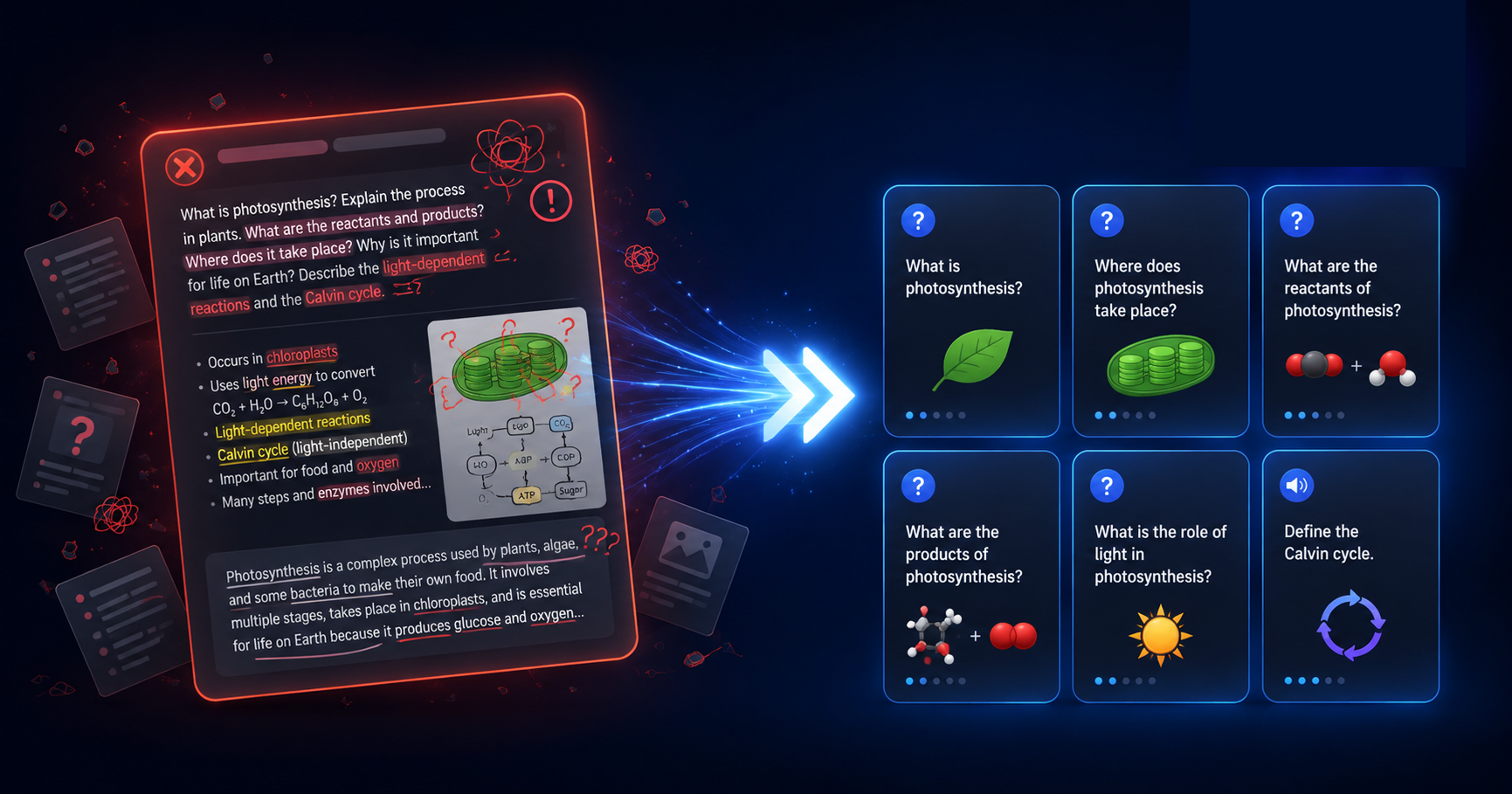
Ask for one coherent fact, relationship, distinction, or sequence. “Explain photosynthesis” is too broad for consistent self-checking.
Enough context
“What causes it?” is ambiguous out of order. “What causes seasons on Earth?” still requires recall but makes the target clear.
No accidental clues
Avoid wording, grammar, formatting, or card order that reveals the answer.
A checkable answer
State the essential answer concisely. Keep optional explanation visually separate from what must be recalled.
Write a good card in five steps
Decide what the learner should do
Choose a concrete action: name, define, distinguish, explain, order, calculate, or apply.
Select one meaningful unit
Avoid bundling independent questions, but keep connected steps together when their order matters.
Write a specific cue
Include the minimum context needed to make the intended answer unambiguous.
Write the answer standard
State the smallest answer you would accept as correct. Add a source or explanation only when useful.
Test and revise
If several answers seem reasonable, add context. If checking takes too long, shorten or split the card.
Weak prompts and better alternatives
“Better” means easier to interpret and score—not necessarily harder.
Definition
Weak: Mitosis
Better: What is mitosis, and what does it normally produce?
Answer: Nuclear division that normally produces two genetically identical daughter nuclei.
Contrast
Weak: Proactive vs. retroactive interference
Better: How does proactive interference differ from retroactive interference?
Answer: Proactive: older learning disrupts newer learning. Retroactive: newer learning disrupts recall of older learning.
Cause
Weak: Seasons happen because…
Better: What is the main cause of seasons on Earth?
Answer: Earth’s axial tilt changes the angle and duration of sunlight in each hemisphere during its orbit.
Application
Weak: Opportunity cost
Better: You work instead of attending a concert. What is the opportunity cost?
Answer: The value of the best forgone alternative—in this case, attending the concert.
Match the question to the real task
| Goal | Prompt | Watch for |
|---|---|---|
| Recall a fact | “What is…?” | Missing context |
| Distinguish ideas | “How does A differ from B?” | Omitting the decisive difference |
| Explain a mechanism | “Why does X occur when Y changes?” | Prompts so broad that any related paragraph fits |
| Recall a sequence | “What are the steps of X, in order?” | Combining unrelated steps |
| Apply a rule | A short new case asking which rule applies and why | Reusing only the source example |
Multiple-choice cards can practice choosing among alternatives, but choices provide recognition cues and permit guessing. If the eventual task requires unaided recall, answer before seeing options or use an open question.
What to remove or rewrite
- Copied headings that specify no task
- Several independent questions on one card
- Long pasted answers that are hard to score
- Yes/no questions with no request for a reason
- Wording or grammar that reveals the answer
- Changing facts without a date and source
- Reverse cards when only one direction matters
- Cards for details unrelated to a learning goal
How to use the cards after writing them
Try to retrieve the answer before turning the card over. Compare your response with the answer standard and correct errors. Feedback is particularly important after a wrong or incomplete attempt.
Space later attempts instead of repeating every card back-to-back. Distributed practice generally improves long-term retention compared with massing practice into one period, but there is no universal interval for every learner and goal. The useful gap depends in part on how long the information must be retained.
Do not treat correct flashcard recall as proof of broad understanding. When transfer matters, add a new example, explanation, comparison, or problem outside the original wording. Retrieval practice can support transfer, but results vary with the task and the match between practice and later use.
Check each card before keeping it
- Does the cue identify one task?
- Can it be answered out of order?
- Must I retrieve before revealing?
- Have I removed accidental clues?
- Can I judge the response consistently?
- Is the required answer concise?
- Would a new example better serve the goal?
- Is a changing fact dated and sourced?
Sources and limits
These sources do not prescribe a universal card count or fixed schedule.
Frequently asked questions
What makes a good flashcard question?
It gives enough context to identify one task, requires retrieval, and has an answer that can be checked consistently.
Should every flashcard test only one fact?
Not necessarily. A card should usually test one coherent idea or relationship. Connected steps can stay together when the sequence is the skill being practiced.
Are multiple-choice flashcards effective?
They can practice discrimination, but they also allow recognition and guessing. Use an open question when the real task requires unaided recall.
How long should a flashcard answer be?
Use the shortest answer that contains the information needed to judge the response.
Related articles
Continue with practical guides to clearer, easier-to-review cards.


Turn clear questions into regular practice
Create focused flashcards and use spaced repetition to plan later reviews.