
How to Learn Japanese Kanji with Flashcards the Right Way
A kanji almost never has just one reading — it usually has several, and the specific word decides which one is correct. Card it like an ordinary vocabulary word and your deck will quietly teach you facts you can't actually use. Here's a system built around how kanji really work.
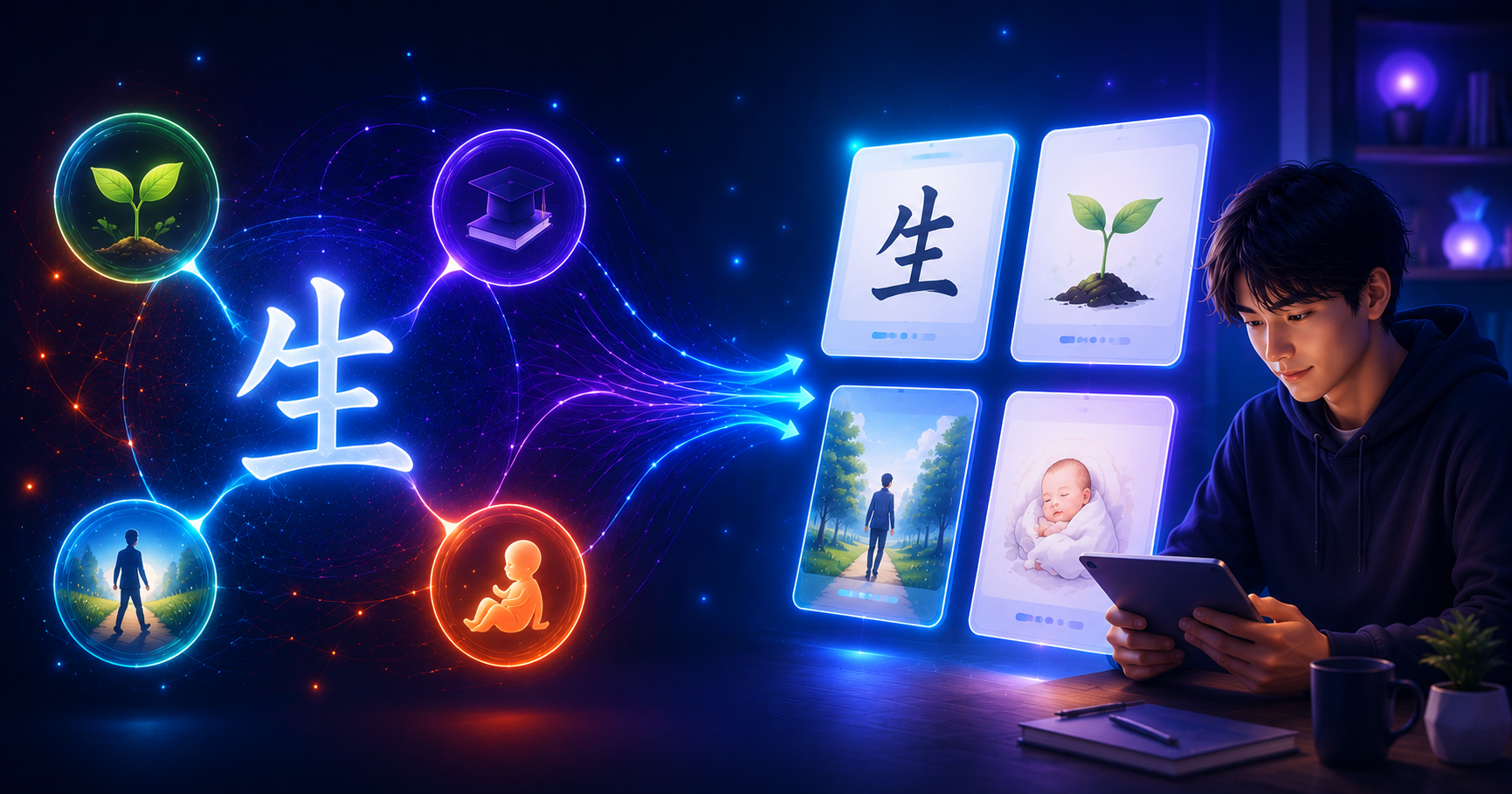
Ask most kanji learners what 生 means and they'll say "life" or "birth" without hesitation. Ask them how to pronounce it and things get complicated fast: sei, shō, i(kiru), u(mareru), nama, ki — and the correct one depends entirely on which word 生 appears in. This is the single fact that makes kanji flashcards different from vocabulary in almost every other language, and the reason so many decks quietly stall around a few hundred characters.
Learners coming from an alphabetic language often expect kanji to behave like unusually complicated letters — memorize the shape, memorize the sound, done. What actually happens is closer to memorizing a small family of related words that all happen to share a written form. That reframing changes almost everything about how a kanji deserves to be carded.
The fix isn't a different app or a secret trick — it's carding meaning and reading as separate facts, and anchoring every reading to a real word instead of testing it in isolation. Get that structure right and kanji become a large but very learnable vocabulary, the same as any other language's word list.
This matters whether you're starting from zero or already have a stalled deck of a few hundred characters. The structure below works the same way in either case — it's a way of carding kanji correctly going forward, not a full restart of everything you've already learned.
Below: why on'yomi and kun'yomi exist and how to tell them apart, how to card readings so they're actually gradeable, a sensible learning order, real card examples, and the mistakes that quietly sink most kanji decks.
None of this requires a kanji-specific app or a fundamentally different study method. It requires respecting that a kanji is denser than an ordinary vocabulary word — the same one-fact-per-card discipline that works for any language, applied carefully to a character that happens to carry more than one fact at a time.
Why a kanji is more than one flashcard fact
In an alphabetic language, a written word almost always maps to exactly one pronunciation. A kanji doesn't carry that guarantee — the same shape can be pronounced several different ways depending entirely on context. Breaking that shape down into its three separate layers before carding it is what makes the rest of this system work.
Meaning
The core concept a kanji represents. Usually the most stable, straightforward fact of the three — closest to a normal vocabulary word.
Reading(s) — plural
Most kanji carry at least one on'yomi and one kun'yomi reading, sometimes several of each. There is rarely a single "the" pronunciation to memorize.
Which reading applies where
The word a kanji sits inside decides which of its readings is correct. This "which one, when" fact is unique to kanji and impossible to test with a bare character-to-sound pair.
A bare "生 = life, sei" card looks reasonable and is genuinely incomplete — 学生 (gakusei, student) uses sei, but 生まれる (umareru, to be born) uses a completely different reading of the same character. Learning one reading as "the" reading sets you up to guess wrong on the very next word that uses this kanji differently.
生 is admittedly one of the more extreme examples — many kanji have only one on'yomi and one kun'yomi, which is a far more manageable pair. But even a "simple" two-reading kanji still has two separate, context-dependent facts hiding behind one character, which is one more fact than a typical vocabulary card in most other languages needs to carry.
On'yomi vs. kun'yomi, in plain terms
On'yomi (音読み) — the borrowed reading
- Adapted from the original Chinese pronunciation when the character was imported
- Used mainly in compound words made of two or more kanji (熟語)
- Often shorter and shared across many unrelated kanji
- Example: 生 as sei in 学生 (gakusei, student)
Kun'yomi (訓読み) — the native reading
- An existing native Japanese word matched to a kanji with a similar meaning
- Used mainly when the kanji stands with okurigana (attached hiragana) or alone
- Usually longer and more distinctive to that specific kanji
- Example: 生 as u(mareru) in 生まれる (umareru, to be born)
Neither reading is more "correct" than the other — they simply belong to different situations. The practical rule of thumb: kanji appearing inside a two-or-more-character compound usually lean on'yomi; a kanji standing with attached hiragana (okurigana), or common standalone kanji, usually lean kun'yomi. It's a strong tendency, not an absolute law, but it's a useful first guess when you meet a new word.
This history also explains why on'yomi readings often sound similar across related kanji — they were all adapted from Chinese pronunciation around the same broad era, sometimes centuries apart, which is part of why a single kanji can occasionally carry more than one on'yomi as well. Kun'yomi, by contrast, comes from whatever native Japanese word already existed for that meaning, so it tends to be more distinctive and less likely to be shared across unrelated kanji.
Isolated reading vs. reading through a real word
Not wrong — but useless on its own. This kanji has at least five other common readings depending on the word.
Now "sei" is anchored to one specific, common word — a fact you can actually recall and apply correctly.
This single change is usually enough on its own to unstick a struggling kanji deck. Learners who switch from isolated-reading cards to word-anchored reading cards typically notice within a couple of weeks that reviews feel less like guessing and more like genuine recall — because the card is finally testing a fact that has exactly one correct answer.
Split meaning, reading, and word into separate cards
This follows the exact same one-fact-per-card logic used for any flashcard, just applied more deliberately than usual. A single kanji asking you to recall meaning, one specific reading, and which word that reading belongs to all at once is really three separate questions wearing one character — split them and each one becomes honestly gradeable again.
Card the meaning on its own
Front: 生. Back: "life, birth, raw." This is the stable core fact and rarely needs to change once learned — it's the closest thing to a normal vocabulary card in this whole system.
Card each reading through a specific word
One card per reading, each anchored to a real word: 学生 for "sei," 生まれる for "u(mareru)," 生きる for "i(kiru)." Add readings gradually as you meet the words that use them — don't try to front-load every reading a kanji has on day one.
Card the word itself, in both directions
学生 → "student" and "student" → 学生, tested separately from the character-level cards above. This is what actually builds usable vocabulary, not just character trivia.
Merge once everything is solid
After a kanji's meaning and its common readings have each passed several review cycles, it's fine to consolidate into fewer, denser cards if you want a lighter long-term deck. The split is a learning-phase scaffold, not a lifelong requirement.
This four-step sequence naturally paces itself. You'll rarely add all four cards for a kanji on the same day — the meaning card usually comes first, and reading cards trickle in over subsequent days and weeks as new words introduce them. That gradual accumulation is exactly what keeps the daily review load manageable even as your total kanji count grows into the hundreds.
How much kanji you actually need, by goal
| Goal | Approx. kanji count | What it covers |
|---|---|---|
| JLPT N5 | ~100 | Basic signs, simple sentences, absolute beginner texts |
| JLPT N4 | ~300 | Everyday conversation topics in simple written form |
| JLPT N3 | ~650 | General newspaper headlines, common workplace text |
| JLPT N2 | ~1,000 | Most newspaper and magazine text, general media |
| JLPT N1 / jōyō | ~2,000–2,100+ | Full adult literacy — the official jōyō list used in schools |
Notice how much this mirrors the coverage curve behind a frequency dictionary for ordinary vocabulary: the first few hundred kanji unlock a disproportionate share of everyday reading, and each additional thousand buys progressively narrower gains. Prioritize by frequency and by which JLPT level actually matches your goal — don't default to the full jōyō list unless near-native reading is genuinely the target.
It's worth picking a concrete target early, because "learn kanji" without a number attached tends to feel endless. Someone aiming for casual travel and basic signage has a genuinely different job than someone preparing for N2 at work — and both are far more achievable once the goal is a specific, bounded list rather than an open-ended commitment to "eventually know kanji."
Common mistakes with kanji flashcards
Memorizing readings with no word attached
A reading with no word context is a fact you can't apply — you'll recognize it on the flashcard and freeze the moment the same kanji shows up in an unfamiliar compound.
Trying to learn every reading of a kanji at once
Kanji with five or six readings feel impossible if you try to front-load all of them immediately. Learn readings one word at a time, as you actually encounter them — the full set accumulates naturally over weeks, not one sitting.
Treating kanji as vocabulary instead of building blocks
Kanji combine into words the way letters combine into English words — but unlike letters, kanji already carry meaning on their own. Learning kanji without also carding the common words they form leaves real, usable vocabulary on the table.
Leaning on furigana forever
Furigana (small hiragana showing pronunciation) is a helpful crutch early on, but reviewing a kanji with furigana permanently visible means the flashcard is testing hiragana reading, not kanji recall. Wean off it as soon as a character feels reasonably familiar.
All four mistakes share a root cause: treating kanji like a simpler system than it actually is, either by testing too little (bare readings with no word) or too much at once (every reading, every time). The fix in each case is the same instinct — slow down at the structural level so the daily review habit you're already building holds up as the deck grows into the hundreds and then thousands of characters.
The quick check for any new kanji card
Is this card testing meaning, or one specific reading — not both at once? Keep them on separate cards while you're still learning the kanji.
Is every reading card anchored to a real word? No bare kanji-to-sound pairs — the word is what makes the reading meaningful.
Have I also carded the word as its own vocabulary item? Character-level facts and word-level vocabulary are both worth testing, separately.
Am I adding every reading at once, or one at a time as I meet them? Spread readings across the words that actually use them — don't front-load a kanji's full reading list in one sitting.
Do I need to write this kanji by hand? If yes, add a dedicated stroke-order card — recognition alone won't build that separate skill.
Kanji aren't harder than other vocabulary — they're just denser
A kanji packs a meaning and multiple context-dependent readings into a single character, which is exactly why it punishes the kind of bare, isolated flashcard that works fine for an ordinary vocabulary word. Split meaning from reading, anchor every reading to a real word, and add readings gradually as you actually meet them rather than all at once.
None of this requires a special kanji-only method disconnected from everything else about spaced repetition. It's the same one-fact-per-card discipline used for any language, applied to a writing system that happens to pack more facts per symbol than most.
It also compounds the same way vocabulary in any language does: the first few hundred characters are the slowest, because almost everything is unfamiliar. Past that point, new kanji increasingly share readings, components, and word patterns you've already learned — the same daily habit starts covering noticeably more ground per week simply because fewer pieces are genuinely new.
If you already have an existing deck built on bare, isolated readings, you don't need to throw it out — just start attaching a real word to each reading the next time that card comes up for review, and let the improvement accumulate one card at a time rather than trying to fix everything at once.
Start with a meaning card for your next new kanji, then add exactly one reading — attached to one real word — and expand from there as new words introduce new readings.
FAQ: learning kanji with flashcards
Why does one kanji have so many readings?
Because Japanese adopted Chinese characters but already had its own spoken language. On'yomi readings are adaptations of the original Chinese pronunciation, used mainly in words borrowed from Chinese. Kun'yomi readings are native Japanese words that got matched to a kanji with a similar meaning. Most kanji ended up with at least one of each, and some have several of both.
Should I memorize a kanji's readings in isolation or through words?
Through words, almost always. A kanji's reading depends heavily on which word it appears in, so memorizing an isolated reading without that context teaches you a fact you can't reliably apply. Card the kanji's meaning separately, then card its readings attached to real, common words that fix which reading is correct.
Should I learn on'yomi or kun'yomi first?
There's no universal rule — it depends on which reading appears in the highest-frequency words for that specific kanji. A practical approach is to learn whichever reading shows up in the first common word you encounter for that kanji, then add the other reading once that word is solid, rather than trying to learn all readings for a kanji at once.
Do I need to know stroke order to use kanji flashcards effectively?
Only if your goal includes handwriting. For reading — texting, subtitles, signs, most modern communication — recognition-based flashcards without stroke-order practice are enough. If you need to write kanji by hand for exams or work, add dedicated stroke-order practice as a separate skill, since it doesn't transfer automatically from recognition.
How many kanji do I actually need to learn?
The official jōyō list used in Japanese schools contains just over 2,100 characters, generally considered the benchmark for adult literacy. JLPT levels give rough intermediate targets: roughly 100 kanji for N5, climbing to around 2,000 for N1. Most learners don't need the full jōyō list unless they're aiming for near-native reading fluency.
How is learning kanji different from learning Chinese characters?
The biggest difference is readings. A Chinese character generally has one standard reading (occasionally two in specific contexts). A Japanese kanji typically has multiple readings — one or more on'yomi and one or more kun'yomi — and the correct one depends entirely on which word it's part of, which is why context-based carding matters even more for kanji than for Chinese characters.