

Starting a course can feel exciting. Continuing through an ordinary month, when the subject gets harder or life gets busy, can feel different. Long-term study motivation is about having reasons to continue and a workable way to act on them, even when enthusiasm varies.
A sustainable study routine should not require you to feel highly motivated every day. Personally meaningful goals, manageable actions, visible progress, stable cues, and realistic recovery plans can make continued study easier. Effective learning methods also matter: a routine that produces little visible learning can be difficult to sustain.
The central idea: choose a reason that matters, make the next action clear, and build a routine you can adjust and return to.
Interest, competing demands, difficulty, and available time can vary across a long project. A study plan needs to work during ordinary weeks, not just during the first burst of excitement. Treat a difficult start as something to investigate: is the task unclear, too large, poorly timed, or no longer connected to a useful goal?
Motivation is not a single quantity. In a meta-analysis of student motivation, Howard et al. (2021) found that different reasons for studying had different associations with persistence, performance, and well-being. Interest and personally valued goals both matter; this does not mean that every task must be intrinsically enjoyable. These associations also do not establish that a particular routine causes motivation.
Ask what learning would let you do: talk with relatives in another language, qualify for work you want, or understand a subject you care about. An external requirement, such as an exam, can still connect to a personally meaningful reason. You do not need to invent a passion for every chapter.
From obligation to purpose
“I should finish this language course.”
“I want to handle everyday conversations when I visit my family.”
From purpose to practice
“This week I will practice asking about travel plans and answering follow-up questions.”
The task now connects a reason to a skill you can observe.
Practical suggestion: write your reason beside the current target. Revisit it when priorities change. Adjusting or ending an outdated goal can be a considered decision, rather than a failure of discipline.
Translate “learn the subject” into a specific capability and the actions that could build it. For example, a biology student might aim to explain a process without notes, then plan time to understand it, draw it from memory, and check the explanation. This is an illustrative plan, not a prescribed study schedule.
Choose a workload that fits around your commitments, including review of earlier material. Leave room to stop at a defined point instead of expanding each session until it becomes difficult to repeat. A small starting set may be easier to maintain than a large one.
Practical suggestion: before closing a session, leave a clear next action: “Open the worked example and explain why this step is valid.” If you repeatedly run out of time, reduce the target or change the schedule before adding more material.
Harkin et al.’s meta-analysis of experimental evidence found that interventions encouraging progress monitoring improved goal attainment on average. This supports monitoring as a self-regulation strategy; it does not establish a universal logging frequency or prove that every tracker helps every learner.
Practical suggestion: keep a brief record of the action completed, what you can now do, and what still needs work. For instance: “Explained the process without notes; confused the last stage; revisit that distinction.” Compare a recent explanation or problem solution with an earlier attempt.
Track participation alongside learning. Completed sessions show whether the plan fits your life; delayed recall, explanations, or realistic tasks show whether the work is useful. A growing card count or an unbroken streak alone cannot tell you both.
Wood and Rünger’s review of habit research describes how repeating responses in recurring contexts can support habit formation. A familiar cue may help with starting, while difficult learning still requires deliberate attention. Repetition does not automatically create interest or commitment.
Choose a situation that already occurs reliably in your life. Prepare the relevant notes or review collection so that starting does not require searching. A routine linked to an event may fit some schedules better than a fixed clock time.
If–then plan: “If I finish breakfast at home, then I will sit at the desk and open my planned review.” This is an example of linking a specific situation to a specific action.
Gollwitzer (1999) discusses implementation intentions as a way to help translate intentions into action. They do not guarantee follow-through. If your cue rarely occurs, choose another; if you notice it but avoid the task, examine the task’s size, clarity, or timing.
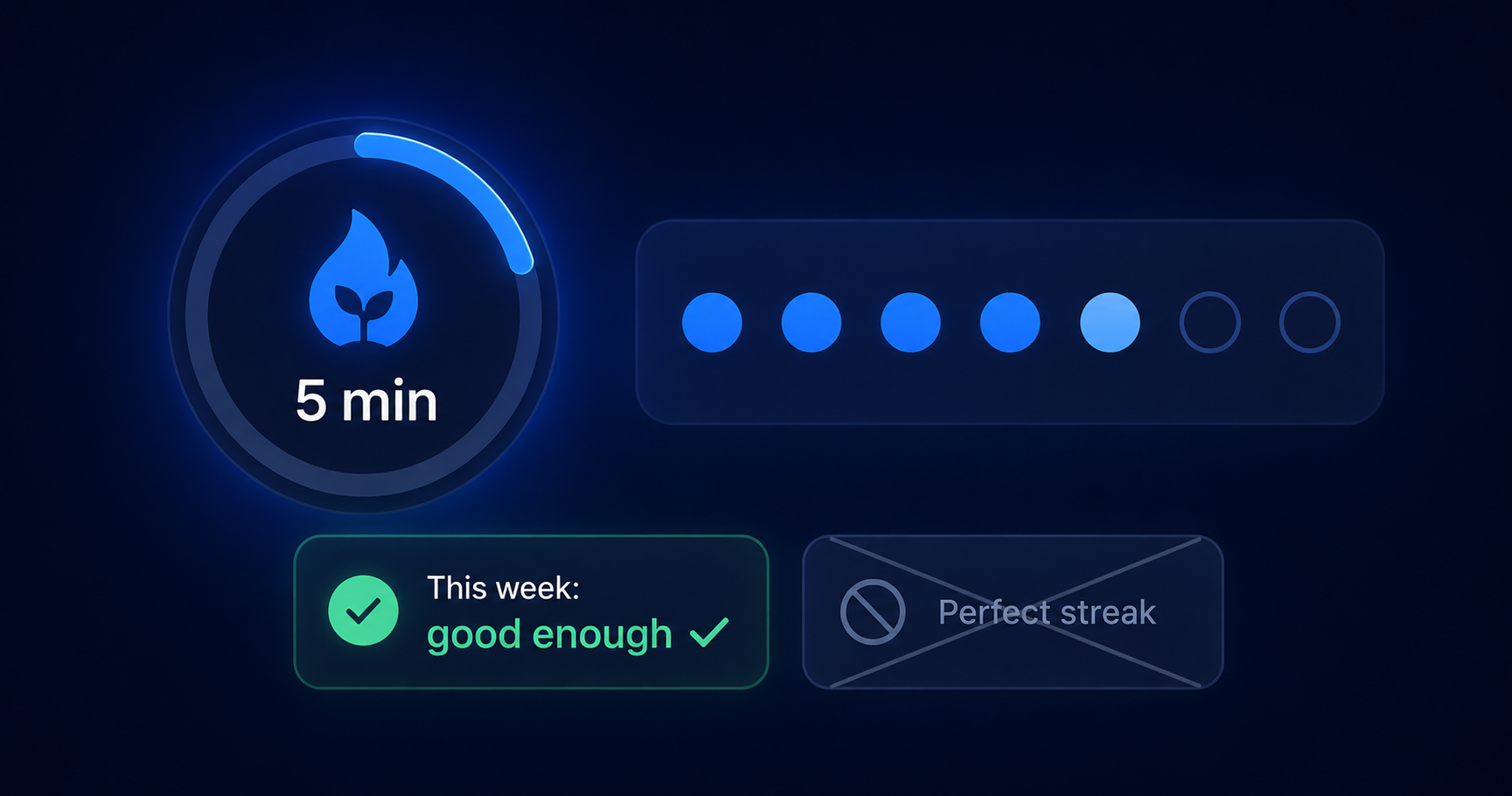
Practical suggestion: decide in advance what a reduced session could look like. It might mean reviewing a manageable part of an existing collection, explaining a familiar idea, or checking a previously attempted problem without adding new material. Choose the scope to match your capacity; there is no universally correct number of minutes or cards.
Keep this version useful rather than turning it into a check-in performed only to protect a streak. If you are too tired to engage, rest and identify a realistic return opportunity. A reduced session is an option, not a requirement to study through illness or exhaustion.
When low energy becomes the usual pattern, reconsider the whole workload. Regularly needing an emergency version is information about the plan, not a reason to keep shrinking it indefinitely.
A missed session need not decide what happens next. Avoid automatically treating all missed work as a debt to repay in one sitting. Check what still matters, choose a manageable entry point, and resume at the next realistic opportunity.
Identify the interruption
Was it a one-off event, an unreliable cue, or a workload that no longer fits?
Choose the return action
For example: “When I am home after class, I will revisit the last topic I understood.”
Rebuild the plan
Prioritize important material and reduce new work while the outstanding review load is high.
These are practical recovery suggestions, not a scientifically established restart protocol. The useful test is whether they make returning feasible. If interruptions recur, change the plan rather than repeatedly promising a larger catch-up session.
Dunlosky et al. (2013) identify practice testing and distributed practice as broadly useful learning techniques. Roediger and Karpicke (2006) demonstrated benefits of retrieval practice for later retention, while Cepeda et al. (2006) reviewed evidence for spacing in verbal recall tasks. These findings concern learning and retention, not direct increases in motivation.
Understand the material, attempt to recall or explain it before checking, and revisit it across separate occasions. Immediate repetition can feel fluent, but delayed retrieval generally provides a more informative test of durable retention. Accurate feedback after an unsuccessful attempt can help correct errors and improve later retrieval. Timing depends on the material, prior knowledge, and how long you need to retain it.
Flashcards can support focused recall, but use problems, explanations, or realistic tasks when the goal requires them. Do not assume that remembering a definition guarantees application in a new situation.
Where Repetit can help
Repetit organizes flashcards and scheduled spaced reviews, so you have less need to decide manually which card to review next. Keep the collection aligned with your goal and the review load within your available time. This is organizational support, not evidence that the app itself increases motivation or guarantees retention.
Waiting for enthusiasm
Use a recognizable cue and a clear first action, while checking whether the goal still matters.
Planning for your best day
Base the workload on ordinary capacity and adjust when commitments change.
Protecting a streak at any cost
If the counter encourages empty check-ins or guilt, track useful work and returns after interruptions instead.
Also avoid using collection growth as your main success measure. Adding material can crowd out the practice you intended to do. Review whether your current work is building the skill you chose, rather than repeatedly changing tools or expanding the plan.
At a review point that fits your project, look back over your record. A weekly check is one possible choice, not a research-established requirement. Use the pattern to change a specific part of the plan.
| Signal | Question to ask | Possible adjustment |
|---|---|---|
| Starting | Am I taking the study opportunities I planned? | Change the cue or make the first action clearer. |
| Learning | Can I explain or use more than before? | Check understanding and use practice that matches the goal. |
| Workload | Does the work fit alongside my other commitments? | Reduce new material or revise the target. |
| Recovery | Can I return after an interruption? | Choose a smaller return action and reassess outstanding work. |
If you study regularly but see little learning, examine the method and task difficulty. If you learn during sessions but rarely start, examine timing and workload. If the goal no longer serves you, revise it. Consistency should help you pursue a worthwhile goal, not become a separate obligation.
- Write down why the learning matters to you.
- Choose a manageable target expressed as something you can do.
- Link a reliable cue to a specific first action.
- Prepare a reduced session and allow for needed rest.
- Record useful work and evidence of learning.
- Choose how you will return after an interruption.
How can I stay motivated to study for months?
Connect the goal to something you value, choose manageable actions, record progress, and use a reliable study cue. Review the workload as your circumstances change; you do not need to feel equally enthusiastic every day.
What should I do when I do not feel motivated to study?
Identify what is making the session difficult. If you have the capacity, use a smaller version of the planned task with a clear stopping point. If you need rest, pause and choose a realistic opportunity to return.
Is it bad to miss a day of studying?
A missed session does not mean you must abandon the plan. Resume with a manageable task at the next realistic opportunity. If absences keep recurring, adjust the cue, workload, or schedule rather than automatically doubling the next session.
How can I make study progress more visible?
Keep a brief record of completed actions and examples of what you can now explain or do. Revisit comparable tasks after a delay so the record shows learning as well as time spent.
Do study streaks help with long-term motivation?
A streak can be a useful reminder if you find it encouraging. If it leads to guilt or empty check-ins, track completed study opportunities and returns after interruptions instead. A streak alone does not show how much you have learned.
Can spaced repetition help me maintain a study routine?
Scheduled reviews can give a session a clear starting point. Spacing supports retention, but it does not directly guarantee motivation or consistency. Keep the review load realistic and include practice that matches your learning goal.
How can Repetit support a sustainable study routine?
Repetit helps organize flashcards and scheduled spaced reviews, reducing the need to decide manually which card to review next. You still choose the material and workload; the app does not guarantee motivation or learning outcomes.


Give your next review a clear starting point
Organize flashcards and scheduled reviews in Repetit, with a workload that fits your study plan.