Mnemonic Devices: How to Memorize Complex Information Faster
A grocery list, a list of bones in the wrist, the order of planets, a client's name at a conference — none of it is inherently memorable. Mnemonic devices don't make you smarter; they give raw facts a shape your brain is already good at holding onto, like a rhythm, a story, or a place.
The word "mnemonic" comes from Mnemosyne, the Greek goddess of memory, and the idea behind every mnemonic device is roughly 2,500 years old — Greek and Roman orators used them to memorize long speeches without notes. The common thread across all of them is simple: bare facts (a list of names, a sequence of digits, a set of unrelated terms) are hard to hold onto, but rhythm, imagery, structure, and personal meaning are things human memory handles naturally.
A mnemonic device borrows one of those natural strengths and attaches it to the fact you actually need. An acronym borrows language and pattern-recognition. A rhyme borrows rhythm. The method of loci borrows spatial memory, which is one of the most robust systems the brain has. None of them add new information — they just make the information easier to grab onto.
Below: six mnemonic types and how each one works, the psychology behind why they help, a comparison of when to reach for which one, a four-step process for building your own, the mistakes that make them backfire, and how to combine mnemonics with flashcards so the fact survives long after the trick is forgotten.
Mnemonic devices at a glance
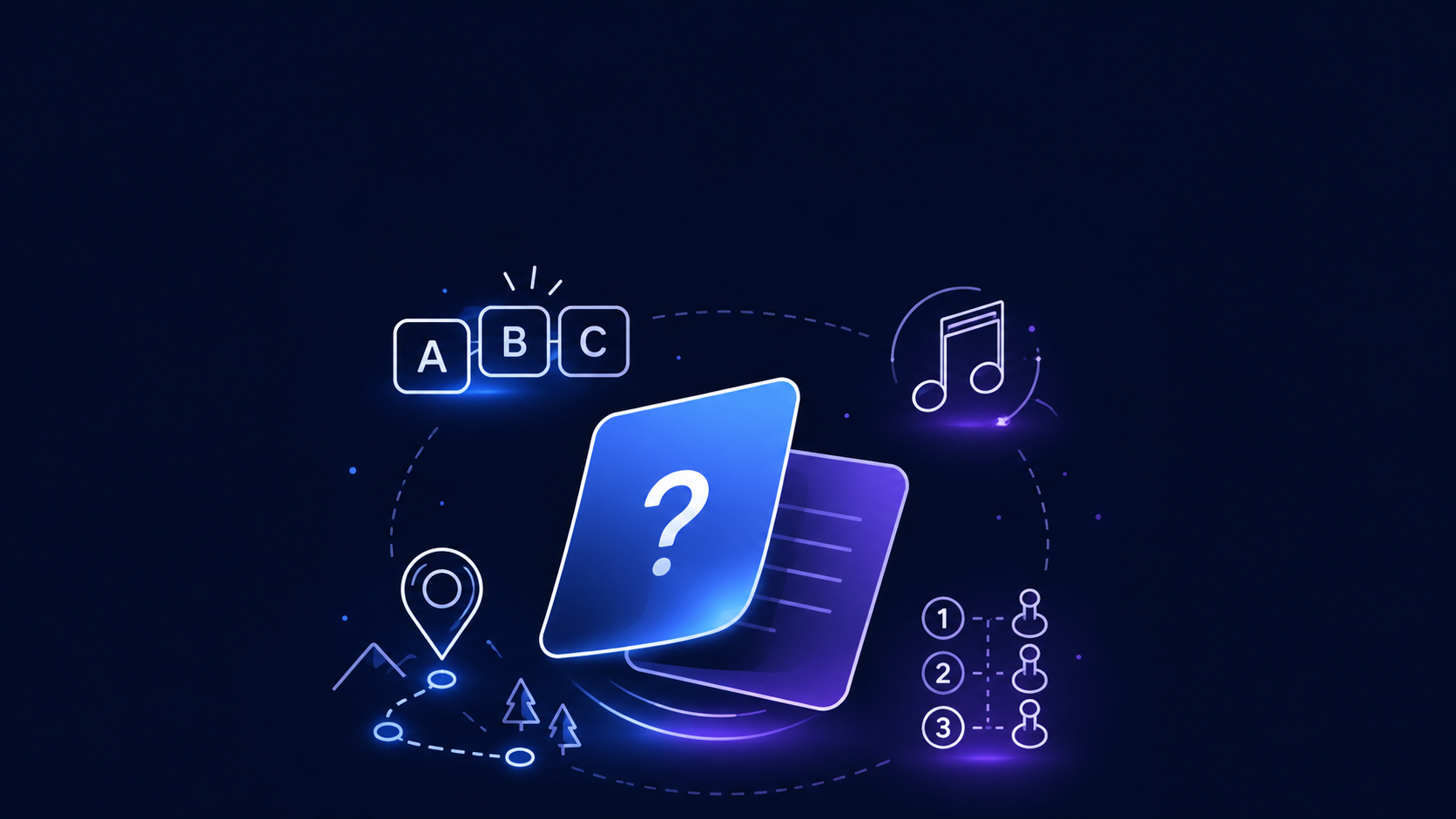
Common mnemonic types: acronyms, acrostics, rhymes, loci, keyword, pegs
Age of the method of loci, used by ancient Greek and Roman orators
Time it takes to build a simple acronym or rhyme on the spot
What mnemonics fix — they don't slow forgetting on their own
In short: pick the mnemonic type that matches the shape of what you're memorizing — letters for a short list, rhythm for a sequence, a mental route for many items in order, vivid imagery for foreign words or names. Build it once, rehearse it a few times, then let flashcards and spaced repetition keep it in memory after the mnemonic has done its job.
Six mnemonic devices worth knowing
Acronyms & acrostics
Take the first letter of each item and spell a new word (acronym) or build a sentence from them (acrostic). Best for short, ordered lists where the sequence matters.
Example: ROY G. BIV for the colors of the rainbow; "Every Good Boy Does Fine" for treble clef lines.
Rhymes & rhythm
Set a fact to a rhyme or a beat so it recalls the way a song lyric does — get one word wrong and the meter tells you immediately. Best for rules with exceptions or short facts you'll say aloud.
Example: "Thirty days hath September..." for the length of each month.
Method of loci
Place items to remember at specific points along a route you know well, then mentally walk the route to recall them in order. Best for long, ordered lists — the technique memory champions use to memorize card decks.
Example: a speech's five points placed at your front door, hallway, kitchen, living room, and stairs.
Keyword & imagery
Link an unfamiliar word or name to a familiar-sounding word, then picture the two interacting in an absurd, vivid scene. Best for foreign vocabulary and names attached to faces.
Example: the French word "pain" (bread) pictured as a loaf causing you literal pain.
Peg system
Pre-memorize a fixed set of images for numbers (one is a bun, two is a shoe) and "hang" new items on the matching peg. Best for numbered or ranked lists you'll reuse the same pegs for repeatedly.
Example: item 3 pegged to "tree" — picture the third thing to buy growing on a tree.
Chunking & grouping
Break a long string into smaller groups so working memory can hold it, the way phone numbers are split into blocks instead of read as one long digit string. Best for numbers, codes, and long sequences without inherent meaning.
Example: a 10-digit number read as three chunks instead of ten separate digits.
Mnemonics don't add memory — they add structure
Elaborative encoding
Memory holds onto information better when it's processed deeply and linked to something you already know, instead of repeated as an isolated fact. A mnemonic forces that link to happen — you can't build an acrostic or a keyword image without connecting the new fact to existing knowledge.
Dual coding
Information stored as both a verbal fact and a mental image gives you two independent paths back to it instead of one — if the fact itself slips your mind, the image can still trigger it. Vivid, unusual, even absurd images are remembered better than plain ones because they stand out.
Built-in retrieval order
An acronym, a rhyme, or a route through a memory palace all carry their own sequence — get to the third letter, the next rhyme, or the next room, and the following item is cued automatically. Plain lists give you no such cue if you lose your place.
Which mnemonic fits which material
| Technique | Best for | Limitation |
|---|---|---|
| Acronym / acrostic | Short ordered lists (5–10 items) | Falls apart past a dozen items; letters can be hard to force into a word |
| Rhyme / rhythm | Rules, short facts said aloud | Awkward for anything longer than a couplet or two |
| Method of loci | Long ordered lists, speeches, card decks | Takes practice to build reliable routes; slower to set up than an acronym |
| Keyword / imagery | Foreign vocabulary, names and faces | Doesn't help with abstract concepts that resist imagery |
| Peg system | Numbered or ranked lists, reused often | Requires memorizing the peg list itself first |
| Chunking | Long digit strings, codes, IDs | Doesn't add meaning — only makes the string easier to hold briefly |
These aren't mutually exclusive — a memory palace route often uses keyword imagery at each stop, and a peg list is really an acronym-free way to chunk numbers into fixed images. Combining two techniques is normal once the individual ones feel automatic.
Build your own mnemonic in four steps
Name exactly what's hard to hold onto
Is it the order of items, the items themselves, or a number attached to each one? A mnemonic built for the wrong problem — say, an acronym for something you actually struggle to keep in sequence — wastes the effort.
Pick the technique that matches that shape
Short list, fixed order → acronym or acrostic. Long list, fixed order → method of loci. Foreign word or a name → keyword imagery. Digits → peg system or chunking. Use the comparison above if it's not obvious.
Make it vivid, absurd, or personal
A bland, generic image is barely more memorable than the bare fact. Exaggerate size, add motion, make it slightly ridiculous, or tie it to something already meaningful to you — the goal is a mnemonic your brain wants to remember on its own.
Test recall immediately, without looking
Right after building the mnemonic, close the source and try to reconstruct the full list or fact from the trick alone. Gaps at this stage mean the mnemonic needs a clearer image or a stronger link, and it's cheap to fix now rather than at exam time.
Mistakes that make mnemonics backfire
Building a trick more complex than the fact
If reconstructing the mnemonic takes longer than just recalling the answer directly, it has stopped paying for itself. Keep the device simpler than the information it's protecting, not the other way around.
Only ever testing the mnemonic, not the fact
Being able to recite ROY G. BIV isn't the same as knowing the colors of the rainbow are in that order for a reason tied to wavelength. Test the underlying fact occasionally, not just your ability to recall the trick.
Reusing the same peg list for unrelated material
A peg system or memory palace route holds one set of associations at a time. Loading a second, unrelated list onto the same route without clearing the first causes the two to blur together during recall.
Treating the mnemonic as the finish line
A clever mnemonic gets a fact into memory on the first try — it doesn't stop that fact from fading over the following weeks. Skipping review because "I have a trick for it" is how mnemonics quietly stop working.
Turn a mnemonic into cards you review on a schedule
Right after you build it
Put the mnemonic cue on the front of a card — the acronym, the rhyme, the loci route — and the actual fact it stands for on the back. This captures the association while it's fresh, before the details blur.
Split multi-item mnemonics like acrostics or loci routes into one card per item, following the minimum information principle, so a single weak link doesn't hide inside a card testing five things at once.
In the weeks after
As the cards join your regular review queue, correct answers push each one to a longer interval, so eventually you're recalling the fact directly and barely reaching for the mnemonic at all — which is the point.
This is the same handoff described in how spaced repetition works: the mnemonic solves the first encounter, and increasing review intervals solve everything after it.
A mnemonic is a shortcut into memory, not a replacement for it
Match the technique to the material — letters and rhythm for short ordered lists, a mental route for long ones, vivid imagery for words and names, pegs or chunking for numbers. Make the image or link a little absurd, and test it without looking right away.
Then hand it off: put the mnemonic and the fact on a flashcard and let spaced repetition carry it from there. The trick does the hard part of getting the fact into memory the first time; the review schedule is what keeps it from quietly leaving again.
Name the problem, pick the matching technique, make it vivid, test it, then let review take over.
FAQ: Mnemonic devices
What is a mnemonic device?
A mnemonic device is a trick that turns hard-to-remember information into something easier to hold in memory — usually by adding structure, rhythm, imagery, or a personal association that plain facts don't have on their own. Acronyms, rhymes, and the method of loci are all mnemonic devices.
What's the difference between an acronym and an acrostic?
An acronym uses the first letters of a list to spell a new, memorable word, like ROY G. BIV for the colors of the rainbow. An acrostic uses the first letters to build a sentence instead, like Every Good Boy Does Fine for the lines of the treble clef. Acrostics work better when the letters don't spell anything pronounceable.
Do mnemonics work for numbers and dates?
Yes — the peg system and number-rhyme methods convert digits into concrete images (one is a bun, two is a shoe, and so on), which are far easier to picture and link to an event than a bare number. This is the same idea used in date-memorization techniques that pair a year with a vivid scene.
Is the method of loci the same as a memory palace?
Yes, they're the same technique under two names. The method of loci is the formal, older name; memory palace is the popular term for placing items to remember at specific points along a familiar route, then mentally walking that route to recall them in order.
Can mnemonics replace spaced repetition?
No — a mnemonic gets a fact into memory faster on the first try, but it still fades without review. Mnemonics and spaced repetition solve different problems: one makes encoding easier, the other makes forgetting slower. Used together, a mnemonic becomes the front of a flashcard that then gets reviewed on a schedule.
What's the biggest risk of relying on mnemonics?
Building a mnemonic that's more elaborate than the fact it's supposed to help you remember. If recalling the trick takes longer than just knowing the answer, it has stopped saving effort. The fix is testing recall of the actual fact regularly, not just recall of the mnemonic.