
Active Recall: Why Remembering Beats Rereading
You read a chapter, nod along, and feel like you know it. Then someone asks you a question about it and your mind goes blank. Active recall is the fix — one of the most well-researched, most replicated study techniques in memory science, and one of the simplest to start using today.
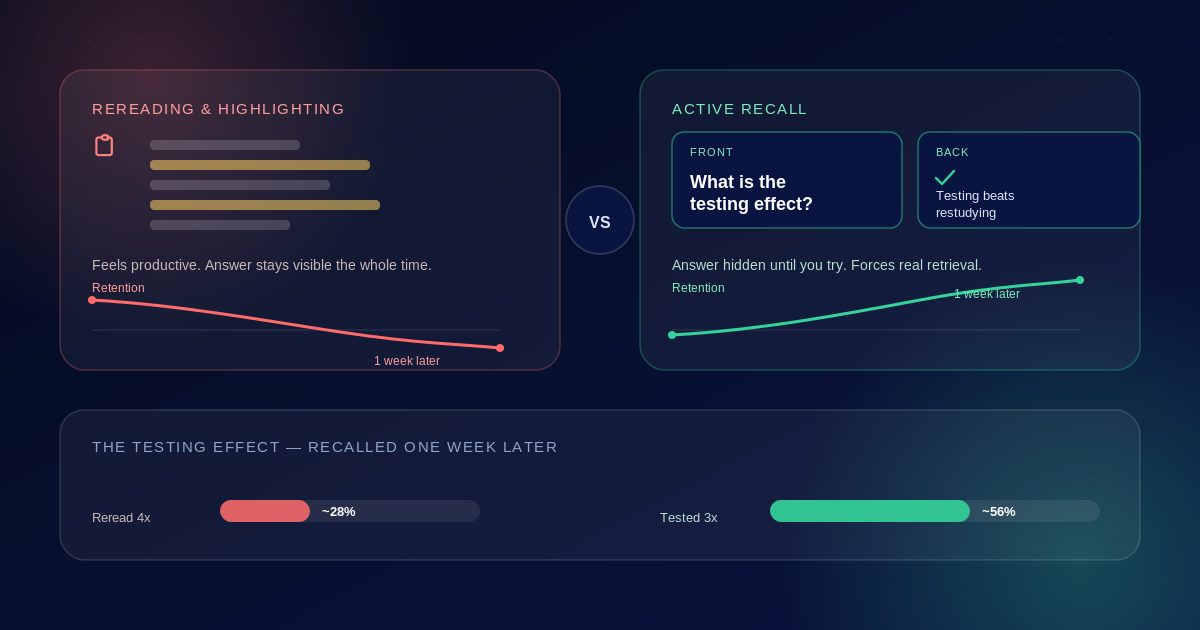
Most students study the same way: read the textbook, highlight the important parts, read it again before the exam. It feels productive. The words are familiar, the page looks colorful, and you recognize every sentence — so it must be sinking in, right?
Not quite. Recognizing information is not the same as being able to produce it. That gap is exactly why active recall — actively testing yourself instead of rereading — consistently outperforms every passive study method in controlled research.
Psychologists call this the "fluency illusion": material feels easy to process because you've just seen it, and your brain mistakes that ease for genuine mastery. The illusion collapses the moment someone asks you to explain the idea without the page in front of you — and that's usually the moment of an exam, an interview, or a real conversation in a foreign language.
Ask yourself a question first. Before checking your notes, try to answer it from memory — even if you only get part of it right.
Struggle a little. The moment of effortful "digging" for the answer is what strengthens the memory trace — not the answer itself.
Check and correct. Compare what you recalled with the real answer and fix any gaps immediately.
Repeat later. Test yourself on the same material again after a delay — this is where active recall and spaced repetition work together.
It helps to separate two words people often use interchangeably: recognition and recall. Recognition is picking the right answer out of options already in front of you — like a multiple-choice question. Recall is producing the answer from nothing, with a blank space instead of options. Recognition is a much shallower memory task, which is exactly why rereading and highlighting — both recognition exercises — feel easy but leave weak, short-lived memories.
A quick way to feel the difference: think of a movie you watched a year ago. If someone lists five plot summaries and asks you to pick the right one, you'll probably recognize it instantly. Now try to describe the plot yourself, from memory, with no options in front of you. That second, harder task is recall — and it's a far more accurate test of what you actually remember. Every real exam, conversation, and on-the-job situation works like the second task, not the first.
The landmark 2006 study
Roediger and Karpicke had students either restudy a passage four times or read it once and then test themselves on it three times. A week later, the group that tested itself remembered far more — despite spending less total time "studying" the material.
The effect replicates
The testing effect has since been confirmed across hundreds of studies, subjects, and age groups — from vocabulary lists and science facts to medical school anatomy and foreign-language grammar. It shows up whether the test is written, spoken, or done on flashcards.
Desirable difficulty
Researchers call this a "desirable difficulty": the extra mental effort of retrieval feels harder in the moment than rereading, but produces memories that last far longer — a short-term cost for a long-term gain.
This connects directly to how forgetting works. Every time you successfully retrieve a memory, you slow down the rate at which it fades — the same mechanism behind the Ebbinghaus forgetting curve. Rereading never triggers that mechanism, because there's nothing to retrieve — the answer is already right there on the page, so the brain has no reason to reinforce the pathway leading to it.
Interestingly, the testing effect works even when you get the answer wrong. A failed retrieval attempt, followed immediately by seeing the correct answer, still strengthens memory more than never attempting retrieval at all — the search itself primes your brain to encode the correction more deeply.
There's a second reason rereading feels deceptively good: people are generally poor judges of their own learning. In Roediger and Karpicke's study, the students who reread the passage predicted they would remember more than the students who tested themselves — the opposite of what actually happened a week later. This mismatch between how confident you feel and how much you'll actually remember is one of the biggest hidden traps in studying, and it's exactly why "it feels like I know this" is a dangerous signal to trust.
Rereading & highlighting
- The answer is visible the whole time
- No retrieval effort required
- Creates false confidence ("fluency illusion")
- Doesn't reveal what you actually don't know
- Forgotten within days
Active recall
- The answer is hidden until you try
- Forces genuine retrieval effort
- Gives honest, immediate feedback
- Pinpoints exactly what needs more work
- Builds durable, long-term memory
There's also a hidden cost to highlighting specifically: it turns reading into a motor task. You're scanning for phrases that look important and dragging a marker across them, which occupies your attention without requiring you to understand, connect, or remember anything. Studies comparing highlighting to no annotation at all often find no measurable benefit — the color makes the page look studied, not the memory stronger.
Flashcards (question on front, answer on back)
The simplest and most flexible active recall tool. Every card is a tiny test: see the question, retrieve the answer, then check yourself. Because each card isolates one fact, you also get precise, granular feedback on exactly which pieces of a topic are weak.
The blank page method
Close your notes and write down everything you remember about a topic on a blank page. Then compare it against your notes, circle what you missed, and turn those gaps into new flashcards. This works especially well for essay-based subjects and broad topic overviews.
Practice questions & past papers
Answering real exam-style questions is retrieval practice in its purest form — it mimics the exact conditions, phrasing, and time pressure you'll face later, so the retrieval pathway you build matches what the actual test will demand.
Teach it back (the Feynman technique)
Explain the concept out loud in simple words, as if teaching someone else, with no notes to lean on. Every stumble, "um," or vague hand-wave shows you exactly what you haven't truly learned yet — jargon can hide gaps that a plain explanation cannot.
Too soon
Testing yourself minutes after learning something is easy because it's still in short-term memory — it feels productive but barely challenges long-term retention.
Too late
Wait too long and the material has already faded past the point of a quick jog — you end up relearning it instead of reinforcing it, which wastes far more time.
Just right
The ideal moment to retest is right before you'd naturally forget — that's the exact problem spaced repetition algorithms are built to solve automatically.
This is why active recall and spaced repetition are usually described as a pair rather than two separate techniques. Active recall supplies the "test yourself, don't reread" method; spaced repetition supplies the schedule that decides exactly when each test should happen. Neither one works as well without the other — testing on a bad schedule wastes effort, and a perfect schedule built around passive review barely moves the needle on retention.
In Repetit, every review session is built around this loop: you see the front of the card, try to answer before flipping it, then honestly grade whether you got it right. Cards you struggle with come back sooner; cards you nail come back later — that's spaced repetition pairing with active recall to do the heavy lifting for you.
Not every flashcard actually tests recall, though. A card that shows the full sentence with only one word blanked out is close to recognition — the surrounding context does most of the work for you. A stronger card asks a direct question with no hints: "What is the testing effect?" rather than "Testing yourself on material improves ___." The less scaffolding on the front of the card, the more genuine the retrieval effort on the back.
Want your cards to actually test recall instead of recognition? Follow our guide on how to make effective flashcards — one clear question per card, no multiple choice, no peeking.
Peeking too early
Glancing at the answer before you finish trying skips the retrieval effort entirely — the part that actually builds memory. Give yourself a real few seconds of "digging" before you allow a look.
Grading yourself too kindly
Marking "close enough" as correct hides the gaps you actually need to review. Be strict — the goal is honest feedback, not a good feeling, and a card marked wrong today saves you from a real mistake later.
Using multiple choice only
Recognizing the right option among four is much easier than producing the answer from scratch — and much weaker for retention. Save multiple choice for a final check, not your main study method.
Testing only once
One successful recall isn't enough for long-term memory — without a follow-up review, the memory decays like any other. Pair active recall with spaced review so the same material comes back over time.
Writing cards that are too broad
A card asking "explain the French Revolution" mixes a dozen facts into one retrieval attempt. Break large topics into single, specific questions so each review gives you clean, precise feedback.
Only testing right before the exam
Cramming retrieval practice into the last 48 hours still beats rereading, but it loses most of the long-term benefit. Start testing yourself early, even a little at a time, for retention that survives past the exam.
Notice the pattern running through all six of these: each one quietly removes the retrieval effort while leaving the appearance of studying intact. Peeking early, grading generously, choosing recognition-based formats, testing once, writing vague cards, and cramming at the last minute all feel like active recall from the outside — but none of them actually make your brain search for the answer under real conditions. The fix in every case is the same: make retrieval a little harder, a little more honest, and a little more frequent.
Language learning
Testing yourself on vocabulary — word first, translation retrieved from memory — beats passively reading translated word lists.
Exam preparation
Practice questions reveal exactly what you're not ready to answer yet, well before it costs you points on the real thing.
Medical & legal terminology
Dense, high-volume definitions stick far better when you retrieve them under pressure than when you simply reread them.
Programming & certifications
Syntax, commands, and exam objectives are ideal question-and-answer material — small, discrete, and easy to turn into cards.
Facts & dates
Historical events, names, and numbers are classic recall material — easy to state as a clear question with one right answer.
Professional certifications
Corporate training and microlearning both rely on frequent, short self-testing sessions rather than long reading assignments.
Active recall isn't a trick — it's one of the most replicated findings in memory research. The shift is simple: instead of asking "did I go over this?", ask "can I produce this from memory?" Every question you force yourself to answer, instead of just reread, is a small deposit into long-term memory.
Combine it with spaced repetition and you get the two most effective, evidence-backed study habits working together — which is exactly how Repetit's flashcards are designed to be reviewed.
You don't need to overhaul your entire study routine overnight. Pick one subject, turn its key facts into a short stack of question-and-answer cards, and test yourself on them tomorrow instead of rereading your notes. That single swap — retrieval instead of review — is where the difference in retention starts.
FAQ: active recall
What is active recall in simple terms?
Active recall is a study method where you try to retrieve information from memory instead of just looking at it again. Instead of rereading a page, you close it and ask yourself what was on it — the effort of pulling the answer out of your own head is what makes the memory stronger.
Why does active recall work better than rereading?
Rereading creates a feeling of familiarity that people mistake for knowledge, but familiarity fades fast because the brain never had to work to retrieve anything. Active recall forces retrieval, and each successful retrieval strengthens the neural pathway to that memory, which is why it produces much longer-lasting retention.
What is the testing effect?
The testing effect is the research finding that testing yourself on material — even with no feedback — improves long-term retention more than spending the same amount of time restudying it. It has been replicated across hundreds of studies since Roediger and Karpicke's landmark 2006 experiment.
How do I use active recall with flashcards?
Write a question on the front of the card and the answer on the back. When you study, look only at the question, say the answer out loud or in your head before flipping the card, and grade yourself honestly. That single retrieval attempt before checking the answer is what makes a flashcard an active recall tool instead of a rereading tool.
Is active recall the same as spaced repetition?
No, but they work together. Active recall is the technique of testing yourself instead of rereading. Spaced repetition is the schedule that decides when you test yourself again. Flashcard apps like Repetit combine both: every review is an active recall test, timed by a spaced repetition algorithm.
Can active recall be used for any subject?
Yes. Active recall works for vocabulary, definitions, formulas, historical dates, medical and legal terminology, programming syntax, and any material that can be phrased as a question with a specific answer. It is less useful on its own for physical or creative skills that need hands-on practice.