
CSV & XLSX import
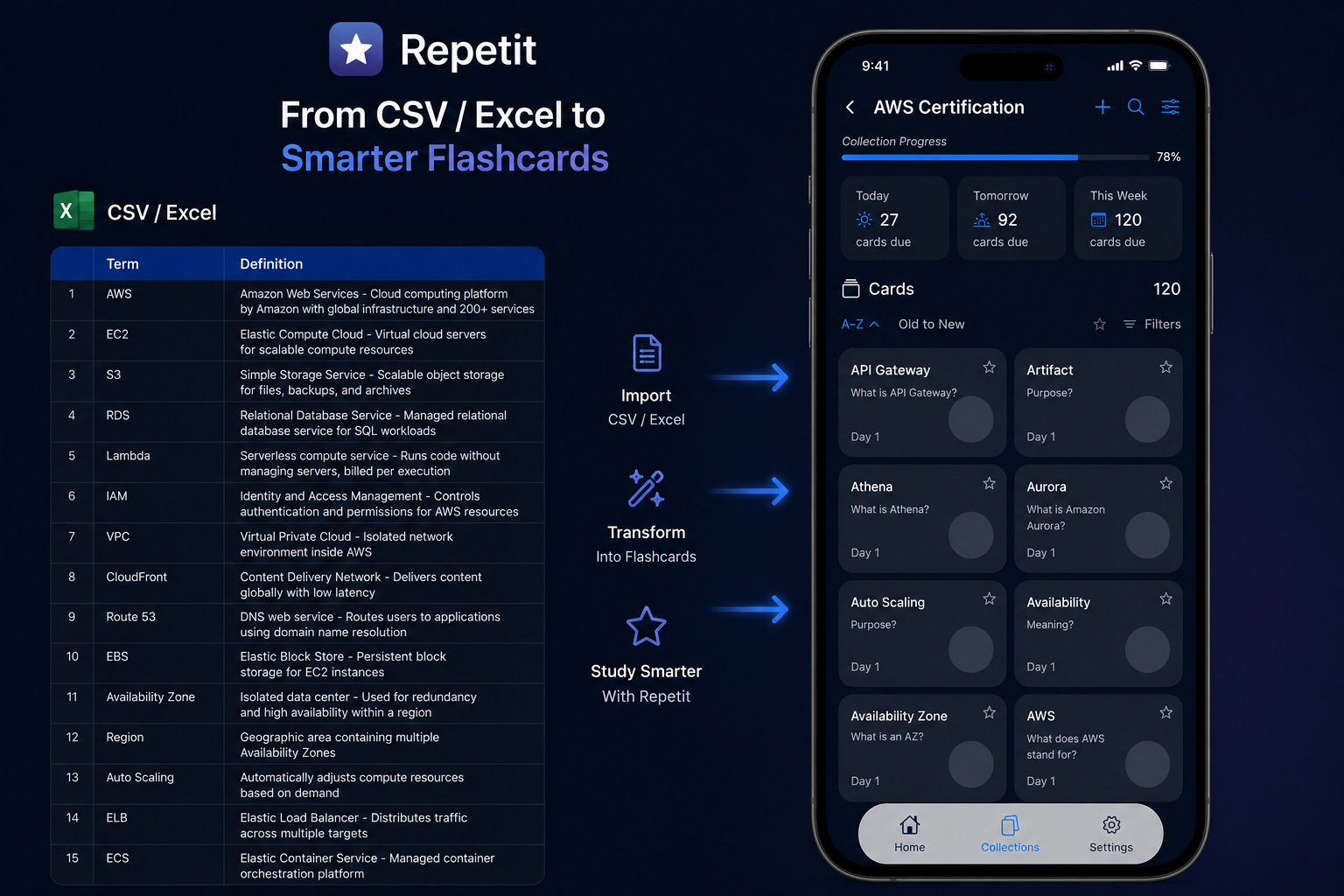
Turn a company glossary, course phrase list, or your own spreadsheet of email formulas into a review deck in seconds.
You can hold a conversation in English. Then you join a call with a client, and the room moves in a language you don't quite have — email openers, negotiation phrases, presentation transitions. Here's how to build a flashcard system for the business English that actually shows up in your work.

Business English isn't really a separate language — it's a specific register, with its own fixed phrases, polite hedges, and unwritten rules about how direct you're allowed to be. General English classes rarely cover it well, and generic vocabulary apps cover it even less, because most of them are still built around single words and their translations.
That's the exact gap business English flashcards are meant to close. Instead of a random word list, you build a deck out of the actual language you need at work: terms specific to your industry, phrases you write in email every week, language for pushing back in a negotiation, and the transitions that hold a presentation together.
Below: why generic vocabulary lists fail at this specific job, the four content areas worth carding, real bad-vs-good card examples for each one, a step-by-step system for building your own deck, and what to do once the deck is built so the phrases actually come out under pressure — not just on a quiz.
General courses teach you to describe your holiday and order food. Nobody drills "let's circle back on this" or "I'll loop you in" — phrases you'll hear in your first week at any English-speaking company.
You know the grammar, but your emails still read stiffly formal or oddly blunt, because email phrasing follows conventions no grammar rule teaches — only repeated exposure does.
You can say what you mean slowly, alone, with time to think. Under the time pressure of a live negotiation or a question from the audience, the right phrase doesn't come — so you either go silent or default to blunt, undiplomatic English.
Every industry and every company layer on their own acronyms, product names, and internal shorthand. A generalist word list can never keep up — that vocabulary only exists inside your actual meetings and documents.
None of this means your English is lacking. It means the material you studied and the material your job demands were built for two different purposes. A grammar-focused course optimizes for accuracy across general topics; your job needs a narrow, high-frequency set of formulas used correctly and quickly, under time pressure, in front of people whose opinion of you matters.
Business English has two properties that make it a near-perfect fit for flashcards. First, it's mostly made of a closed, learnable set of recurring chunks — a working professional realistically needs a few hundred email phrases, negotiation moves, and presentation transitions, not tens of thousands of random words.
Second, spaced repetition only resurfaces what you're about to forget. A phrase you've used confidently for months barely appears in your review queue; a phrase you keep fumbling gets shown more often, right before you'd otherwise lose it. That's exactly the kind of targeted repetition that turns "I recognize this" into "this comes out automatically in a meeting."
And because reviews take 10–15 minutes and work offline, a deck fits into the gaps a busy schedule actually has — before a call, on a commute, between meetings — instead of requiring a dedicated hour you don't have.
There's also a compounding benefit that a one-off course can't offer: every new email, meeting, or negotiation you go through becomes raw material for the next card. The deck keeps pace with your actual career instead of freezing at whatever level a course left you at six months ago.
Words like stakeholder, deliverable, bandwidth, leverage, or KPI — plus whatever acronyms and product names are specific to your company. Card these inside a full sentence, not as an isolated word.
The fixed formulas that make an email sound natural instead of translated: how to follow up, how to attach a file, how to politely push a deadline, how to close without sounding abrupt.
Phrases for making an offer, rejecting one diplomatically, asking for a concession, stalling for time, and signaling what's actually a deal-breaker versus what's just a preference.
The connective phrases that hold a talk together: moving between slides, summarizing, inviting questions, and buying yourself a second to think when you're asked something hard.
1. A business term
Technically correct, but gives no sense of how the word actually sits in a sentence.
Now the card teaches the word's meaning and exactly which nouns it pairs with.
2. An email phrase
Doesn't teach how professionals actually announce an attachment.
The card teaches the exact formula, not just one word inside it.
3. A negotiation phrase
Doesn't show how to actually say this to another person without sounding aggressive.
The card teaches how to be direct without sounding confrontational — the actual skill being tested.
4. A presentation transition
Correct, but doesn't give you a line you can actually say to close a talk.
The card teaches the exact signpost, not just the underlying verb.
| Content area | What generic lists get wrong | What to card instead | Example chunk |
|---|---|---|---|
| Terms & Concepts | Bare word + definition | Word in a sentence + collocation | "leverage + client relationships" |
| Email Phrases | One vocabulary word from the phrase | Whole sentence formula, fill-in-the-blank | "Please find attached ___" |
| Negotiation Language | Term without tone guidance | Phrase + note on firmness/formality | "That's not quite what we had in mind." |
| Presentation Language | Isolated connector word | Full transition phrase, in sequence | "That brings me to my final point." |
Email openers, meeting transitions, and negotiation moves recur constantly, in nearly the same wording. Learning the formula once, correctly, is more valuable than learning ten related but disconnected words.
"No" and "that's not quite what we had in mind" carry the same core meaning but land completely differently in a negotiation. A card that ignores tone teaches half the skill.
A meeting doesn't pause while you translate in your head. Reviewing full chunks trains the phrase to come out as a single unit, the way a native speaker produces it — not word by word.
A native colleague notices "raise a concern" versus an unnatural pairing much faster than they'd notice a slightly wrong vocabulary word. Chunk cards teach exactly which words travel together.
Separate decks for Terms, Email Phrases, Negotiation Language, and Presentation Language. Each has its own texture, and mixing them makes it harder to review with the right mindset for each.
Before reaching for a generic list, scan your last twenty sent emails and your last few meeting notes for phrases you translated awkwardly or avoided using. These are your highest-value cards.
If your company or course provides a glossary or phrase list in a spreadsheet, import it as CSV or XLSX directly into a collection rather than manually typing each entry.
Put the work scenario on the front — "a client pushes back on price" — and the phrase on the back. This trains you to retrieve language by situation, which is how it's actually needed in real time.
For negotiation and pushback phrases, add a short line on formality and firmness — "polite but firm," "casual, use with familiar clients" — so you know when each phrase is appropriate.
Play back tricky terms and phrases with text-to-speech before a big call or presentation, so the first time you say a phrase out loud isn't in front of the client.
10–15 minutes each morning is enough for maintenance. Before a big meeting or presentation, do a quick targeted review of just that collection.
Turn a company glossary, course phrase list, or your own spreadsheet of email formulas into a review deck in seconds.
Keep Terms, Email Phrases, Negotiation Language, and Presentation Language as distinct decks, each tracking its own progress.
Hear any card read aloud — useful for rehearsing pronunciation and stress on phrases before you have to say them live.
Add tone notes, formality labels, or a short scenario to any card, so the phrase comes with the context you need to use it correctly.
Review before a call, on a commute, or between meetings — no internet connection required, with progress syncing automatically after.
See which phrases are solid and which are still shaky before you walk into the meeting where you'll actually need them.
Have you actually heard or needed this phrase at work? If yes, it's a strong candidate — real usage beats any generic list.
Is this a whole phrase, not a single word? If you're about to card one word alone, stop and find the fuller sentence or formula it belongs to.
Does the tone or formality matter? If the phrase could sound rude or overly stiff if misused, add a one-line note on when to use it.
Is the pronunciation tricky? Attach audio so you can rehearse it before saying it out loud for the first time in front of someone.
If none of this applies: it might be a generic word better left in a broader vocabulary deck, not a dedicated business English collection.
A business English deck built during your first months in a role and maintained afterward becomes a permanent asset, not a one-time study project. Every awkward email, every negotiation you weren't sure how to phrase, every presentation question that caught you off guard is a candidate for a new card — and each one you add makes the next similar situation easier.
Over a year, this turns into a personal phrasebook shaped exactly around your job, not a generic textbook's guess at what you might need. That's the real advantage over cramming a business English course once and hoping it sticks — the deck grows with your career instead of expiring the moment the course ends.
It also changes how a new role feels. The colleagues who sound naturally fluent in meetings usually aren't more talented at English — they've simply had more repeated exposure to that company's or industry's specific phrasing. A flashcard system compresses years of passive exposure into months of deliberate, spaced practice, which is exactly why it works as well for a business register as it does for any other kind of vocabulary.
Fixed phrases and chunks work best: email openers and closers, negotiation language, presentation transitions, and industry terms used in a full sentence. Single isolated words work poorly for business English, because most of its usefulness comes from the exact phrasing, not the individual word.
A regular vocabulary card usually tests a word and its meaning. A business English card should test a whole functional phrase in a real work context — for example, the front shows a meeting situation and the back shows the exact phrase a native speaker would use, plus a short usage note on tone and formality.
10–15 minutes a day is enough for steady progress. Because spaced repetition only resurfaces phrases you're close to forgetting, you're never re-reviewing material you already know well, which keeps daily sessions short even as your deck grows.
Yes. Any glossary, phrase list, or course vocabulary exported to a spreadsheet can be imported as CSV or XLSX and turned into a review deck in seconds, instead of manually retyping every phrase.
Generic lists are a reasonable starting point, but the highest-value cards come from your own meetings, emails, and calls. A phrase you actually heard a colleague or client use, carded the same day, is far more relevant than a generic phrase from a textbook you may never need.
Yes. Repetit's text-to-speech reads back the front or back of any card, which is especially useful for phrases with tricky stress patterns or terms borrowed from other languages, so you can rehearse how they actually sound before saying them out loud in a meeting.