
10 Flashcard Mistakes That Kill Your Retention
You're doing spaced repetition every day and still forgetting half your deck. The algorithm isn't broken — the cards are. These are the 10 flashcard mistakes that quietly wreck recall, with real bad-vs-good examples and a concrete fix for each.
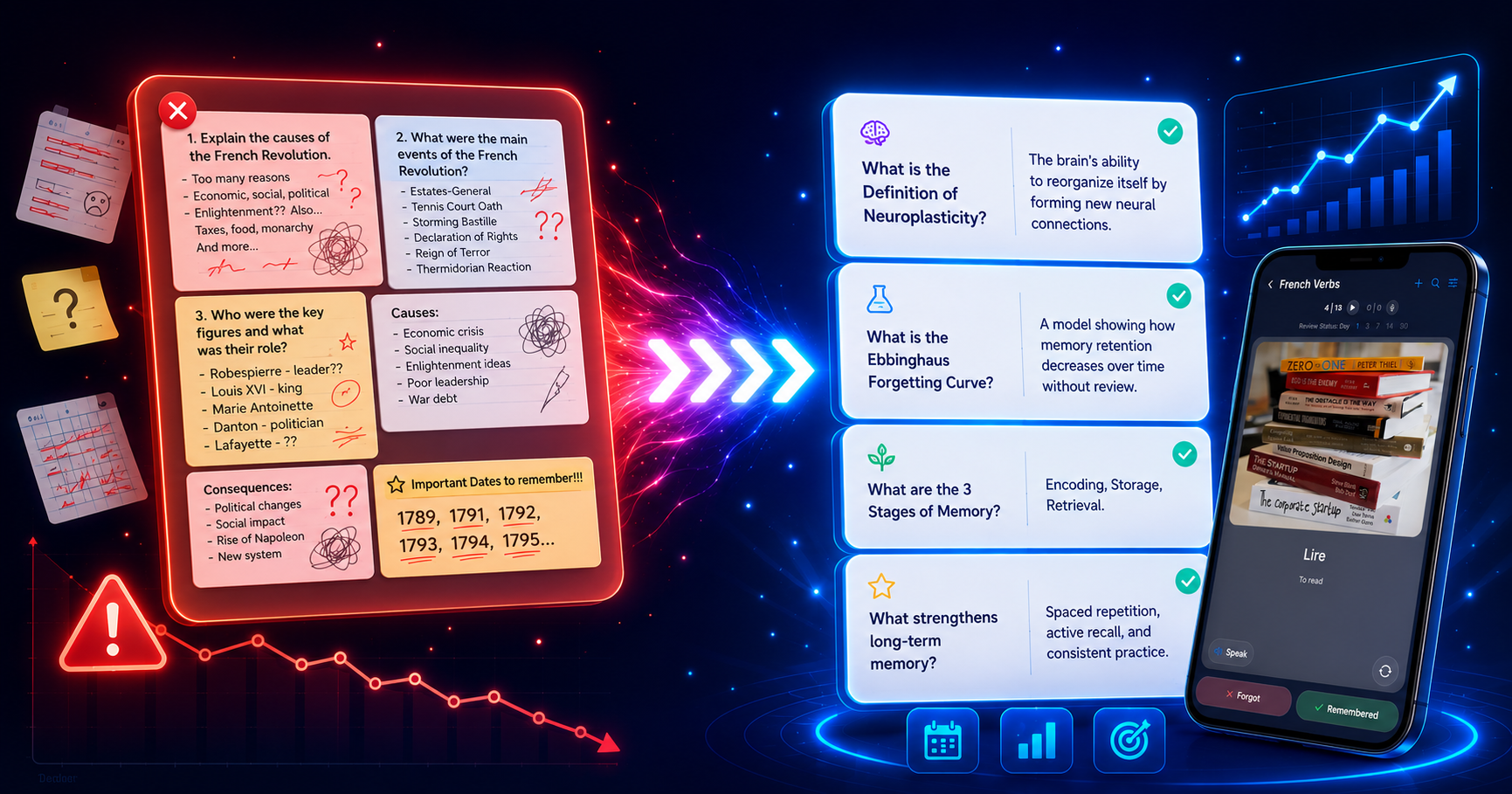
Spaced repetition has a reputation problem. People try it, follow the schedule diligently, and still forget material they've reviewed ten times — so they conclude the method doesn't work for them. In almost every case, the method is fine. The flashcard mistakes are what's failing.
A spaced repetition algorithm can only schedule reviews correctly if the underlying card gives it something clean to grade. A card that mixes two facts, buries the answer in a paragraph, or gives away the answer in the question breaks that contract — and no amount of reviewing fixes a card that was written wrong in the first place.
Below are the 10 flashcard mistakes we see most often, each with a real bad-card example, a rewritten good-card example, and the specific fix. If you want the positive version of this guide first, see how to make effective flashcards — this article is the mirror image: what to stop doing.
Seven of these mistakes live inside the card itself — wording, length, how many facts get crammed in. The other three are workflow mistakes that have nothing to do with how a card is written: never reviewing what you create, adding too much too fast, and stubbornly re-reviewing a failing card instead of fixing it. Both categories produce the exact same symptom — a deck that feels like it "isn't working" — so both get equal attention here.
The flashcard mistakes that quietly wreck your recall
Cramming two ideas onto one card
This is the most common flashcard mistake by a wide margin. A card that asks for several facts at once is impossible to grade honestly — you might recall two of three answers and have no clean way to rate the card. The minimum information principle exists specifically to solve this: one card, one fact, always. It also has a quieter cost: a multi-fact card that gets rated "hard" pushes every fact inside it onto the same short interval, even the parts you already knew cold — so the cards you actually needed more practice on get buried among ones you didn't.
Nine sub-facts hiding inside one card. Impossible to grade cleanly.
This becomes 3 separate cards — each answerable in one clean attempt.
Writing walls of text
A flashcard is a retrieval trigger, not a study note. If the front takes more than 5 seconds to read, your brain spends its effort parsing the question instead of retrieving the answer — and review sessions start feeling like a chore instead of a quick daily habit.
The context paragraph is doing more work than the question itself.
Same fact, readable in under 2 seconds.
No context — bare, dictionary-style definitions
Memory attaches to meaning. A bare, textbook-style definition gives your brain nothing to hook onto — it's arbitrary text to memorize by brute force. A definition wrapped in a real example gives you a second way back to the answer: through meaning, not just repetition.
Correct — and completely forgettable. Nothing to attach it to.
Same definition, now anchored to a concrete, memorable scenario.
Vague, essay-style prompts
"Explain X" or "Tell me about Y" isn't a flashcard — it's an essay topic. There's no clear line between a right and wrong answer, so you can never honestly rate whether you "knew" the card. A good front is a closed question with exactly one correct answer.
There's no way to "fail" or "pass" this cleanly — every answer is partially right.
One question, one unambiguous answer, instant grading.
Hiding the answer inside the question
Fill-in-the-blank cards are useful — but only if the blank actually requires retrieval. If the missing piece is obvious from spelling, length, or format, you're not recalling anything; you're pattern-matching, and the card silently stops testing what you think it tests.
The blank shape and the "A" already give it away — no real recall happening.
Nothing to lean on — the answer has to come from memory.
Copy-pasting straight from the textbook
Copying a sentence verbatim skips the step where you actually process the idea. The card ends up testing whether you can recognize the source text's exact phrasing — not whether you understand the concept. Rewriting a fact in your own words is a small act of active recall in itself.
Copied straight from the textbook — dense, jargon-heavy, never processed.
Same fact, plain language, proof that you actually understand it.
Creating cards but never reviewing them
This isn't a card-writing mistake — it's the most damaging flashcard mistake of all, and it has nothing to do with how the cards are written. Cards without repetition behind them are just notes with extra steps. The entire value of spaced repetition comes from reviews landing on schedule, not from the act of creating the card.
Retention of newly created cards after 2 weeks with zero reviews — roughly what you'd expect from reading something once and never revisiting it.
Retention of the same cards after 2 weeks with daily reviews on a normal 1–3–7–14 day schedule — no change to the cards themselves.
Adding 100+ new cards in one sitting
Motivation strikes and you build an entire deck in one Sunday afternoon. It feels productive — until every one of those cards becomes due within the same few days, and the review queue turns from a 10-minute habit into an hour-long ordeal you start avoiding.
Reviews due within 3 days after creating 150 cards in one sitting — the queue spikes immediately and stays heavy for weeks.
Steady review load when the same 150 cards are added at 10–15 per day instead — manageable from day one.
Skipping images and audio on visual or spoken material
Text-only cards use a single memory channel. For anything that has a real visual shape — anatomy, geography, art, diagrams — or a real sound — pronunciation, listening — a text-only card throws away a second, often stronger, retrieval route. This isn't a minor nice-to-have: dual coding (pairing verbal and visual memory) is one of the more consistently replicated effects in memory research, and it costs nothing beyond a few extra seconds during card creation. See our guide on multimedia flashcards for the full science behind this.
Correct, but a spatial fact described only in words is hard to visualize under pressure.
The image itself becomes a second, faster route to the answer.
Reviewing a failing card harder instead of fixing it
If a card has failed five, six, eight times in a row, the problem is the card — not your memory. Rating it "Again" for the ninth time and hoping repetition alone will fix it wastes review time that could go toward a card rewritten to actually stick.
Too broad for one card — nothing has changed after 8 failed attempts.
Split into anchored questions — each one now has a clean, memorable answer.
All 10 flashcard mistakes at a glance
| # | Mistake | What it breaks | The fix |
|---|---|---|---|
| 1 | Two facts on one card | Impossible to grade cleanly | Split into separate atomic cards |
| 2 | Walls of text | Slows down every review | Under 15 words on the front |
| 3 | Bare definitions, no context | Nothing to anchor memory to | Add a real example or scenario |
| 4 | Vague, essay-style prompts | No honest right/wrong grading | Rewrite as a closed question |
| 5 | Answer leaks into the question | No real retrieval happens | Remove hints, ask directly |
| 6 | Copy-pasted textbook text | Tests recognition, not understanding | Rewrite in your own words |
| 7 | No repetition at all | Cards decay unreviewed | Attach cards to a daily schedule |
| 8 | 100+ new cards at once | Review queue spikes and burns you out | Cap new cards at 10–20/day |
| 9 | No images or audio | Loses a second memory pathway | Add media for visual/spoken facts |
| 10 | Reviewing failing cards harder | Wastes time on a broken card | Rewrite after 3 failures |
The 10-second check that catches most flashcard mistakes
Does this card test exactly one fact? If answering it requires recalling more than one discrete thing, split it.
Can I read the front in under 5 seconds? If not, trim it — move context to a note field, not the question.
Would two different people give the same answer? If the question is open to interpretation, tighten it into a closed question.
Did I write this in my own words? If it's copy-pasted from a source, rewrite it — even slightly.
Is there a visual or audio element I'm skipping? For anything spatial, visual, or spoken — add it now rather than later.
Am I adding this to today's total, or a fresh batch? If today's new-card count is already at 15–20, save the rest for tomorrow.
Good cards make spaced repetition easy. Bad cards make it feel broken.
None of these 10 flashcard mistakes are about intelligence or effort — they're about card design, and every one of them is fixable in minutes once you know to look for it. Most people don't have a memory problem when spaced repetition isn't working for them; they have a handful of badly framed cards quietly generating most of their frustration.
The fastest way to improve an existing deck isn't to rebuild it — it's to fix the cards you fail most often first. Those are exactly the cards where one of these 10 mistakes is usually hiding.
It's worth separating the two kinds of fixes here. Mistakes 1 through 6 and 9 and 10 are one-time edits — rewrite the card once and the fix lasts forever. Mistakes 7 and 8 are ongoing habits, not edits: no rewrite permanently solves "I don't review" or "I add too many cards at once." Those two need a system, not a correction — which is exactly what a review schedule is for.
Run the 10-second checklist above on your next 10 new cards, and revisit your 5 most-failed cards this week. That alone fixes the majority of what makes spaced repetition feel like it isn't working.
FAQ: flashcard mistakes
What is the single most common flashcard mistake?
Putting more than one fact on a single card. It seems efficient, but it makes the card impossible for you — and for the spaced repetition algorithm — to grade accurately. You might know half the answer and forget the rest, and any rating you give is a compromise that throws off the review schedule.
Why do I keep forgetting the same flashcards no matter how many times I review them?
A card that fails repeatedly is almost always a card design problem, not a memory problem. Common causes: it covers more than one fact, the question is vague, the answer is buried in dense text, or you never actually understood the underlying concept before turning it into a card. Rewrite the card instead of reviewing it harder.
Is it a mistake to copy text straight from my textbook onto a flashcard?
Yes. Copying verbatim skips the mental work of understanding the material, so the card tests whether you can recognize the textbook's exact wording rather than whether you actually understand the concept. Rewriting a fact in your own words is itself a form of active recall and produces a stronger memory trace.
How many new flashcards should I add per day to avoid overloading myself?
10–20 new cards per day is sustainable for most people. Every new card generates roughly four more review events over the following month, so adding 50 cards in one sitting quietly creates 150+ review events that will all come due within the same week. Add cards gradually instead of all at once.
Does it matter if I never add images or audio to my flashcards?
For text-based facts, no. But for anatomy, geography, art, maps, diagrams, or pronunciation, skipping images and audio is a real mistake — it throws away a second retrieval pathway. Dual coding (verbal plus visual or auditory) measurably improves recall for anything that has a real visual or acoustic form.
I made 200 flashcards last month and never reviewed them — is that a wasted effort?
Not wasted, but incomplete. Creating a card without a review schedule behind it captures the fact once but never revisits it before it decays, so most of that effort evaporates within days. The cards still have value — the fix is to start reviewing them on a normal daily schedule now, not to start over.