
Images, Audio & Sketches in Flashcards: Why Multimedia Memory Works
A text-only flashcard sends information through a single channel. Add an image, and you open two more. Your brain stores the fact visually, verbally, and as a relationship between the two — giving you three separate paths to the same memory. This is not a learning-style myth; it's one of the most replicated findings in cognitive psychology.
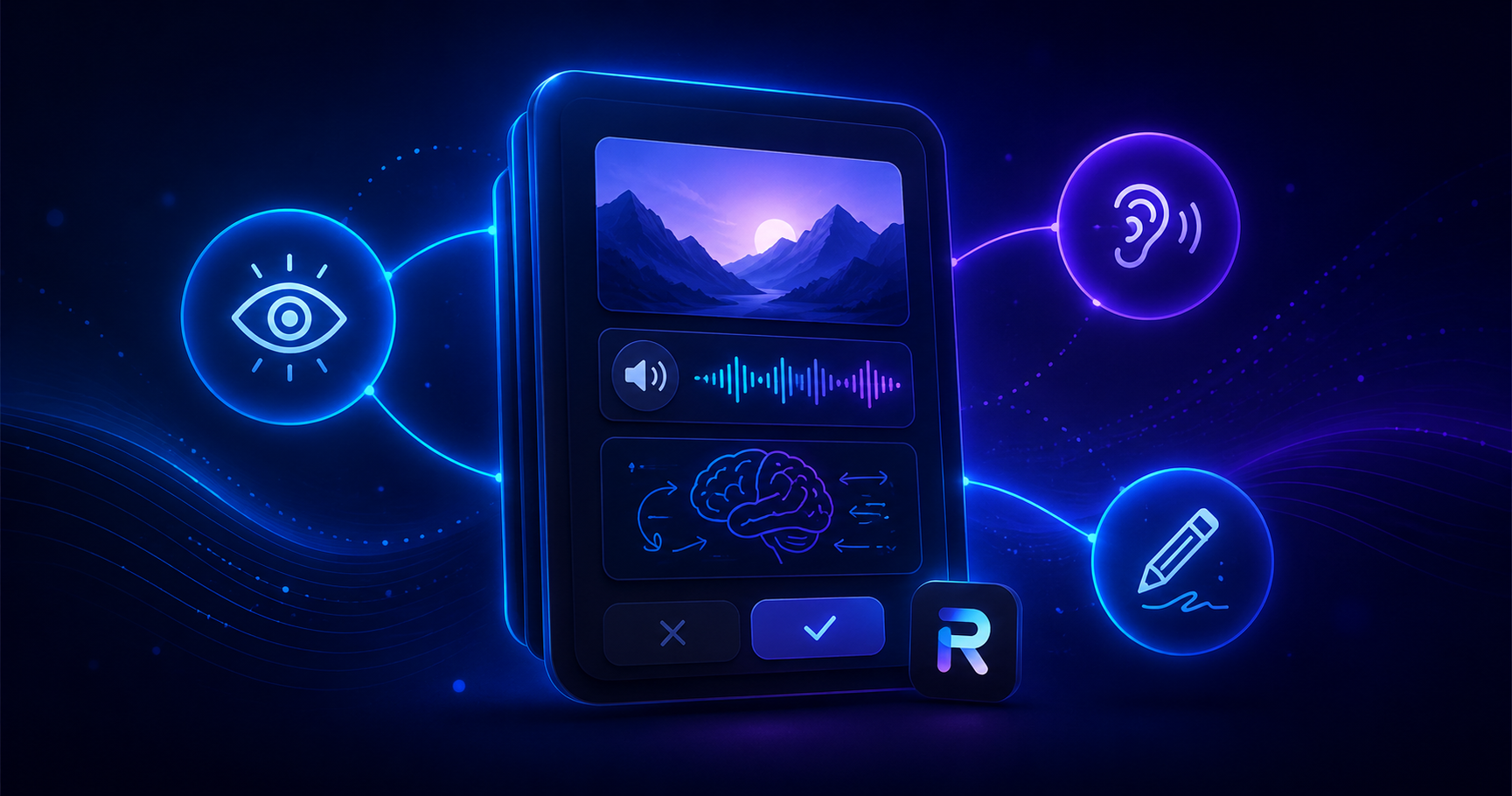
Two theories that explain why multimedia cards work
The brain has two separate memory systems for words and images
Psychologist Allan Paivio proposed that the brain encodes verbal information (words, text, language) and non-verbal information (images, sounds, spatial relationships) in two distinct but interconnected systems. When both systems encode the same concept — for example, the word "mitochondria" alongside a diagram of one — the memory is represented twice, in two independent stores.
The practical consequence: if one pathway degrades over time (you forget the label), the other may still be intact (you can still picture the structure). Two independent encoding routes means twice the probability of successful retrieval.
Images are remembered nearly twice as often as words alone
Lionel Standing's landmark 1973 experiment showed participants 10,000 pictures over five days — and tested recognition one year later. Despite the massive quantity, recognition accuracy remained around 73%. In contrast, word-only lists showed dramatically lower retention. The effect has been replicated dozens of times: visual memory is simply more robust than verbal memory at delay intervals longer than a few hours.
For flashcards, this means that adding an image to a text card doesn't just decorate it — it fundamentally changes how the information is stored, making it accessible through the visual system even when the verbal trace has faded.
Images — the highest-impact addition to any flashcard
An image on a flashcard works on two levels simultaneously. First, it adds a second encoding pathway (dual coding). Second, images tend to be more emotionally distinctive than words, which triggers the amygdala — the brain's emotional processing centre — to flag the memory as more important and consolidate it more strongly during sleep.
The most effective use of images is on the front of the card as the retrieval cue — forcing the brain to process the visual stimulus and retrieve the verbal label, rather than simply recognising text. A diagram with an unlabelled arrow pointing to a structure is a far stronger memory test than "What is the function of X?"
Hard to spatially anchor — you know the names but not where they are relative to each other.
Visual position + verbal label = two independent retrieval routes. Location and name reinforce each other.
Reading a word and hearing a word activate different memory pathways. The phonological loop — the component of working memory that processes speech sounds — is entirely separate from the visual processing system. A vocabulary card that you've only ever seen written will not feel familiar when you hear it spoken at natural speed. This is why reading English and understanding spoken English feel like completely different skills — because neurologically, they partly are.
Adding audio to a card trains the phonological loop alongside visual recognition. For language learners, this means pronunciation confidence is built during regular review — not separately. For music students, hearing the actual interval, chord, or rhythm pattern on the front of the card encodes the sound, not just its label.
You learn the spelling-to-meaning link. But you'll mispronounce it and won't recognise it when spoken to you.
Repeat aloud before flipping.
Listening + speaking + reading + meaning — four encoding events per review.
Drawing is one of the most powerful encoding strategies identified in memory research — consistently outperforming re-reading, note-taking, and even writing words out by hand. A 2016 study by Wammes, Meade, and Fernandes at the University of Waterloo found that participants who drew to-be-remembered words recalled them an average of 29 percentage points higher than those who only wrote them.
Why? Drawing forces elaborative encoding — to draw a concept, you must actively reconstruct its shape, structure, and internal relationships. You can write "mitochondria" while half-asleep. You cannot draw one without thinking about what it actually looks like. That cognitive effort is the encoding event. The sketch itself, added to the card, then becomes a visual retrieval cue during review.
Critically: artistic quality doesn't matter. A rough functional diagram encodes information just as effectively as a polished illustration. The encoding happens in the act of drawing, not in the quality of the result.
You can memorise this definition without ever visualising the structure. High chance of superficial knowledge.
The sketch forces you to reconstruct the structure on creation. On review, the visual triggers instant recognition of the rule.
When to use each media type — by subject
| Subject | Image | Audio | Sketch | Best use |
|---|---|---|---|---|
| Medicine / Anatomy | – | Diagrams with unlabelled callouts | ||
| Language learning | – | Image + audio together for vocabulary | ||
| Geography | – | Unlabelled maps for location recall | ||
| Music theory | – | Audio clips as the primary cue | ||
| Programming / CS | – | – | Hand-drawn data structures and flows | |
| History | – | Maps for events; timelines for sequences | ||
| Chemistry | – | Molecular structures and reaction diagrams | ||
| Art history | – | – | Artwork thumbnail → artist, period, movement | |
| Law / Definitions | – | – | – | Text-only is usually sufficient |
| Mathematics | – | – | Geometric diagrams and function graphs |
Combining all three: a trimodal card
For concepts that are genuinely high-priority — must-know vocabulary, core anatomy, essential musical skills — combining all three media types creates what memory researchers call elaborative encoding: multiple distinct representations of the same fact, each activating the others during retrieval.
A trimodal vocabulary card for language learning, for example:
"毎年、桜が咲くのを楽しみにしています。" (I look forward to the cherry blossoms blooming every year.)
This card activates: auditory memory (the sound), visual memory (the image), verbal memory (the kanji, romanisation, and translation), and semantic memory (the example sentence in context). Four independent retrieval paths to one word.
Reserve trimodal cards for vocabulary that genuinely matters — high-frequency words, words you keep forgetting, or words central to your current study goal. Creating this level of card for every word is unnecessary and time-consuming. For the top 10–20% of your deck by importance, it's extremely effective.
FAQ: multimedia flashcards
Do images on flashcards actually improve memory?
Yes — significantly. The picture superiority effect is one of the most replicated findings in memory research: images are recalled at roughly twice the rate of text alone after a delay. When an image is paired with a word or concept, it creates a second retrieval pathway through the visual system. If the verbal pathway fades, the visual one may still surface the memory.
What is dual coding theory?
Dual coding theory (Allan Paivio, 1971) proposes that the brain stores verbal and non-verbal information in two separate but linked systems. When both systems encode the same concept — for example, the word "dendrite" alongside a diagram — the memory is represented twice. Two independent stores mean twice the chance of successful retrieval, and the systems reinforce each other during review.
When should I use audio on flashcards?
Audio is most valuable when the sound of something is part of what needs to be learned: foreign language pronunciation, musical intervals and chords, listening comprehension training, and medical terminology with oral exams. For subjects where only meaning matters and spoken production isn't a goal, text-only cards are sufficient.
Is it worth making sketches on flashcards?
Yes — research by Wammes et al. (2016) found that drawing a concept improves recall by roughly 29 percentage points over writing it. Drawing forces elaborative encoding: you must reconstruct the structure, shape, and relationships of the concept, which is itself a powerful memory event. Artistic quality doesn't matter — a rough functional diagram encodes just as effectively as a polished illustration.
Should every flashcard have an image?
No. Images help most when the concept has a visual form — anatomy, geography, vocabulary with concrete referents, chemistry, art. For purely abstract concepts, legal definitions, or mathematical formulas, text-only cards can be equally effective. A quick heuristic: if you can answer "what does this look like?", add an image. If you can't, don't force one.