
Space out review
Instead of one long session, review the same material a few times across increasing gaps — right before you'd otherwise forget it. Each well-timed pass buys the memory more time before it needs reinforcing again.
You read a fact, nod, move on — and twenty seconds later it's gone. That's not a failing memory. That's how memory works: most information is only ever meant to be temporary, unless something tells your brain it's worth keeping.
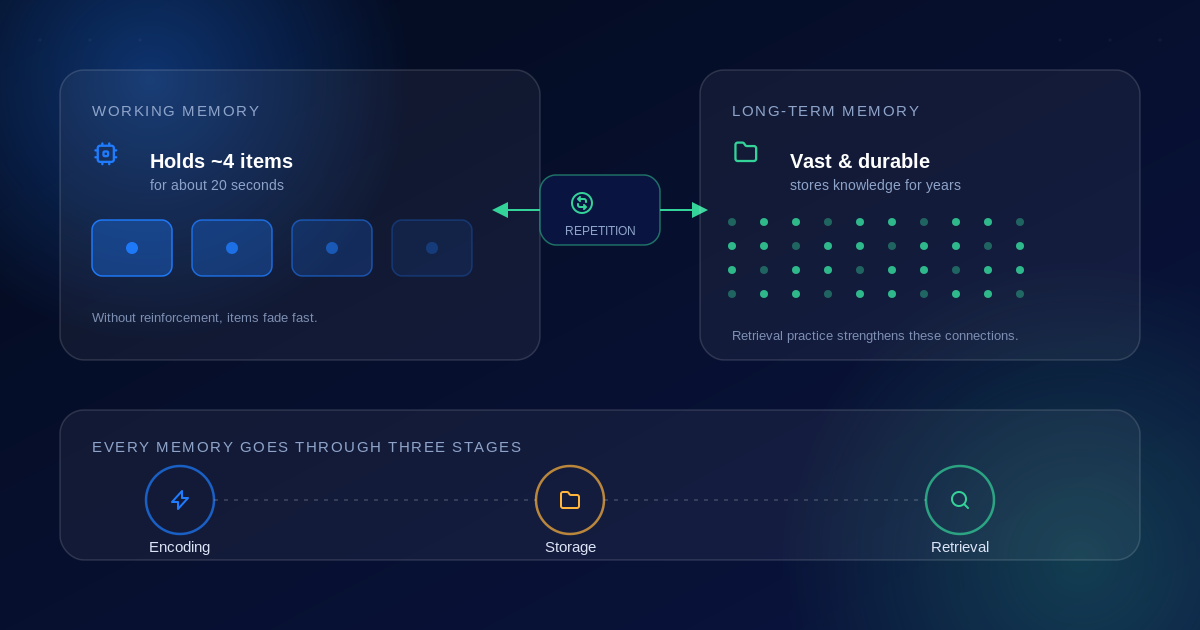
Understanding how memory works starts with one simple idea: memory isn't one system, it's several. What you use to hold a phone number for ten seconds is not the same system that lets you recall your childhood address twenty years later.
Psychologists group memory into a small number of distinct types of memory, each with its own capacity, duration, and job. The two that matter most for learning are working memory — small and temporary — and long-term memory — vast and durable.
The gap between them explains almost everything about why studying sometimes "doesn't stick," and why repetition is the single most reliable bridge between the two.
None of this is abstract trivia. Once you can see which system a piece of information is currently sitting in — a fleeting thought in working memory, or a durable fact in long-term storage — it becomes much easier to diagnose why a study session isn't working, and exactly what to change about it.
Your senses take in raw information and your brain converts it into a form it can work with. Distracted, shallow encoding (skimming while multitasking) produces a weak trace before storage even begins, no matter how much time gets spent afterward trying to fix it.
The encoded information is held somewhere in the brain — briefly in working memory, or more durably in long-term memory if it was reinforced enough to make the transfer. Most information that's ever going to be forgotten is lost at this stage, quietly, without any obvious signal that it's happening.
Retrieval pulls a stored memory back into conscious awareness. Crucially, each successful retrieval also re-strengthens the memory — which is why testing yourself works better than simply reviewing, and why a memory you retrieve often becomes easier to retrieve again later.
Modern estimates put working memory at roughly 3–5 chunks of information at once — smaller than the famous "7 ± 2" figure from the 1950s. Grouping details into fewer, bigger chunks is how you work around the limit.
Left alone, an item in working memory fades in roughly 15–30 seconds. Silently repeating it (rehearsal) can keep it active a little longer, but it still won't become a lasting memory on its own.
A new interruption — a notification, a new task, a stray thought — can knock out whatever working memory was holding. This is why multitasking during studying quietly erases progress you thought you'd made.
Working memory isn't a flaw in the system — it's doing exactly what it evolved to do: hold just enough, just long enough, to act on it. The problem only shows up when we expect a single pass through working memory to count as "learning." It doesn't. Without something to push the information further, it's designed to disappear.
It's also worth clearing up a common mix-up: "short-term memory" and "working memory" are often used as if they're the same thing, and in casual writing they usually are. Strictly speaking, short-term memory refers to the brief storage of information, while working memory describes the same brief storage plus the ability to actively manipulate what's held there — doing mental math, rearranging a sentence, comparing two ideas at once. For the purposes of studying, the distinction rarely matters; what matters is that both are small and both are temporary.
Phonological loop. Holds and silently "replays" verbal and sound-based information — this is what you use when you repeat a new name under your breath so you don't lose it.
Visuospatial sketchpad. Holds visual and spatial information — picturing a route, mentally rotating a shape, or holding an image of a flashcard's diagram in mind.
Central executive. Directs attention between the other components, decides what to focus on, and is the first thing disrupted by interruptions or multitasking.
Episodic buffer. Added to the model later, it binds information from the loop, the sketchpad, and long-term memory into a single, coherent moment of experience.
Facts, vocabulary, concepts, and general knowledge — the kind of information flashcards are built to strengthen, independent of when or where you learned it. Most academic and professional studying lives here.
Personal experiences and events tied to a specific time and place — what you did last summer, or the day you learned a particular fact. It's often easier to recall than semantic memory because it comes with a built-in context.
Skills and habits built through repeated practice — typing, riding a bike, pronouncing a language fluently — that run with little conscious thought once they're established.
Memories tagged with a strong feeling get prioritized for storage — which is one reason vivid examples and personal stakes make facts easier to remember than dry, neutral ones.
These categories aren't just academic labels — they explain why some things stick effortlessly while others need deliberate work. You'll probably never forget how to ride a bike (procedural), and you'll likely remember exactly where you were during a major life event (episodic). Semantic facts, like a vocabulary word or a formula, get none of that automatic reinforcement, which is exactly why they need a system like spaced repetition to receive the repeated retrieval they don't get for free.
| Feature | Working memory | Long-term memory |
|---|---|---|
| Capacity | About 3–5 chunks | No known practical limit |
| Duration | Roughly 15–30 seconds | Days to a lifetime |
| What it holds | What you're actively thinking about right now | Facts, skills, experiences, and concepts |
| Main vulnerability | Interruptions and new information | Lack of use — retrieval strengthens it, disuse weakens it |
| Everyday example | Holding a new phone number just long enough to dial it | Remembering your childhood address years later |
| How to strengthen it | Reduce distractions, chunk information | Repetition, retrieval practice, sleep |
Each time the same neural pathway fires, the connection between those neurons gets physically stronger — "cells that fire together, wire together." This is called long-term potentiation, and it's the biological basis of practice.
During sleep, the hippocampus replays recent experiences and gradually transfers them into the cortex for longer-term storage. Skipping sleep after studying interrupts this transfer before it's finished.
Actively pulling a memory back out — active recall — reinforces it more than simply looking at it again. Every successful retrieval is itself a small rehearsal that deepens the trace further.
This is also exactly why the Ebbinghaus forgetting curve looks the way it does: without any of these three mechanisms, a memory fades on a predictable schedule. Add a review at the right moment, and the curve resets and flattens — the entire premise behind spaced repetition.
None of these three mechanisms work well in isolation. Repeating something once without sleeping on it barely helps; sleeping well after a single glance doesn't either. It's the combination — repeated retrieval, spaced out over time, protected by real sleep — that reliably turns a fragile, 20-second working-memory trace into a long-term memory you can recall years later.
This is also why cramming and repetition can look similar on the surface but produce completely different results. Cramming repeats information within the same short window, before the memory has had any chance to fade — which trains almost nothing, because there's no forgetting for the retrieval to overcome. Spaced repetition deliberately waits until the memory is weak enough to require real effort to retrieve, which is exactly the condition long-term potentiation needs to kick in.
Hermann Ebbinghaus ran the first rigorous memory experiments on himself in the 1880s, memorizing nonsense syllables and timing exactly how fast he forgot them — the origin of the forgetting curve. Decades later, in 1956, psychologist George Miller published "The Magical Number Seven, Plus or Minus Two," proposing that short-term memory holds about seven items — a figure so catchy it became pop psychology, even though later research narrowed the real number closer to four.
In 1974, Alan Baddeley and Graham Hitch replaced the idea of one single short-term store with the multi-part working memory model described above — separating verbal, visual, and attentional processes that had previously been lumped together.
Perhaps the most striking evidence came from an unplanned experiment: in 1953, a patient known for decades only by his initials, H.M., had large parts of his hippocampus surgically removed to treat severe epilepsy. He could still hold a conversation using working memory and could still learn new physical skills, but he lost the ability to form any new long-term factual or personal memories at all. His case, studied for the rest of his life, gave researchers the clearest proof that working memory and long-term memory are handled by genuinely separate brain systems — not just two ends of the same process.
Instead of one long session, review the same material a few times across increasing gaps — right before you'd otherwise forget it. Each well-timed pass buys the memory more time before it needs reinforcing again.
Close your notes and try to answer from memory first. Retrieval is what strengthens a memory — rereading mostly just feels familiar, without producing the same lasting effect.
Sleep is when the brain consolidates the day's new information. Studying late and skipping sleep undercuts the memory you just built, no matter how good the session felt at the time.
Linking new information to something you already know gives it more retrieval paths — more ways for your brain to find it again later, even if one path fades.
Pairing text with an image, sound, or your own handwriting creates multiple routes back to the same memory, making it more resilient to a single cue failing.
Give new material your full attention the first time. A distracted first pass produces a weak trace that no amount of later review fully fixes, because there's little substance there to strengthen.
Switching between tasks doesn't run them in parallel — it interrupts working memory over and over, so encoding quality drops for both tasks at once, and the total time spent often ends up higher, not lower.
Forgetting doesn't erase a memory trace completely — relearning forgotten material is almost always faster than learning it the first time, evidence that something was retained under the surface all along.
True eidetic memory in adults is exceptionally rare and not well documented under controlled conditions. What looks like it is usually the result of expert-level chunking and heavy, deliberate practice in one narrow domain.
Cramming mostly fills up working memory for the length of the exam. Without spacing and retrieval afterward, most of it fades within days — sometimes within hours of walking out of the room.
Hours spent don't automatically translate into retention — a distracted, passive hour builds a far weaker trace than twenty focused minutes of active retrieval and real self-testing.
Memory is reconstructive, not a replay of stored footage. Each time you recall something, your brain rebuilds it from fragments — which is also why memories can shift slightly, and become less accurate, each time they're retrieved and re-stored.
Most of these misconceptions share a root cause: they treat memory as a fixed, all-or-nothing recording device instead of an active, reconstructive process. Once you see memory as something built and rebuilt through repeated retrieval, the advice that actually works — spaced review, self-testing, protected sleep — stops sounding like a study hack and starts sounding like the obvious conclusion.
Once you understand how memory works — a small, fast working memory feeding into a vast, durable long-term store — a lot of study advice stops sounding like folklore and starts sounding like engineering. Repetition isn't a study "trick." It's the literal mechanism your brain uses to decide what's worth keeping.
That's exactly the gap flashcards and spaced repetition are built to close: short, active retrieval sessions, timed to hit each memory right before it would otherwise fade, until it moves fully into long-term storage.
You don't need to memorize the neuroscience to benefit from it. Just remember the core idea: one exposure rarely survives, but a few well-timed retrievals almost always do.
The next time a study session feels like it "isn't sticking," ask which stage is actually failing — weak encoding from distraction, no reinforcement to move it into storage, or too little practice retrieving it. The answer usually points straight at the fix.
Working memory is a small, temporary workspace that holds a few pieces of information for about 20 seconds while you actively use them. Long-term memory is a much larger, durable store that can hold information for years. Information has to pass from working memory into long-term memory — usually through repetition — or it simply fades.
Modern research puts the practical limit at around 3 to 5 chunks of information at a time, lower than the once-popular "7 plus or minus 2" figure. A chunk can be a single digit or a whole familiar phrase — grouping information into fewer, larger chunks is one of the easiest ways to work around this limit.
Mainly through repetition, retrieval, and sleep. Each time you rehearse or successfully recall a piece of information, the connection between the neurons that represent it gets physically stronger — a process called long-term potentiation. Sleep then helps the brain replay and transfer that day's new information into more stable, long-term storage.
Most one-time exposures never make it past working memory, so there was never a durable long-term trace to lose in the first place. When something was studied but not reinforced, the memory trace weakens over time — which is why review timed just before you'd forget is so effective at making it stick.
Yes. During sleep, the brain replays recently learned material and transfers it from short-term storage in the hippocampus to more permanent storage in the cortex. Cutting sleep short after a study session can measurably reduce how much of that session is retained the next day.
Flashcards force active retrieval instead of passive rereading, and retrieval is one of the strongest triggers for strengthening a memory trace. Spaced repetition times each retrieval attempt for just before you'd naturally forget, which repeatedly pushes information from a fragile state into stable long-term storage with the fewest possible reviews.