

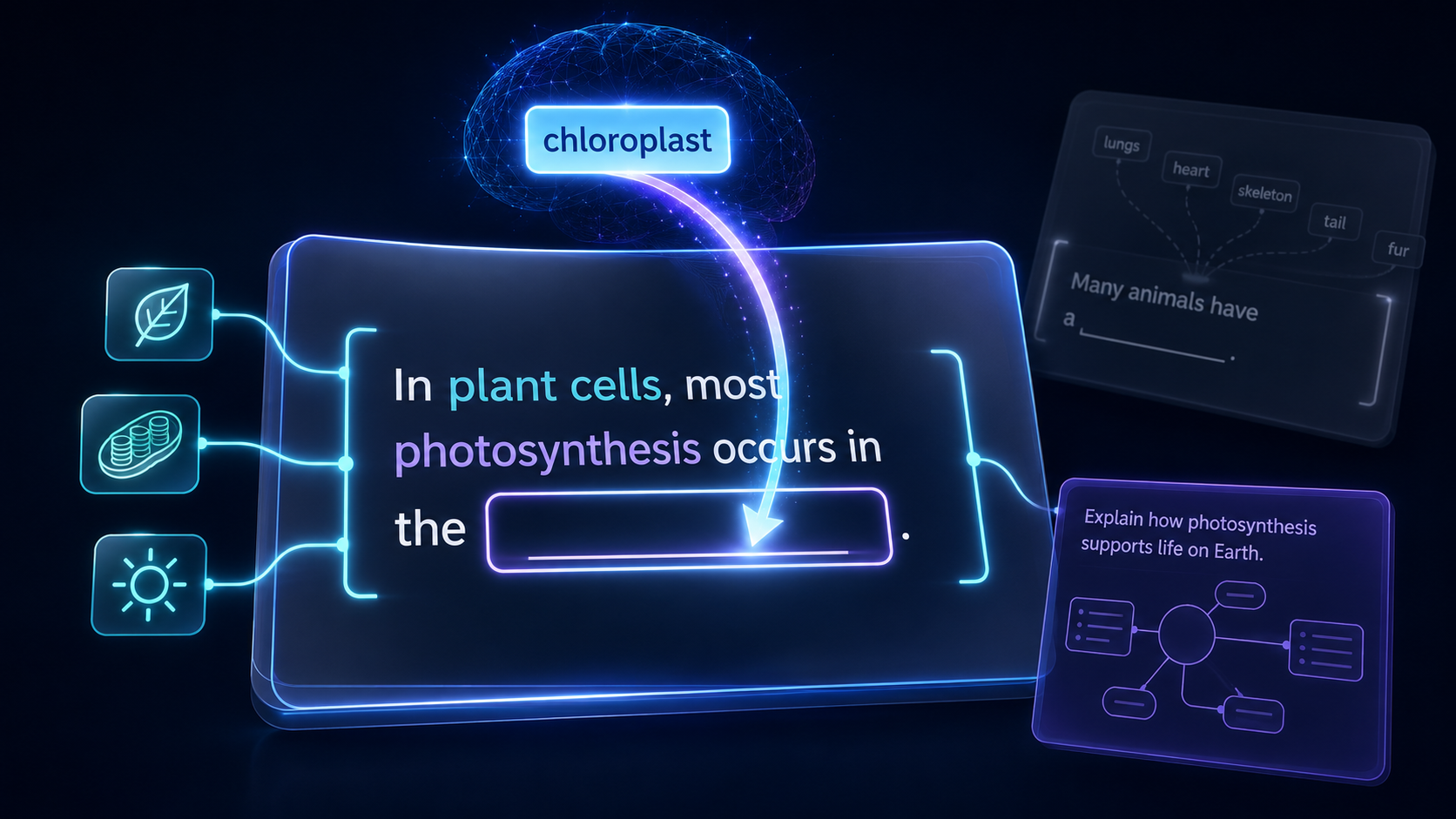
An image occlusion flashcard covers a label or region of an image. You try to identify the hidden information, then reveal it and check your answer. It is a convenient way to turn anatomy plates, maps, labeled diagrams, and similar visual material into cued-recall prompts.
The method is best understood as a card format, not as a separately validated learning technique. It can be used to practise retrieval and to distribute that practice over time. Evidence supports those broader learning activities, but direct research comparing image occlusion with other ways of studying visual material is limited.
Evidence in one sentence: retrieval practice and spaced or distributed practice can improve later retention; that evidence does not demonstrate a special advantage for image occlusion or show that it is suitable for every visual task.
Anatomy and histology
Identify a labeled structure while useful landmarks remain visible.
Maps
Recall a place, feature, or boundary from its position and surrounding geography.
Scientific diagrams
Name a component in a cell, circuit, apparatus, or process diagram.
Interfaces and equipment
Identify a control or component when visual recognition is part of the real task.
Image occlusion is a weaker fit when the real goal is to explain a mechanism, solve a problem, interpret an unfamiliar image, or perform a procedure. A hidden label can test identification, but it does not automatically test those broader outcomes.
Choose an accurate, legible source
Check labels against a trustworthy source and use an image that remains readable on the device where you will review it. If you publish, share, or distribute the card or deck, make sure you have permission to reuse the image; private study does not automatically require publication rights, although the source’s terms still apply.
Define the response
Decide whether the card asks for a name, location, boundary, direction, or other specific answer. If several answers would be reasonable, clarify the prompt.
Mask the target, not the context
Cover enough to hide the answer while retaining landmarks needed for orientation. Check that the mask’s size or position does not reveal the answer.
Attempt recall before revealing
State the answer, then uncover it and correct errors. Merely revealing and rereading the label removes the retrieval attempt.
Review again after a delay
There is no universal optimal interval sequence. Adjust later reviews to your performance and to how long you need to retain the material.
| Goal | Useful prompt | Add another task when… |
|---|---|---|
| Name an anatomical structure | Hide its label but leave relevant landmarks visible. | You must also explain its function, innervation, or clinical significance. |
| Locate a country or region | Cover the name while retaining surrounding geography. | You must interpret demographic data, history, or an unfamiliar map projection. |
| Identify a diagram component | Hide the component name and ask for it explicitly. | You must explain the system, predict an outcome, or troubleshoot a fault. |
Use a separate question-and-answer card, worked problem, sketch, or practice case for the additional task. Practising the label and practising the explanation are related, but they are not the same test.
Weak evidence of learning
- Recognising the answer only after it appears
- Guessing from mask shape, label length, or card order
- Memorising one diagram when the assessment uses unfamiliar views
- Treating label recall as proof of explanation or application
More informative practice
- Producing the answer before revealing it
- Keeping cues clear but not answer-revealing
- Checking the same structure in another valid view when needed
- Adding direct questions for function, mechanism, and decisions
Hiding one label at a time is often easier to score, but it is not a scientific rule that every card must contain exactly one mask. Some tools generate several cards from one image while testing one target on each card. What matters is that the expected response is clear and that irrelevant clues do not do the retrieval for you.
Important boundary: these studies do not show that recalling a label from one image guarantees transfer to a different image, viewpoint, or applied problem. Include those tasks when they match your goal.
What is an image occlusion flashcard?
An image occlusion flashcard covers a label or region of an image and asks you to recall what is hidden before revealing it.
Are image occlusion flashcards effective?
Image occlusion can turn a labeled image into a retrieval prompt. Evidence supports retrieval practice and spaced or distributed practice broadly; it does not establish a special advantage for image occlusion over other suitable study formats.
Should I hide one label or every label?
Either setup can be usable. A focused prompt is easier to score, while keeping nearby landmarks visible can preserve orientation. Avoid leaving clues that make the answer obvious.
Can image occlusion teach understanding as well as labels?
Recalling a hidden label tests that label in its visual context. If the goal also includes function, mechanism, comparison, or diagnosis, add a separate prompt that directly tests that outcome.


Build focused flashcards for what you need to remember
Use clear prompts, attempt retrieval, and space later reviews instead of relying on familiarity.