

You do not have to memorize every sentence to deliver a speech from memory. The practical goal is to know what you want to say, why each part belongs, and how to move to the next idea. Your wording can change while the message stays consistent.
Start with the audience: what should they understand, feel or do by the end? Use that purpose to decide which points and examples are essential. If the argument is unclear on paper, simplify it before trying to remember it.
Keep exact wording where it matters. A quotation needs accurate wording; an opening sentence or final request may benefit from deliberate phrasing. You can rehearse those passages closely while explaining the rest in your own words. Follow any requirements of the occasion for scripted text.
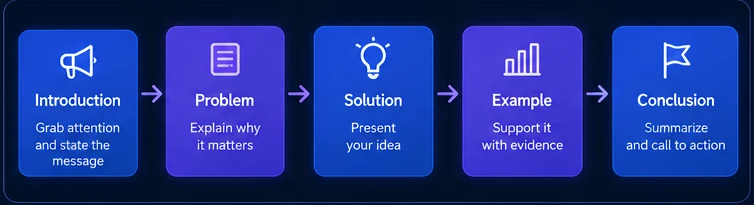
Read the script for its argument, then reduce it to a short outline. Divide it into sections, or beats, with a clear job: introduce the problem, explain why it matters, offer a solution, support it with an example, and ask the audience to act. This is an example structure, not a required number or order of sections.
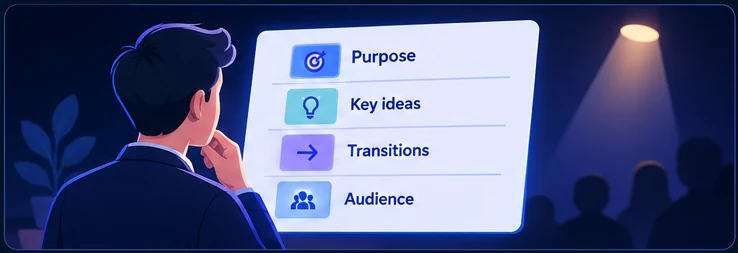
For each section, write its purpose, the key ideas you must cover, and the link to the next part. Leave supporting sentences in the script rather than copying them into the outline.
Purpose
What does this section help the audience understand?
Key ideas
Which claims, facts or examples must you include?
Transition
Why does the next section follow from this one?
Give each section a distinctive verbal anchor, such as “the hidden cost” or “the proposed change.” Some speakers find a simple visual cue useful for distinguishing one section from the next. Treat that as an optional mnemonic; choose cues that make sense to you.
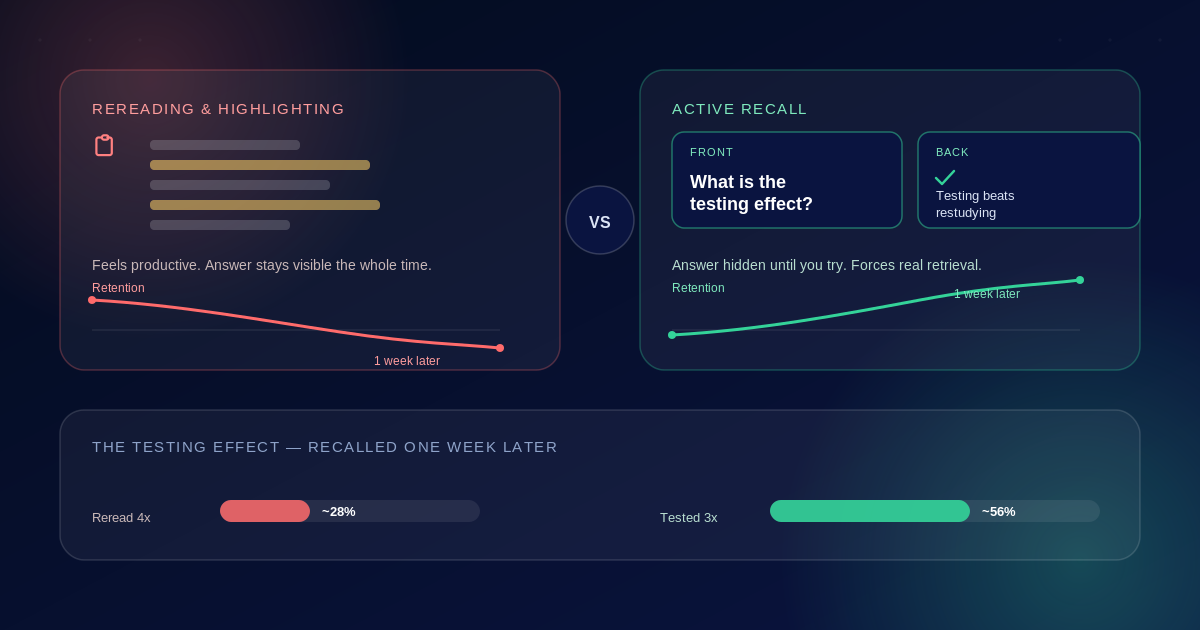
Rereading a script can make it feel familiar, but familiarity is not the same as being able to produce the next idea without looking. Rehearsal from cues tests whether the speech is actually accessible from memory.
- Look at a section anchor, then put the script aside.
- Explain the section aloud, including its essential ideas and example.
- Say the transition and begin the next section.
- Check the script for omissions, factual mistakes or wording that needs to be exact.
- Try the weak connection again, then return to it in a later session.
Checking the correct wording or idea after an unsuccessful attempt helps correct the error before the next rehearsal. Do not mark a section as successful just because you recognized the answer after looking.
Retrieval practice has research support for later retention of studied material. Using it for section anchors is a practical application of that principle, not a speech-specific protocol established by those studies.
Start with a small set of prompts covering the main sections and transitions. Put a clear cue on the front and concise anchor ideas on the back. Speak before turning the card over. Reserve full sentences for passages where exact wording matters.
- Section → key ideas: explain what that part contributes.
- Previous section → next transition: connect the ideas aloud.
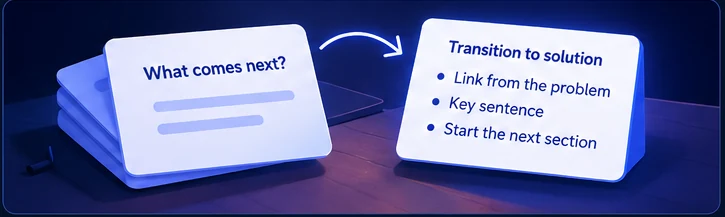
- Anchor phrase → what comes next? start from a point inside the speech.
- Slide or visual → point to explain: state the message behind the visual.
- Opening cue → opening line or idea: practice entering the speech.
- Final section → conclusion: state the takeaway and call to action.
In Repetit, you can keep these cues in a collection for the particular presentation and use spaced reviews to return to them. Say your response aloud before revealing the answer. Card reviews support preparation; full spoken rehearsals are still needed to practice delivery.
Here is how cues could support a proposal to extend a library’s evening hours. The answers give anchors rather than paragraphs to recite.
| Part | Cue | Answer anchors |
|---|---|---|
| Opening | What is the opening idea and first sentence? | Access after work. “A library cannot serve everyone if its doors close before they can arrive.” |
| Main section | What is the purpose of the section about access? | Explain the barrier: work schedules; evening study needs; current closing time. Check actual local details before using them. |
| Transition | How do I move from the problem to the proposed solution? | “If opening hours are the barrier, we can begin by testing a change to those hours.” Then introduce the pilot proposal. |
| Story or example | Which example supports the need for evening access? | A clearly hypothetical resident who finishes work after closing and needs a quiet place to study. |
| Closing | What final idea and call to action should the audience leave with? | Access should fit community needs; ask the committee to consider an evening-hours pilot and evaluate its use. |
When a cue appears, develop the idea in spoken language. A correct card answer alone does not show that you can deliver the whole presentation with its transitions and timing.
To remember speech transitions, rehearse both sides of each boundary: finish the current point, explain the connection, and start the next point. A transition might answer a question raised by the previous section or move from a claim to its example.
A gap to notice
You can explain each section when shown its title, but stop when trying to move between them.
A targeted repair
Use the end of the previous section as the cue. Say the linking sentence and continue into the next idea before checking your outline.
If every rehearsal always starts from the beginning, later sections get fewer independent starts. Practice beginning from several major anchors so you can recover if you lose your place. Choose a section from the middle, explain its purpose, and continue from there.
During rehearsal, if you go blank, pause and look for the next main idea. Check a cue if needed, then practice that connection again. If notes are allowed at the event, prepare a compact outline you can read at a glance. Include essential names, figures or quotations that must be accurate.
Decide which words in the opening and closing need to stay fixed. Rehearse the opening aloud from its cue, then continue into the first main point. Practice the final section through to the closing line so the conclusion belongs to the argument.
For a call to action, be clear about what you want the audience to do. Check that your closing expresses that request and the main takeaway. If the wording changes between rehearsals, judge whether the meaning remains intact.
Distribute preparation across separate sessions when time allows. Research on distributed practice generally supports long-term retention compared with massed practice, but it does not establish one ideal speech-rehearsal timetable. Useful gaps depend on how long you need to retain the material and how well you can recall it.
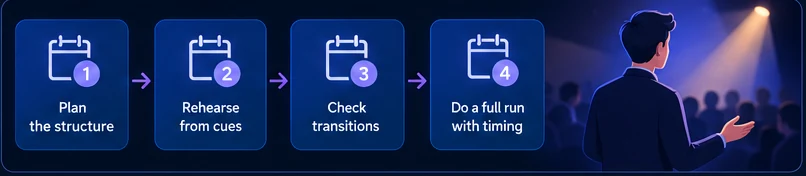
As a practical example, use an early session to map and recall the sections, a later session to check transitions without the script, and a session closer to delivery for a full run. Adapt this sequence to your deadline. Revisit a weak connection sooner; check a reliable section again after a longer gap. This is an example workflow, not a scientifically optimal schedule.
Rehearse under conditions reasonably similar to the real presentation, and include full runs with realistic timing and any slides or equipment you will actually use. Speak aloud, stand or sit as you expect to at the event, and check whether the speech fits the available time.
After a run, note where you lost the thread, omitted an essential point or needed to look down. Repair those passages, then include them in another full run. A recording or a listener can help you notice unclear explanations and transitions. Keep room for pauses instead of rushing to reproduce the script.
- Can I state the purpose of each section without looking?
- Can I move from one section to the next from memory?
- Can I start from the middle if I lose my place?
- Can I explain each key idea naturally rather than reciting it mechanically?
- Have I rehearsed the whole speech aloud with realistic timing?
- Have I practiced again after a meaningful delay?
- Do I know the opening and closing well enough for the real presentation?
Use the answers to choose the next rehearsal task. If section recall is good but the flow breaks down, work on transitions. If the parts work separately, test the complete speech.
These studies concern learning and memory tasks, not trials of this speech-preparation method. They support the general principles of retrieval and distributed practice. The advice about outlines, transitions and full spoken runs is a practical application to preparing a speech.
Understand your purpose, map the structure, and give each section an anchor. Retrieve the ideas aloud, practice the transitions, and learn any opening or closing wording that needs precision. Return across spaced sessions and complete full runs under realistic conditions. Use cue cards to prompt the speech while you practice explaining the message naturally.
Should I memorize a speech word for word?
Usually, you can learn the structure, key ideas and transitions while allowing the wording to vary. Practice exact wording where it matters, such as a quotation, an opening line or a closing call to action.
What is the easiest way to memorize a speech?
Start by understanding the message and dividing it into meaningful sections. Give each section a short anchor, recall its key ideas aloud, and connect it to the next section. Return to the speech across separate practice sessions.
How can I remember the next part of a speech?
Practice the link between sections. Use a cue that asks how the current idea leads to the next one, then say the transition and begin the next section aloud. Keep a brief outline available if your presentation allows it.
How should I practice a speech without reading the script?
Look at a section cue, put the script aside, and explain the ideas aloud. Check for missing points afterward. Gradually use fewer cues, practice starts from different sections, and complete full spoken rehearsals.
Can flashcards help me memorize a speech?
Flashcards can cue section purposes, key ideas, transitions, and opening or closing lines. Answer aloud before checking the back. Use them alongside full rehearsals so that you also practice the flow and timing of the speech.
What should I do if I forget part of my speech during rehearsal?
Pause and try to recall the next main idea. If needed, check a short cue or the script, then practice the connection again. Start from that section independently and include it in a later full rehearsal.


Build cues for your next speech
Use Repetit to revisit section anchors and transitions between full spoken rehearsals.