

An open-book exam lets you consult specified materials while answering questions. It may take place in an exam room or online. The format does not tell you which resources are allowed or how much time you have: those details come from the exam instructions.
You still need to understand the subject. A reference can supply a definition or equation; you must decide whether it fits the question, use it correctly, and explain your reasoning. UNSW’s open-book exam guidance stresses applying information rather than simply reproducing it.
Prepare three things together: your understanding of the course, a usable set of permitted references, and experience answering representative questions. The reference system below is a practical study approach, not a scientifically validated formula for exam success.
Read the official assessment brief, course learning platform, and exam regulations before making your materials. Ask the instructor or exam office to clarify anything ambiguous; keep their written answer with your preparation notes.
- Books and paper: Which titles or editions? Are handwritten notes, printed summaries, loose sheets, tabs, and annotations allowed? Is there a page or size limit?
- Digital resources: Are local PDFs, search functions, e-books, or particular applications allowed? Must files be available offline?
- Tools and assistance: Check calculator models, internet access, AI tools, messaging, and collaboration separately. Use these only when explicitly permitted, and only within the stated scope.
- Timing and submission: Confirm the exam duration, availability window, question choices, required answer format, and any upload deadline. Check how approved accessibility arrangements apply.
- Attribution: Find out how quotations, diagrams, and source references must be acknowledged.
Oxford’s online exam guidance warns students to distinguish their own notes from material taken from other sources. Label quotations and record source details while preparing; follow your own institution’s referencing requirements.
Open-book does not mean unrestricted access. Permission to use a textbook does not establish permission to browse the web, consult an AI tool, or work with another person.
The University of Melbourne recommends organizing materials around key concepts and linking summaries to source pages. Start with the syllabus and learning outcomes, then group your existing notes under the topics you are expected to use.
- Definitions: give the meaning, a useful contrast, and the source location.
- Processes and arguments: show the sequence or reasoning, with links to supporting evidence and exceptions.
- Formulas: include variable meanings, units, assumptions, and the conditions under which the formula applies.
- Examples: label the kind of problem each example solves and why that approach was chosen.
Use the same topic names across your index, notes, and tabs. For digital files, distinguish printed page numbers from PDF viewer numbers where they differ. If search is permitted, test that the files are searchable and that your likely search terms find the intended passage.
Avoid shrinking an entire course into unreadable text. Keep a short route to the detailed source instead. Remove duplicate explanations only after checking that you have retained any different assumptions or exceptions.
Give each reference a job: a compact index points to topics; topic notes explain relationships; the textbook supplies detail. Add tabs or digital bookmarks only if allowed. Test the system by using it to answer a question, rather than judging it by how tidy it looks.
A biology example: from topic list to answer
Suppose a biology exam permits a textbook and the student’s own paper notes, including an index. The assessed topics include membrane transport, enzymes, and cell respiration. The page numbers below are invented to illustrate the layout; replace them with locations in your own edition.
| Topic / search cue | Source location | Linked note and example |
|---|---|---|
| Membrane transport / gradients | Textbook pp. 42–49; notes p. 2 | Diffusion vs active transport; concentration-gradient diagram |
| Enzymes / inhibition | Textbook pp. 78–83; notes p. 4 | Competitive inhibition; substrate-concentration question |
| Cell respiration / ATP | Textbook pp. 110–119; notes p. 7 | Stage map; locations and inputs/outputs |
On the enzyme note, link the definition of competitive inhibition to an active-site diagram, the effect of substrate concentration, and a worked interpretation of a reaction-rate graph. Mark the assumptions: the introductory model concerns reversible competitive inhibition, with other conditions held constant.
Practice question: “A reversible competitive inhibitor reduces an enzyme’s reaction rate. Would increasing substrate concentration reduce its effect? Explain using the model taught in the course.”
Use the index: select “Enzymes / inhibition,” open notes p. 4, and locate the competition diagram. Consult the indexed textbook passage only if the explanation needs checking, rather than rereading the chapter from the beginning.
Build the answer: in this model, substrate and inhibitor compete for the active site. Increasing substrate concentration can reduce the inhibitor’s effect; at sufficiently high substrate concentration, the same maximum rate can be approached. Explain that mechanism instead of merely copying a definition, and check the response against your course’s model answer.
Repair the system: record where the search stalled. If the index says only “Chapter 5,” replace that label with the specific topic and page. If you found the definition but could not answer, add the missing relationship to the note and practise a different question. A lookup problem and an understanding problem need different fixes.
Use instructor-provided sample questions or past papers where available. Check their relevance to the current syllabus and format. Include questions that ask you to interpret evidence, select a method, compare explanations, or apply a principle to an unfamiliar case.
- Reproduce the conditions. Use only the resources and tools permitted for the exam. For a full rehearsal, follow its official duration and submission process, including any approved adjustments.
- Plan before searching. Identify what the question asks and what evidence or calculation you need. Allocate time according to the exam instructions and mark weighting, leaving room for checking and submission.
- Complete an answer. Write the reasoning, calculations, or argument in the expected format. Finding the relevant passage is only part of the task.
- Review the attempt. Compare with the marking criteria or an authoritative solution. Separate content errors, unsuitable methods, navigation delays, and incomplete answers.
- Revise and retest. Fix the specific weakness, then attempt another relevant problem. Avoid relying only on a question whose solution you now remember.
For a shorter session, an illustrative option is a 20-minute block containing a question and a review. That is a planning example, not a research-based time prescription. Adjust it to the actual question demands.
Melbourne’s exam preparation advice includes timed practice with notes. During rehearsal, note which lookups are useful and which become prolonged searches. If you get stuck in the real exam, follow the question-navigation rules and return later where the format allows.
Use active recall to check essential terms and relationships you need to reason with. Try explaining a concept before consulting the source, then check and correct the explanation. This is a preparation exercise; during an open-book rehearsal, practise using the allowed materials as well.
Flashcards can ask “When would this formula apply?”, “What distinguishes these processes?”, or “Which assumption fails here?” Keep full calculations, essays, and data-analysis questions in your main practice sessions. A correct card answer does not show that you can complete a whole exam problem.
Roediger and Karpicke (2006) found better delayed retention after testing than restudying prose passages, while restudying performed better on the immediate test. An immediate repeat can check a correction, but it is limited evidence of lasting retention.
Butler (2010) found benefits for new inference questions under the study’s conditions. That supports a possible role for retrieval in transfer, without guaranteeing success on every new task or open-book exam.
Spread study across sessions when possible. Dunlosky and colleagues (2013) rated practice testing and distributed practice highly in their review. There is no single optimal spacing schedule for every learner, subject, or deadline. Adjust review to your difficulties and exam date; do not let card reviews displace realistic problem solving.
- Expecting to learn the course during the exam. Study the concepts beforehand and use references for specific details.
- Bringing an unfiltered archive. Select the permitted sources you can navigate, and give each a clear place in your index.
- Preparing answers to predicted questions only. Practise choosing and adapting methods when the wording, evidence, or conditions change.
- Copying passages instead of answering. Address the question in your own reasoning and acknowledge sources as required.
- Polishing notes without testing them. Use a timed question to reveal missing links and confusing labels.
- Assuming digital access means permission. Verify each tool and resource against the written rules.
- I have confirmed the permitted resources, tools, and attribution rules.
- My index leads to the correct pages in the edition or files I will use.
- My notes connect definitions, methods, assumptions, and examples.
- I have completed representative questions with the permitted resources and time limit.
- I have addressed the content gaps and search delays revealed by practice.
- I know the exam start time, duration, submission procedure, and support route.
For an online exam, rehearse the required file format and upload process if a practice environment is available. For an in-person exam, pack the permitted materials and check that annotations and inserts comply with the rules.
The university pages offer practical guidance, not experimental proof that a particular note layout improves scores. The research below informs the supporting memory techniques; it does not validate this entire preparation system.
Do you need to study for an open-book exam?
Yes. You need to understand the course concepts and practise applying them. Access to sources does not replace reasoning, and searching unfamiliar material uses exam time.
What materials can you use in an open-book exam?
Only the materials and tools explicitly allowed by your exam instructions. Check the rules for books, notes, annotations, digital files, calculators, internet access, AI tools, and collaboration.
How should you organize notes for an open-book exam?
Group notes by topic, use clear headings, and build a compact index linking concepts to source pages and worked examples. Keep definitions, conditions, and exceptions easy to find.
How do you practice for a timed open-book exam?
Answer exam-style questions with only the permitted resources and the official time limit. Review answer quality and time spent searching, then revise the notes that caused delays.
Can flashcards help with open-book exams?
Yes. Use them for essential terms, distinctions, and choosing when to apply a principle. Keep them supplementary to full exam-style problems, and use them during the exam only if permitted.

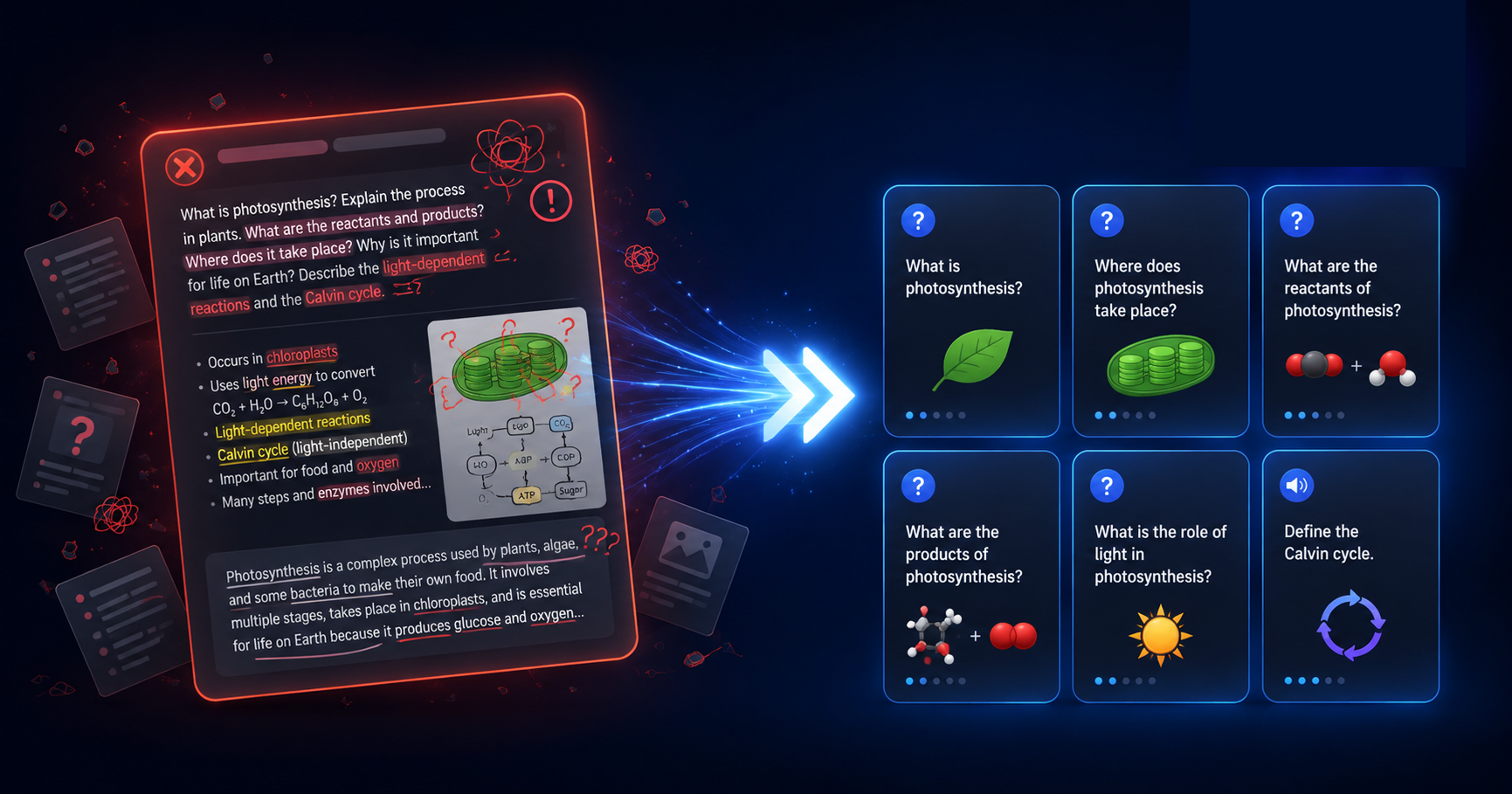

Review the concepts your practice questions reveal
Use focused flashcards for terms and distinctions that need more work, alongside your exam-style practice.