
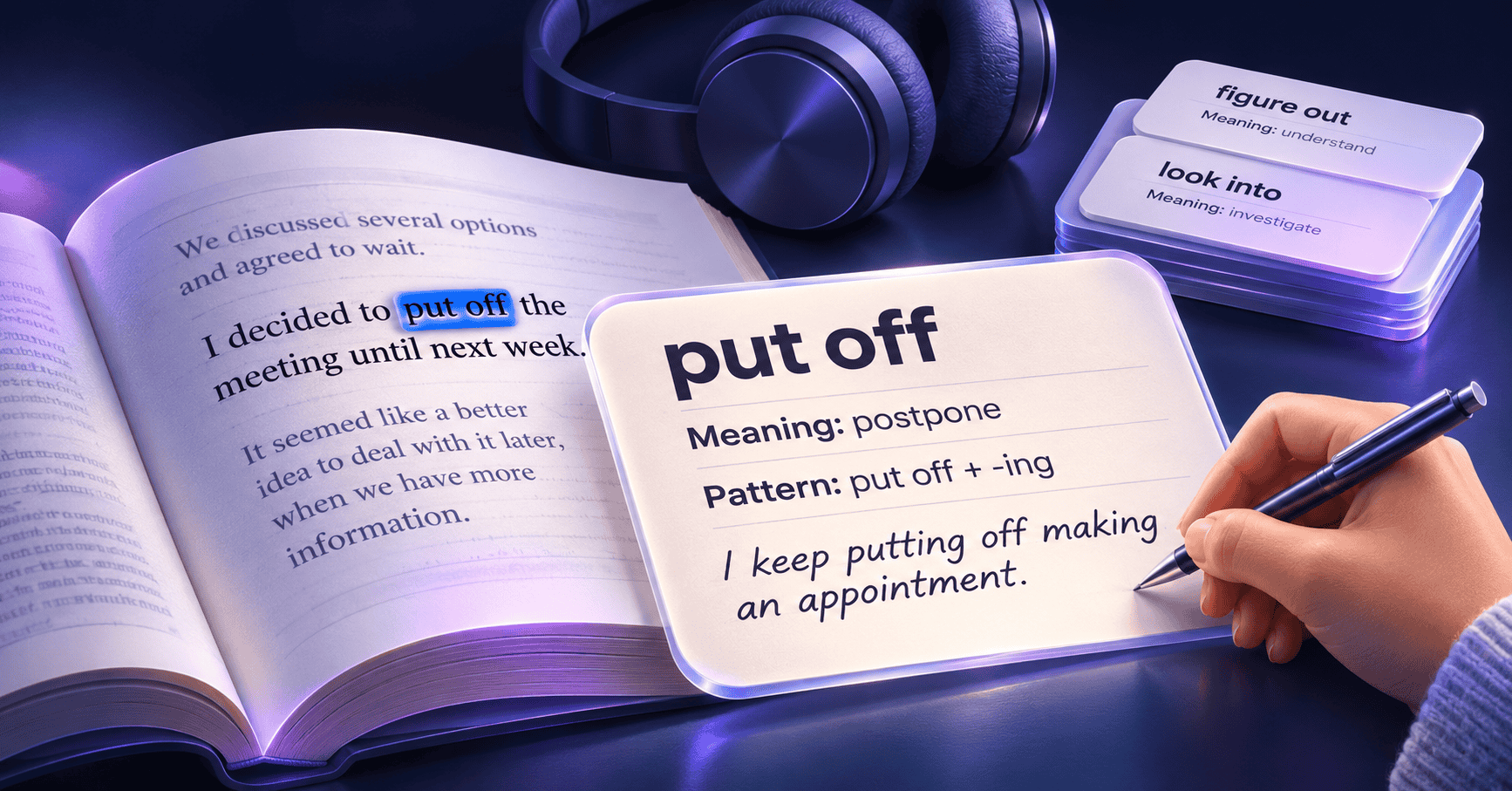
A personal vocabulary list is a collection of words and expressions you choose from language you actually encounter. It might begin with a phrase in a novel, an unfamiliar verb in a podcast, or a useful expression from a conversation.
Real content gives you a reason to learn an item and an example of how someone uses it. But saving a sentence is only the beginning. This guide shows you how to select useful vocabulary, check its meaning, build focused flashcards, and keep the collection manageable.
An isolated entry such as put off = postpone leaves important questions unanswered: What can you put off? Which verb form follows it? What did it mean in the sentence you heard?
A useful entry preserves the expression, the intended meaning, and a short example: “We put off booking the tickets until Friday.” Here, the phrase means delaying an activity. The pattern put off + -ing helps you build another sentence.
Context helps identify a meaning; it does not guarantee that you will remember it. Recognizing put off while reading also differs from retrieving it when explaining a delayed plan. Decide whether an entry is mainly for comprehension or for speaking and writing. Some words only need to be recognizable for your current goals.
When you learn words from reading or listening, ask what each candidate would help you understand or say. Give priority to:
- Current goals: expressions for a job interview, a course, or a trip you are preparing for.
- Repeated encounters: a word that keeps appearing across your reading or listening. Recurrence in your materials is a useful signal, although it does not establish general language frequency.
- Communication value: a phrase such as “Could you clarify…?” that fills a gap in what you can say.
- Current interests: vocabulary from the cooking videos, technical articles, or sports interviews you regularly follow.
- Uncertain meaning: an expression you cannot reliably infer, especially when misunderstanding it changes the message.
Collect useful combinations such as meet a deadline, not just deadline. An unfamiliar historical object mentioned once in a novel may need a quick lookup rather than a flashcard. Let the story continue instead of stopping for every unknown word.
Books and articles
Copy the short sentence containing the target and save the title, page, or URL. If it refers to a proposal in the previous paragraph, add “it = the proposal.” Highlight the target without losing the sentence around it.
Films and television
Save a line, episode, and timestamp. Note who is speaking and whether the exchange is casual, sarcastic, or formal. Check unclear wording against the audio; subtitles may paraphrase it.
Podcasts and interviews
Bookmark the timestamp and replay the sentence. Compare a transcript with what you hear before copying it. Keep a short audio reference when available so you can revisit pronunciation and rhythm.
Conversations
Jot down the expression soon afterward and note the situation, such as “colleague asking to reschedule.” If you cannot remember the wording exactly, label it a reconstruction and verify it before making a card.
Use a temporary inbox while enjoying the content. Later, choose which items deserve full entries. A bookmark is enough for a candidate; it does not commit you to reviewing it forever.
Check a reliable learner’s dictionary for the meaning that fits your sentence. A translation can be helpful, but compare examples, part of speech, grammatical patterns, and common word combinations. For words you want to say, listen to dictionary audio and note stress. Check labels such as informal, formal, or regional usage before copying an expression into a different setting.
Worked entry: put off
- Target: put off, in the sense “postpone.”
- Context: “We put off booking the tickets until Friday.” This is an invented travel-planning example, not a quotation from a published source.
- Meaning here: delay booking until a later time.
- Pattern: put off + noun or -ing form: put off the trip; put off booking. With a pronoun object, use put it off.
- Personal example: “I keep putting off making an appointment.”
- Usage note: useful in everyday planning; postpone is an alternative when a more formal verb suits the situation.
- Reference: Cambridge Dictionary: put off. For an actual encounter, add its title and page or timestamp.
Keep the entry focused on this meaning. In “The smell put me off my food,” the phrase has a different sense. Add a separate meaning and context if that use becomes relevant; do not assume one translation covers them all. If your personal sentence feels uncertain, check dictionary examples or ask a teacher for feedback before treating it as a model.
Choose prompts according to what you need to do with an item. You do not need all five card types for every entry. Keep the answer hidden until you have tried, then check both meaning and form.
Recognition
Front: What does put off mean in “We put off booking the tickets until Friday”?
Back: Postpone or delay. This checks understanding with the expression visible.
Active production
Front: Tell a friend you keep delaying an appointment. Use the two-word verb beginning with put.
Back: “I keep putting off making an appointment.” Other natural sentences can be correct. This checks retrieval and sentence building with a limited cue.
Sentence completion
Front: Use put off in the right form: “Yesterday we ___ booking the tickets.”
Back: “put off.” This checks the form in a sentence; it does not test whether you can retrieve the expression without being given it.
Meaning in context
Front: “The smell put me off my food.” Does this mean postponing a meal or losing the desire to eat?
Back: Losing the desire to eat. This checks a different sense. Add this card only after checking and recording that sense.
Collocation and grammar
Front: Which is natural: “put off booking” or “put off to book”?
Back: “put off booking.” This checks the following verb pattern, not full command of the expression.
A completion prompt without enough context may have several valid answers. Specify the intended expression or accept natural alternatives rather than marking a good sentence wrong. Successful card answers show what you can do under those cues; they do not automatically establish fluent conversational use.
Spaced practice means revisiting vocabulary across separate sessions. Retrieval means trying to recall a meaning or expression before revealing the answer. Research supports benefits for memory under studied conditions, but neither principle guarantees permanent retention or a single best schedule for everyone.
A suggested starting routine: choose a few entries after reading or listening, review them the next day, return a few days later, and check again about a week later. Spend roughly five to ten minutes if that fits your day. These intervals and quantities are practical suggestions, not scientifically established requirements.
Extend intervals when recall remains reliable. Bring difficult items back sooner, inspect the missing meaning or pattern, and simplify ambiguous prompts. If you cannot answer, reveal and study the correction; repeated guessing is not the goal. A failed attempt does not by itself guarantee learning.
- Review: keep useful, uncertain items in your active set, with more production practice for vocabulary you need to say.
- Revise: fix vague cues, inaccurate examples, and repeated grammar errors. Merge duplicates that test the same expression and sense.
- Archive: move consistently easy items out of frequent review, retaining their context for occasional checks or future reference.
- Remove: delete irrelevant candidates and low-value duplicates. Keeping every saved word is not a learning goal.
Pause additions when due reviews take more time than you can sustain. Preserve time for new reading, listening, and conversation instead of allowing your list to replace them.
Choose one or two active expressions for a short journal entry, voice message, or conversation about something real. For put off, explain a plan you delayed and why. Ask a teacher or language partner whether the phrasing fits the situation, rather than checking only whether the target appeared.
When reading, notice the expression in a new sentence and work out its meaning before consulting your entry. When listening, replay a short passage and check whether you recognize the phrase in speech without the transcript. Say the phrase in your own sentence after listening to a pronunciation model.
Remembering a form and meaning is one goal; choosing it appropriately while speaking or writing is another. If you recognize an item but cannot use it yet, keep it as comprehension vocabulary or add targeted production practice if your goals require it.
- Saving too many words: select the most useful items from your inbox and leave the rest as bookmarks.
- Recording only translations: restore the source sentence and identify which sense the translation describes.
- Ignoring combinations and register: add a useful phrase or verb pattern and any relevant usage label.
- Keeping duplicates: search before adding; attach a new encounter to an existing entry unless it introduces a distinct sense or pattern.
- Rereading instead of recalling: hide the answer and attempt the specific task before checking.
- Treating one meaning as the whole word: record additional relevant senses separately, with their own examples.
- Never checking your own use: compare a personal sentence with reliable examples or request feedback on grammar, collocations, and tone.
Occasionally sample a few entries without reviewing them immediately beforehand. Ask whether you can:
- Recognize the expression and recall its intended meaning after a delay.
- Interpret it correctly in a different passage or recording.
- Produce an appropriate personal example if active use is your goal.
- Use its usual word combinations, grammar, and register accurately.
- Maintain reviews while still making time for real content.
These are practical self-checks, not validated diagnostic instruments. Note the specific gap—such as “understands in print, misses in audio”—and adjust that entry. A growing card count alone does not show that your usable vocabulary is growing.
- Choose a word or expression relevant to your goals.
- Save the sentence, source, and context needed to interpret it.
- Verify the sense, grammar, collocations, and relevant usage notes.
- Add a checked personal example and pronunciation reference if useful.
- Make a focused prompt for recognition or production.
- Attempt recall before checking; revisit in later sessions.
- Try the expression in new content or your own communication.
- Revise, merge, archive, or remove entries as needs change.
These sources inform the guide’s background on vocabulary knowledge and memory. The entry template, selection rules, and example routine are practical editorial recommendations; these papers did not test this complete workflow.
How do I choose words for a personal vocabulary list?
Prioritize words and expressions that recur, matter to your goals, block understanding, or help you say something useful. Skip items you are unlikely to need soon.
Should I save individual words or complete sentences?
Save the target word or expression together with a short original sentence and enough context to identify its meaning. Make a focused prompt from that entry rather than memorizing every sentence.
How many new words should I add each day?
There is no universal scientifically established daily number for every learner. Start with a few useful items and reduce or pause additions if reviews crowd out reading, listening, or conversation.
Can flashcards help me remember vocabulary?
Flashcards can provide opportunities to retrieve meanings, forms, and word combinations. Attempt an answer before checking it, and combine reviews with real language use; card success alone does not establish conversational fluency.
How often should I review new vocabulary?
As a starting point, try a review the next day, a few days later, and about a week later. Adjust intervals to your recall, goals, and time. This is a suggested routine, not a universally optimal schedule.
How do I know whether I have learned a word?
Check whether you recognize it after a delay, understand it in a new context, and, if you need it for speaking or writing, use it with appropriate grammar, collocations, and register. Knowing one meaning does not mean knowing every use.



Put your vocabulary list into practice
Choose a useful expression from today’s reading or listening, save its context, and create a focused flashcard in Repetit.