
Why Flashcards Don't Work (And How to Fix It)
You review every day, and half the deck still feels like it never sinks in. Before you blame your memory, run it through four questions — because "flashcards don't work" almost always traces back to one of four fixable problems.
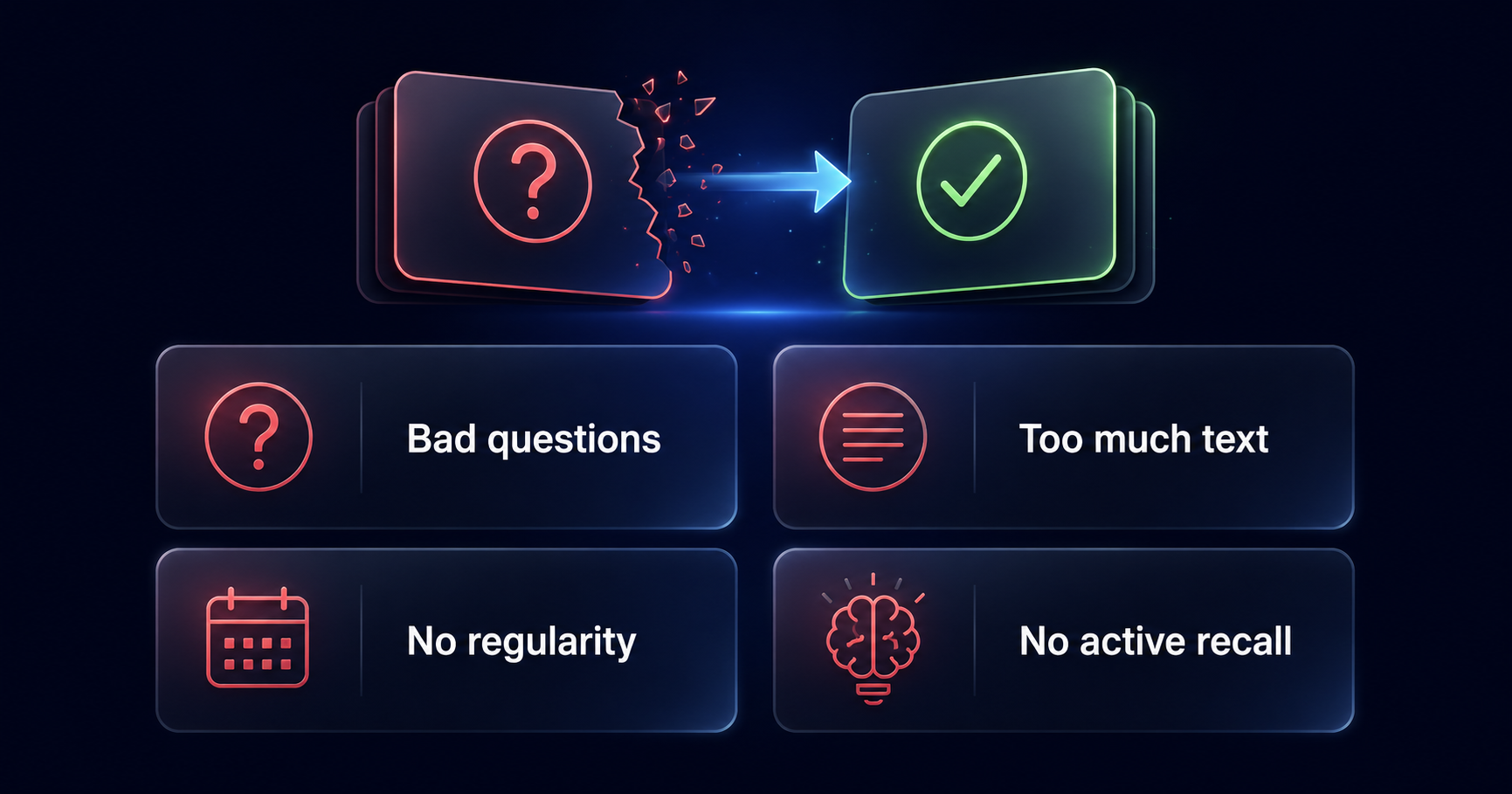
"Spaced repetition doesn't work for me" is one of the most common things people say after a few frustrating weeks of reviewing — and it's almost never true. The scheduling math behind spaced repetition is well tested and doesn't quietly stop working for some people. What actually happens is much narrower and much more fixable: one of four specific things is broken, and it isn't your memory.
Every "it's not working" complaint we've seen traces back to one of the same four root causes: the questions themselves are bad, there's too much text to process, reviews aren't happening on a regular schedule, or the review isn't actually active recall — it just feels like it is. Fix the one that applies to you, and the feeling of "this isn't working" tends to disappear within a week or two.
This article is a diagnosis, not a checklist — four causes, not ten rules. If you want the longer, exhaustive version with more bad-vs-good card examples, see 10 flashcard mistakes that kill your retention. Start here if you just want to know what's actually wrong before you go rewrite anything.
The four reasons flashcards stop working
Bad questions
You stare at the front of the card and genuinely can't tell what it's asking — or you could defend three different "right" answers.
The question is vague ("Explain X"), bundles more than one fact together, or leaks the answer through its own wording.
Rewrite it as one closed question with exactly one correct answer. If you can't grade it right/wrong in under a second, it isn't a flashcard yet — see the minimum information principle.
Too much text
Review sessions feel slow and draining, even when the material itself isn't especially hard.
The front — or the back — is a paragraph, not a prompt. Your brain spends its effort parsing the question instead of retrieving the answer.
Trim the front to under ~15 words. Anything you're tempted to add for context belongs in a separate note field, not the question itself.
No regularity
Some days you do 150 reviews, some weeks you do zero — and the same handful of cards keeps coming back "forgotten."
Spaced repetition depends on reviews landing close to their scheduled date. Skip enough days and cards you'd have nailed on day 3 get attempted — and failed — on day 11.
Attach reviews to an existing daily habit — coffee, commute, before bed — instead of "whenever I have time." See our review schedule guide for a 15-minute setup.
No active recall
You "know" the material while looking at the deck — then blank the moment the answer is actually hidden.
Re-reading, highlighting, and skimming the back of the card all produce a feeling of familiarity that has nothing to do with being able to retrieve the answer unprompted.
Cover the answer, commit to a real guess before you flip the card, and rate honestly — "I sort of knew it" still counts as a fail. See why active recall works.
Which of these sounds like you right now?
"I can't tell what half my cards are even asking." That's bad questions — see cause 1 above and the minimum information principle.
"Reviewing feels exhausting, not quick." That's too much text — see cause 2 and aim for under 15 words per front.
"I skip days, then binge, then feel behind." That's no regularity — see cause 3 and the review schedule guide.
"I feel like I know it, then blank when tested." That's no active recall — see cause 4 and why active recall works.
The numbers behind each cause
Of new information is typically lost within 24 hours without any active retrieval — this is why passive review feels fine and performs badly.
Roughly how many more times a vague or multi-fact card gets marked "forgotten" and re-reviewed compared to a clean, single-fact card.
Typical daily review time once cards are clean and reviews happen on schedule — no marathon sessions required.
What fixing all four looks like on one real card
Back: "Rising warm air cools with altitude."
"Not working" is a symptom. It always has one of these four causes.
None of these four causes are about intelligence, effort, or having "a bad memory." They're about card design and daily habits — both of which are fixable in the time it takes to read this article. Most people who feel like spaced repetition "just doesn't work for them" have never actually tested spaced repetition with clean cards on a regular schedule.
Two of these causes — bad questions and too much text — are one-time edits: rewrite the card once and it's fixed for good. The other two — no regularity and no active recall — are habits, not edits. No amount of rewording fixes "I don't review consistently" or "I'm skimming instead of guessing." Those need a system, which is exactly what a review schedule and honest active recall are for.
Pick your 10 most-failed cards this week, match each one against the four causes above, and fix what you find. That alone resolves most of what makes flashcards feel broken.
FAQ: why flashcards don't work
I review every day and still forget cards — what's wrong?
Reviewing daily rules out the regularity problem, so look at the cards themselves first: are they testing one clear fact each, and are you covering the answer and forcing a real guess before flipping? A daily habit with weak cards or passive review still feels like it "isn't working."
Is spaced repetition broken, or is it just my cards?
In the overwhelming majority of cases, it's the cards or the habit around them, not the method. Spaced repetition is a scheduling algorithm — it can only work with what you feed it. Vague questions, dense text, skipped days, or passive re-reading all break the input, not the algorithm.
How do I know if a card is testing active recall or just recognition?
Cover the answer and commit to a specific guess — out loud or written — before you look. If you catch yourself thinking "I'd recognize it if I saw it" instead of producing an answer, that's recognition, not recall, and the card isn't testing what you think it's testing.
What's the fastest thing to fix first?
Regularity, because it's free and takes zero rewriting — just attach reviews to an existing daily habit. Fixing card wording matters too, but it only pays off once reviews are actually happening on a consistent schedule.
Do I need to rebuild my whole deck?
No. Start with the cards you fail most often — they're where one of these four problems is usually hiding. Most decks only need 10–20% of their cards rewritten to feel dramatically better.
How long before I notice a difference after fixing these four things?
Often within a week. Fixing regularity shows up almost immediately since it changes how many cards are overdue. Fixing card wording shows up the next time a rewritten card comes due — usually within a few days on a normal schedule.