

You can understand something today and struggle to remember it next week. Returning to it helps—but finding time for another long study session is not always easy. Mobile flashcards give you a smaller way to revisit what you have learned: open a question on your phone, try to answer, and check yourself.
The aim is a few useful reviews, not more screen time. This guide shows you what a flashcard looks like, how to make a short session worthwhile, and how Repetit handles the review schedule. You will also learn how to keep the routine manageable when life gets busy.
A flashcard has a question on the front and an answer on the back. On your phone, you read the front, try to remember the answer, and then reveal the back to see how you did.
A flashcard in its simplest form
Front: Which planet is known as the Red Planet?
Back: Mars.
Pausing to answer before looking is called active recall. You are finding out what you can bring to mind, rather than just reading something that looks familiar.
Returning to the card on later days is called spaced repetition. Instead of studying everything repeatedly in one sitting, you spread reviews over time. Repetit keeps track of when cards should return.
Why use a phone? Your cards are close at hand when a suitable break appears. The learning comes from answering and reviewing over time, not from the device itself. Research supports these methods, without guaranteeing that every answer will stick.
Choose cards on material you have already studied. Then give each question enough attention to make a real attempt—even if that means reviewing fewer cards.
Read, then pause
Say the answer, type it, or form it fully in your head. Wait to reveal the back until you have tried.
Reveal and compare
Check whether you gave the right answer and included the important details. Accurate wording of your own is usually fine; exact wording matters only when the task requires it.
Record what happened
In Repetit’s Active Review, choose Remembered if you recalled the answer, or Forgot if you did not. Read a missed answer carefully before moving on; the card will return through the review schedule.
One review in practice
From Today, you open Active Review and see “Which planet is known as the Red Planet?” You think “Mars,” reveal the back, and check that you were right. Choose Remembered; Repetit schedules the next review at the next interval. If you could not recall Mars, choose Forgot instead, and the card returns after one day.
If a question was confusing rather than simply forgotten, note it for editing later.
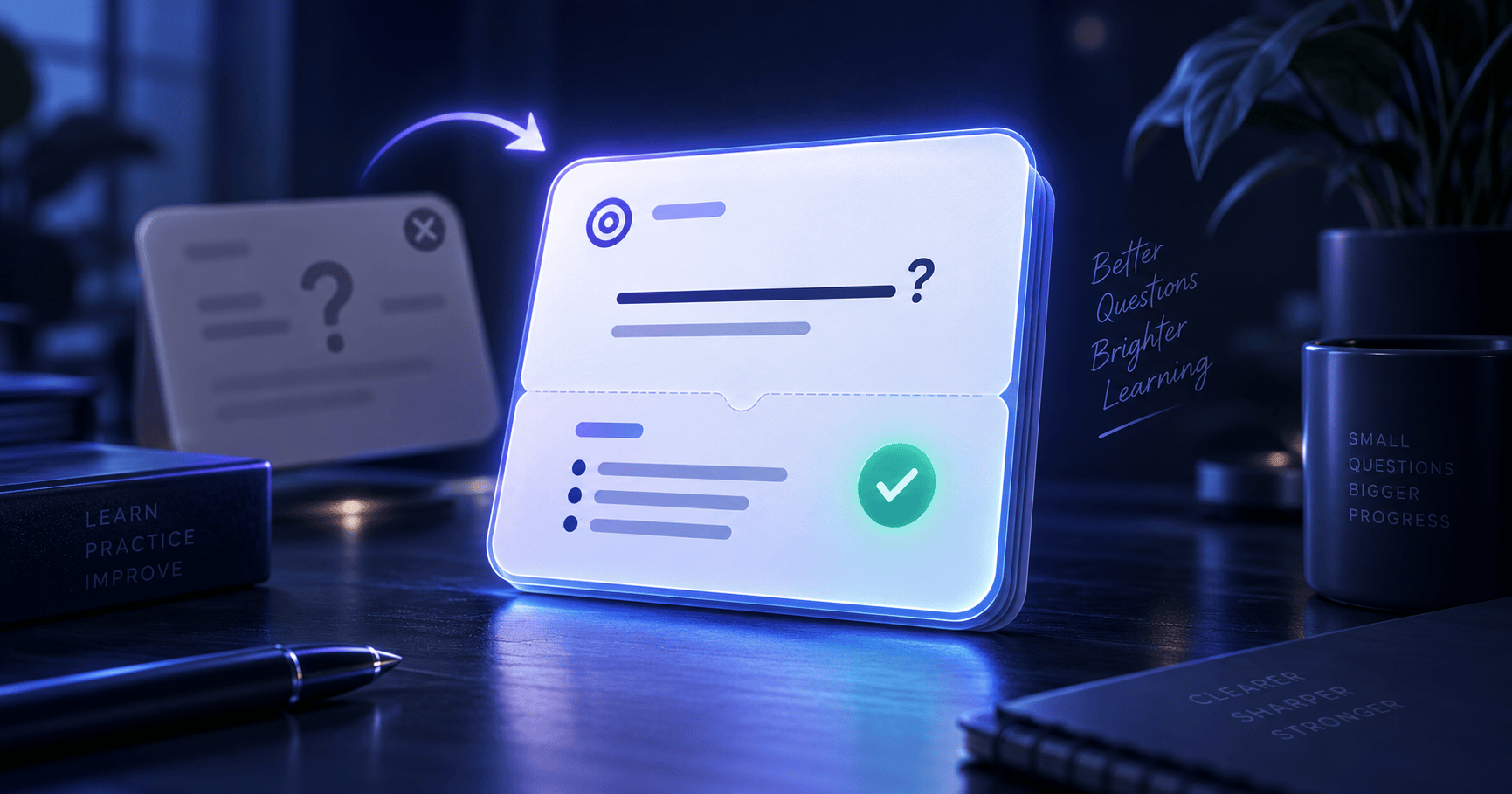
Keep each card focused on one clear question. That is especially helpful on a small screen, where a long prompt and several paragraphs of answers can turn a quick review into a reading task.
Weak: no clear task
“Summaries and quotations—do you understand the difference?”
A quick “yes” does not show what you know. The card never asks you to state the difference.
Better: explain the difference
“How does a summary differ from a quotation?”
Answer: A summary presents the main ideas in your own words; a quotation repeats the source’s exact words.
Both cards target the same distinction. This version gives you two specific points to check against your answer.
Short does not have to mean easy. A focused question can ask you to explain a reason, name a difference, or choose what to do in a situation. Include enough context that the expected answer is clear, but avoid clues that give it away.
Keep the back concise and accurate, using a trustworthy source. If an answer needs a long explanation, learn that explanation separately before testing its key points. For more examples, read how to write effective flashcard questions.
Repetit is a web app you can open in your phone’s browser. In Collections, group cards around something you are learning, such as a course topic, exam chapter, or set of work-related terms. Begin with a few cards so you can see whether they are clear before adding more.
Make it easy to return: bookmark Repetit in your phone’s browser so you can open it directly during a short break. Use that time for prepared cards; leave new topics and detailed card editing for a quiet session with your sources.
Open Today to find cards ready for review, then use Active Review to answer and check them. Your Remembered / Forgot choice determines what happens next.
Repetit’s review cycle
Days between reviews. The app keeps track of the dates for you.
Remembered: move to the next interval. After a successful review at the one-day interval, the next gap is three days.
Forgot: return to the beginning, with a one-day interval—even if the card had reached a longer gap.
Use Review Queue to see upcoming reviews and judge whether there is room for new cards. This cycle is a practical schedule, not a promise that every review arrives at the exact moment before forgetting. Open Repetit and see what is ready to review.
A routine is easier to return to when it has a place in your day. Choose a quiet break or the start of an existing study session, rather than waiting for a perfect stretch of free time. Use an event you recognize as your cue: “When my break starts, I’ll check Today.”
Start with a small set
Choose an amount you can answer carefully. A few cards can be enough to begin; there is no required number or ideal session length.
Give attention a boundary
Choose a stopping point before opening the deck. Stop sooner if you begin rushing or your surroundings need attention.
Quiet the interruptions
Use your phone’s Focus or Do Not Disturb settings if helpful, with exceptions for essential contacts. Leave other apps until afterward.
Review your notification settings so a short session is not repeatedly interrupted. If you use a phone reminder, attach it to a realistic opportunity instead of adding frequent alerts. Focus modes and reminders are phone tools, not special features claimed for Repetit.
Missed a session? Open Today when you return and work through a manageable set. You do not need to double your study time or finish every overdue card in one sitting.
Keep tomorrow’s workload in mind
Every new card adds future reviews. When the queue already fills your available time, pause additions. If a backlog keeps growing, remove duplicates or cards that no longer matter, and reduce how much new material you add.
With an irregular schedule, choose the first suitable break rather than a fixed clock time. If you are tired, walking, or following a conversation, wait. The point is to make review accessible, not to turn every spare moment into homework.
Research on everyday habits suggests that repeating an action in a consistent setting can help it become more automatic, with substantial variation between people. It does not give flashcard learners a fixed deadline. A useful routine can include missed days and adjustments.
Repetit’s progress tracking helps you follow your study activity and progress across collections. Those records show that you are practicing. To see what you have learned, look at what you can do with the material.
Signs the reviews are helping
You answer before revealing the back, still remember after a gap, and can explain an idea in your own words.
Occasionally test a few important items without opening their cards. If your goal involves using the information, try a new example or the real task too.
When a card keeps failing
Check the question before adding more repetition.
Clarify vague wording, split several questions apart, or revisit the lesson if you do not understand the answer. If everything feels rushed, reduce the workload.
Cards can support different goals without doing all the work. For an exam, keep solving full problems. For a procedure, practice the complete sequence. If you recall a definition but cannot use it, add that broader practice rather than assuming more card reviews will solve the problem.
Start with one small collection on a topic you have already studied. Create your first collection in Repetit, then use this checklist when a suitable review opportunity comes up:
- Choose a safe, quiet pause and a small amount of review.
- Open Today and attempt each answer before revealing it.
- Choose Remembered or Forgot based on what you actually recalled.
- Stop at your boundary and save unclear cards for later repair.
Can I use Repetit without installing a phone app?
Yes. Repetit is a web app you can open in your smartphone’s browser. You can organize cards in Collections and find current reviews in Today.
What if I remember only part of an answer?
Choose Forgot if an important part was missing. Different wording can count as Remembered when the meaning is accurate. If a card asks for so many things that rating it is difficult, split it into smaller questions.
How many cards should I start with?
Start with a few representative cards that you can review carefully. Use the first sessions to improve unclear questions before expanding the collection. There is no research-based starting number that suits everyone.
What should I do if my reviews take too long?
Pause new additions and review in smaller sets. Check for duplicates, crowded cards, and material you no longer need. Use Review Queue to see the upcoming workload before adding more.
Can flashcards help with more than facts?
Yes. A card can ask for a reason, a comparison, or a choice in a short situation. Use fuller tasks alongside cards when your goal requires problem-solving, explanation, or practical performance.
Does Repetit’s review cycle guarantee I will remember?
No. It organizes reviews across 1, 3, 7, 14, and 30-day intervals, but results also depend on understanding the material, writing clear questions, and answering honestly. The cited studies did not test Repetit’s specific cycle.


Turn what you learn into knowledge that lasts
Try the approach with one small collection in Repetit, then adjust the routine to fit your day.